Showing posts with label RTC 01 - Professional Relationships. Show all posts

Friday, December 22, 2017

Changing the Paradigm

I finished in my role as Learning Facilitor with Ngā Pūmanawa e Waru on 6 December 2017. I really cherish this time in which I have been privileged to be working alongside teachers to enable shifts in teacher practice. At times, teachers were reluctant about changes they had to make, but they were encourage to adopt 'a beginner's mindset'. 

At times the journey was unpredictable, but when meeting with teachers, I had been looking at the challenges they might experienced and how to overcome difficulties to enable change. What also impressed me was their willingness to seek feedback once they tried something new that I introduced in the learning environment. 

The outcome was one of great satisfaction, as shifts were made in practice and teachers were eager to move forward [even more] to support students in their learning journey.


~ "If your actions inspire others to dream more, learn more, do more and become more, you are a leader." - John Quincy Adams ~

Saturday, December 9, 2017

Constant Improvement

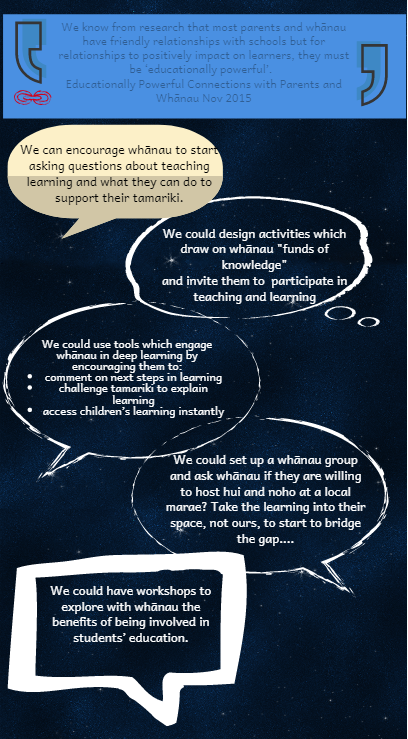
Our school had been very fortunate to secure Anne from CORE Eduaction and CLA as facilitator for our PD this year. One focus was on parent engagement... This has been something that I have been talking about in one of my past Inquiries... How can we get parents ENGAGED in their child's learning? Many people think that attending sports events means that parents are engaged, however; parents are here only 'involved' in what is happening at a school... therefore the importance of getting them engaged... in students' learning, especially class and individual student blogs as an ePortfolio is crucial.

A good starting point for us as a staff was to look at the elements of a positive learning environment for us individually. This also help us to understand each other a bit better (I think)...

Anne lead a session with parents around the eLearning Planning Framework. Feedback from parents and teachers both were very valuable...

As teachers, we also brainstormed our ideas...

Closer to the end of our PD, we went back to a Padlet we started at the beginning of the year and revisited our ideas...

So where to next for us at this stage?

Exciting times ahead...


~ "Excellent schools don't believe in excellence - only in constant improvement and constant change." - Dan McCabe ~

Friday, September 1, 2017

Discussing Computational Thinking and 'playing' with Sphero

Hancine started our Connected Rotorua session by showing us a very interesting video on 'Computational Thinking'...

There is also a free course available for educators through 'Google' to help with integrating 'Computational Thinking' into the curriculum.

It was great to be around educators who knew that Computational Thinking is about problem solving...

Getting an explanation from Neil on how 'sphero' works...


Having a play while being talked through by Shaun...
Photo Credit: Sue Winters (Ngā Pūmanawa e Waru)


~ "There's nothing magical about any tech tool. Real magic rests in the minds and hearts of teachers using digital tools to introduce students to new individuals, ideas and opportunities." - Unknown ~

Friday, July 21, 2017

Saying 'good-bye'... it's not easy

Due to many commitments, I had to make a serious decision regarding my ever growing workload and responsibilities. I realised that I will have to let go [at least] one of the many initiatives I am involved in. It was with a heavy heart and after pondering for many weeks, that I made the decision to withdraw myself as co-organiser from KidsedchatNZ at this moment in time. 

I feel humbled with the replies from the members of the team:


More feedback...


... and then this blog post:

"KidsedchatNZ: Crew Vacancy


Tena koutou KidsedchatNZ whānau

We have some changes afoot with our KidsedchatNZ organising crew. We are sadly farewelling the magnificent Marnel van der Spuy from our team.

Marnel has been one of our co-organisers from our very inception, and has contributed masses of her own time and energy into making our chat the great tool that it is for New Zealand kids to connect. 

Thank you so much Marnel, we have valued your contribution and commitment. You are steadfastly reliable and have always been there for us as a team. We wish you well - the kids at Broadlands School are very lucky.


Are you able to help? We are looking for more teachers to join our team. We believe in KidsedchatNZ, and know from our experience that it is a brilliant tool for kids to begin connecting with each other. 

It is great that there are now more vehicles for our New Zealand kids to use twitter to connect such as @ReadaloudNZ and @ChapterChatNZ

We love them all! These chats don't happen without the commitment of our superhero NZ teachers who believe in using digital technologies as tools for learning - thank you to all of you - you rock.

Can YOU be our next Superhero?"


Wednesday, May 10, 2017

A Librarian on Blogging Journey

When helping to set up for the MindLab session, I was approached by Mary about my work at Ngā Pūmanawa e Waru. I explained to her what I am capable of helping with… She mentioned that she would like help with setting up a blog for their library and we arranged for a time to meet and to get the ball rolling.

This morning, we created a blog, added pages, added important links and information on to it. I also showed her how she could create posts. Mary was very excited and happy with the outcome and asked that I checked in regularly when helping at MindLab to see that see is going well.


Feedback from librarian via email:
“RHGS Library Blog
Professional Development:

To invite the expert – Marnel van der Spuy –Ngā Pūmanawa e Waru to deliver professional development to show me how to make a blog.

This session is the first of ongoing assistance of how to make a blog. It was amazing to have such expert assistance that Marnel was able to provide. The assistance was professional, encouraging, and reassuring. It seemed to take her no time at all to establish the basic blog site we needed i.e. links, photos, advice, examples of blogs; as a real novice in terms of ICT literacy it was a pleasure to have someone who made your lack confidence seem OK with her calm, cheerful manner.

Hopefully Marnel is able to provide ongoing help when she comes in as part of her Mindlab visits or I can request future sessions to support this excellent beginning.”


~ "One person with passions is better than forty people merely interested" - Unknown ~

Wednesday, April 5, 2017

Building Teacher & Student Capability in GSuite

I just love working alongside teachers and students as part of my role as Learning Facilitator with Ngā Pūmanawa e Waru.

After meeting with the two teachers, it became clear that there was a need to provide teacher and student coaching in the use of a shared learning space online - Google Drive / GSuite.

I firstly worked with the year 6 students, showing how to create folders, change colour (if they choose), name the folder for the appropriate items/docs to be added into it. We also discussed how to make a copy if something is shared with them, add it to their drive and rename it. I also showed them how to share the document with their teachers and parents. The doc the teacher shared with the students beforehand, was to record their goals, date accomplished and evidence… I showed how they can add a link from their blog / doc (mentioned that they need to ensure that it is shared with the teacher, to enable her to view it) or how they can upload a photo.

I did all of the above with the Year 4/5 students as well, but after some questions, also showed them how to embed from a video into their individual blogs.

Both sessions went really well, with students having hand on experiences and ended up being engaged in adding learning into their folders.

Reciprocity:  The students continue to support each other throughout the sessions.

Feedback from the teachers:

Saturday, February 25, 2017

A small but select group

I have been part of organising yet another EducampRotovegas. This year we were a small but select group and the conversations were rich and meaningful.

At times we followed the slides, however it was great to have had the opportunity to have impromptu discussions not even added to the slides.


~ "Never doubt that a small group of thoughtful, committed citizens can change the world. Indeed it's the only thing that ever has." - Margaret Mead ~

Thursday, January 26, 2017

Brave, Resilient learners & Change

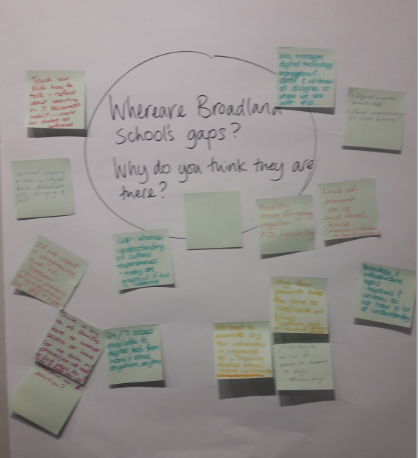
Our school was fortunate to secure Anne Robertson for one of our Teaching Only Days. After posing the Key Question for this session: "How do we challenge the way that professional learning has traditionally been structured and make it more consistent with modern learning practice, that is collaborative, creative, daring and challenging and meets the needs of all teachers in your school?" we introduced ourselves and discussed what motivates us to learn. One interesting thing that came to the front was that learning styles can change and develop. Therefore, Professional Learning has to be meaningful, relevant and focused on how it is going to support our learners.

The first rule of learning is that people learn what they need to learn, not what someone else thinks they should learn” Peter M Senge: The Fifth Discipline: The Art and Practice of the Learning Organisation

An exercise we had to complete was to think about three people on staff, think about their needs and put ourselves in their shoes when thinking about learning. It is vital that teachers should be considered in the same way we think about planning for our learners. We have to allow for different ways for teachers to engage in PL&D. One size does not fit all! Ownership and agency is essential if teachers are to engage positively.

Consider Knowles’ 6 principles of adult learning...
- Adults are internally motivated and self-directed
- Adults bring life experiences and knowledge to learning experiences
- Adults are goal oriented
- Adults are relevancy oriented
- Adults are practical
- Adult learners like to be respected

This can be easily applied to students as well, although not all of them might be motivated to learn, because they have to be in class / at school. What happens at home in the morning, might very well impact on how they learn...
Think UDL and cater for all learning needs in class, this however needs to be the same for teachers.

Image credit: Anne Robertson @robeanne 2016

Each of us had to think about our three teachers again while imagining one came across this small cave entrance with our three teachers... consider... What is my first instinct? What is their first instinct How would you feel if someone said to you - right we are all going to go into this cave now? Think about why your reaction is as is. What is it based on?
It might be hard for some to go in, having a fear of the unknown. This might be the same for people when having to learn new things. It might be easier to motivate kids, rather than motivate adults. Getting people out of their comfort zone. Tip for whānau engagement... think about cultural situations, think about that acting in a different culture could be quite scary.

We bring a whole lot of baggage with us when it comes to making decisions about what we do. Our Mental Model is shaped by the unspoken, unacknowledged, unrecognised assumptions we have just beneath the surface that guide our actions - positively and negatively.  Our prior experience plays a huge part as does our situation and context - age, gender, family situation, school setting. And mental models often resist change.
It is important to remember that we all see thing from different perspective, due to our experiences. This underpins our values/virtues and beliefs.

Enablers and Blockers challenge... 
What do we see as the ENABLERS to engagement in professional Learning at our school and what are the things that BLOCK people from engaging?


Sheryl Nussbaum talks about schools being “Future Ready” - there are 4 elements to being future ready. However, it is very important to consider as we develop Professional Learning programmes, that teachers are learners too.

An environment where the message is always ‘we are not good enough’ can be demoralising and counterproductive for all stakeholders. George Couros #Innovatorsmindset

ln the book “The Innovator’s Mindset” George Couros talks about the need for leaders to trust, to allow a positive space for people to grow and develop their skills, to focus on strengths not weaknesses. 
Something to ponder... Do we look at strengths of people or do we always look at the negative? Finding people's strengths is so important.

"When we build on our strengths and daily successes - instead of focusing on failures - we simply learn more” Tom Rath


Simon Sinek talks of how 'why' should be first, even before the 'how' and the 'what'. This seems a deceptively simple idea... But teachers also need a sort of personalised why… e.g. why should I adopt new practice. It has to be contextual to the way they teach and learn, to the students in their classes and the way that they are as teachers and learners themselves.
It is possible for the ‘why’ to evolve too and it doesn’t have to be static. However, you can’t just change the ‘why’ without a moral purpose or reflecting on it and considering why it might have changed.  Which is where Spirals of Inquiry come in…


Anne talked about an analogy that she heard of recently... consider a fire - what does it need to keep burning? (fuel and oxygen and space between the sticks for the fire to develop). If more sticks are being piled up on the fire, it collapses and has no space for the oxygen to keep fanning the flames so it suffocates and dies out. This is the same with teachers... they need to have space and time to keep motivated to learn and care should be taken not to overload them. 

One thing that came through strongly though was the idea of time for reflection and consolidation which is represented in the Poutama - the Maori representation of steps that symbolise levels of learning and that after each step there is an opportunity to consolidate, to take a breather (rekindle the fire) and assimilate skills learned before moving onward and upwards.

Key idea: We need to provide space for people to have inspiration. Don't keep on piling up... What can we take away... Allow teachers to take a step, and then have time to get an understanding and put learning into practice, before taking the next step.

Engagement in PL&D isn’t an option but leaders need to model good practice, be sensitive and respectful of the learners’ needs and be warm but demanding just as we are with the students in our classes…

Image Credit: https://mymindabout.files.wordpress.com/2013/03/infinite-staircase-olafur-eliasson1.jpg

Building on the Poutama steps of knowledge acquisition with time for assimilation and consolidation of skills discussed earlier - and the spiral of inquiry - this idea of a spiral staircase that can provide space for teachers to focus on their practice and the needs of their learners, that encourages constant, ongoing reflection, and further inquiry is very powerful. A never ending spiral staircase of learning...


~ "You are never too old to learn. At no time ever say, 'It's too late to learn,' not until the day you die." - Kimani Ng'ang'a ~
Tuesday, November 8, 2016

Supporting change as Learning Facilitator

One of the highlights working as a Learning Facilitator at Ngā Pūmanawa e Waru (NPeW) this year [for me] was the connections I made with teachers and working alongside them in their PL & D. Seeing how teachers were active participants in learning new skills and how they made learning real for themselves to enable them to reach the desired outcome was a great experience.

The Ngā Pūmanawa e Waru Learning Team often went in to schools in a group of 3 - 4 to support teachers as they pursued their objectives. Our role was to create an environment where every participant had the opportunity to collaborate, innovate and excel. We achieved some great outcomes and I am so exited and delighted about the changes that are starting to take place.


~ "All change is hard at first, messy in the middle and gorgeous at the end." - Anonymous ~

Wednesday, October 26, 2016

Supporting Junior school teachers as Learning Facilitator

As a Learning Facilitator for Ngā Pūmanawa e Waru, I was in the fortunate position to visit teachers in the Community of Practice for Junior teachers that I started. I realised that there were some great learning already happening, which could be further enhanced with the use of technology. Therefore, I also started working alongside teachers in giving pedagogical support and also on their journey in using technology as a tool to support learning.

As one of the focus areas of NPeW is on Learner Agency, I have been looking at working closely with those teachers in promoting Learner Agency in the junior school, creating more opportunities for learners to input into their learning. I am aware that learners in the Junior school need more support and scaffolding, but the importance in taking a greater responsibility in their own learning can be achieved.


~ "The biggest enemy to learning is the talking teacher" - John Holt ~

Saturday, October 8, 2016

uLearn16 - "Connect, Collaborate, Innovate"

"Coming together is a beginning. Keeping together is progress. Working together is success."- Henry Ford. 
This quote resonate with me throughout [and after] this conference and I have to say that for me, these yearly uLearn events are just getting better and better...

Conference strands this year were:
- Transforming Learning and Assessment
- Transforming Professional Practice
- Transforming Leadership


Keynote Speakers:  Collaborative notes
Keynote 1:  Larry Rosenstock - It's time to change the subject
"We are starting to see more and more schools around the world that are atypical. They do not mis-predict which students can and can’t do. They do not segregate students through structures that we see in most traditional schools. The people running these schools recognise that the world is changing. These are special places that are preparing their students for the innovation economies that their countries so profoundly need."
'It's time to change the subject' blog post
CORE Education, uLearn Blog (Larry Rosenstock Keynote) - Submitted by Tessa Gray
Key takeaway: "We, as educators, must pursue the relentless creation of invention and reinvention"

Keynote 2: John Couch - New dimensions in learning
"If students are engaged, they will succeed and technology plays a vital part in their engagement."
'New dimensions in learning' blog post
CORE Education, uLearn Blog (John Couch Keynote) - Submitted by Tessa Gray
Key takeaway: “Education is what people do to you. Learning is what you do for yourself”

Keynote 3: Michael Fullan - Early lessons from implementing New Pedagogies for Deep Learning
"Our work on School Leadership, Professional Capital and Coherence is becoming deeply integrated and embedded in the clusters and networks of schools that are engaged in implementing ‘new pedagogies'. He identified some early lessons concerning how leadership for deep learning differs when it comes to digitally accelerated innovations. There were also some surprising new findings about the role of students as change agents relative to pedagogy, school organisation, and even societal change."
CORE Education, uLearn Blog (Michael Fullan Keynote) - Submitted by Tessa Gray
Key takeaway: "The job of leaders is to help learners run better"

Keynote 4: Karen Spencer - Beyond the echo chamber: The extraordinary possibilities of a networked profession
"Karen took us on a provocative journey to explore the rapid rise in innovative professional learning. From ‘done to’ staff meetings to collaborative, agile investigations into what’s happening for our learners, the way educators improve and grow has evolved rapidly in recent years. She explored new insights into professional learning, best ways to embrace change, and invited us to think about how we can transform what we do for our learners."
'Keep the fear off the set' blog post
CORE Education, uLearn Blog (Karen Spencer) - Submitted by Tessa Gray
Key takeaway: "Hold our ideas lightly"


Day 1:
  • Breakout 1 - Working towards developing student agency in maths with Jacqui Sharp

Key takeaway: "Before students can be expected to take responsibility for their own learning, there are procedures that need to be mastered. To facilitate this, tasks and workshops should be designed so they are student centred, personalised and challenging. Students grow control of learning through the choices and the reflections they make. Student voice is encouraged and articulates progress, which in turn informs the teacher about further teaching, learning and assessment." 

  • Breakout 2 - What agoggies and self-regulated learning with Mike Scaddan
Key takeaway: "We need to be teaching kids the skills of 'learning how to learn'. But keep in mind that all kids maturation levels are different so they will not all be ready to learn this at the same time. Heutagogy is developmental not necessarily age related. Technology can definitely help to teach the skills needed for self directed learning and growing assessment capable learners."


Day 2:
  • Breakout 3 - A day in the life of a 1:1 iPad classroom (Y0-2) with Richard Williams and Sophie Church

Key takeaway: "Technology is used to extend and reinforce learning, thinking, collaboration, key competencies and to share the students' learning with Whānau."

  • Breakout 4 - A roadmap for strategic leadership of digital technologies with Ray Burkhill and Viv Hall

Key takeaway: "Using a strategic roadmap helps to bring sense to the challenge of ensuring effective pedagogy is driving the use of digital technologies in our school. It also gives a strategic direction that ensures digital technology is integral to building our school’s effective pedagogy and future-focused curriculum."


Day 3:
  • Breakout 6 - Supporting staff through change — professional learning models with Anne-Louise Robertson

Key takeaway: "Ask teachers why they are reluctant to change their practice. Helen Timperley suggested that engagement in PL is not an option, however we should keep in mind those teachers who’s mental models are such that they struggle to engage through fear, being overwhelmed, the context they find themselves in and balance that with the 'go getters.' Leaders need to model good practice, be sensitive and respectful of the learners’ needs and be warm but demanding just as we are with the students in our classes… What do we need to keep the fire burning..?"


  • Breakout 7 - Building capability through Future Focused Learning
This year, I stood back and let a colleague, Hancine Samvelyan, be the main presenter in this workshop. I saw my role as merely supporting, as she decided what slides she wanted to use for the presentation. Her focus was on collaboration as a process.


Many participants felt uncomfortable and challenged within this workshop and the task, but I like the growth mindset displayed from a participant...


Other things happening:
- What you thought of Day 1


I actually love these conferences because you can always take something away. The workshop that I was at, was quite amazing. My one was about learner agency and it actually told me some steps on how to scaffold my kids to that stage. It was something I could go away with and tweak and modify, it was more for the older stages, but there were lots of examples and things that I can take and adapt to my student needs to help them get to the next steps.


Gala Dinner

#eFellows14

with Hancine

with Bede

with Nick

with Stephen


Wristbands received - I got 'em all! Yay!


~ “Continuous learning is the minimum requirement for success in any field.” 
- Dennis Waitley ~