Showing posts with label Ngā Pūmanawa e Waru. Show all posts

Friday, December 22, 2017

Changing the Paradigm

I finished in my role as Learning Facilitor with Ngā Pūmanawa e Waru on 6 December 2017. I really cherish this time in which I have been privileged to be working alongside teachers to enable shifts in teacher practice. At times, teachers were reluctant about changes they had to make, but they were encourage to adopt 'a beginner's mindset'. 

At times the journey was unpredictable, but when meeting with teachers, I had been looking at the challenges they might experienced and how to overcome difficulties to enable change. What also impressed me was their willingness to seek feedback once they tried something new that I introduced in the learning environment. 

The outcome was one of great satisfaction, as shifts were made in practice and teachers were eager to move forward [even more] to support students in their learning journey.


~ "If your actions inspire others to dream more, learn more, do more and become more, you are a leader." - John Quincy Adams ~

Friday, August 11, 2017

Learner Engagement... 'Me and My School'

I was privileged to attend a NZCER 'Me and My School' Learner Engagement Survey Workshop.

"Me and My School is a unique, research-based student engagement survey designed for New Zealand students Years 4 to 10. It offers a snapshot of the learning culture in your school, standardised data to track progress over time and a nationally referenced gender, ethnicity, and year level comparison." - NZCER

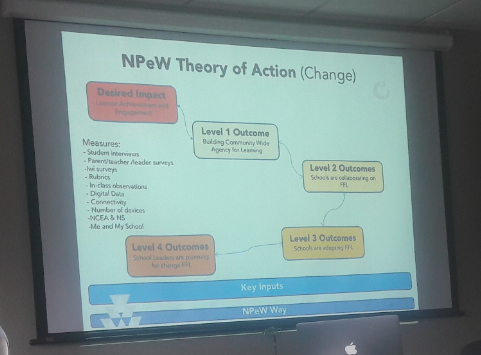
Why 'Me and My School'? (Theory of Action)

Outcomes of using 'Me and My school':
- Impact of NPeW
- Potential link to other data
- Useful assessment at multiple level (schools, CoLs, District)
- Input into school strategic plans for 2018

What does the survey measures? 3 main aspects: - Behavioural - Effective / emotional - Cognitive (willing to try new things??) Links to the Key Competencies

Getting staff ready for online survey:

- Use demo sites to introduce staff - Teachers need to talk students through 'instructions' & 'about me' parts - When students start with survey, advised that teacher should not be walking around, due to anonymous nature

Results: - With online reports you can view interim reports - Making sense of the reports - lots of different ways that data can be looked at / intrepid. Tips: Think about protocols on how to administer - maybe get students to all do it together in class or think about how it works best for your students. If someone is away, get them to do it when they are back. Aim to get all students to partake.

Conclusion:
This assessment tool is designed to give a school robust and systematic information about student engagement.


~ "Measure what you value instead of valuing only what you can measure" - Andy Hargreaves ~

Wednesday, May 10, 2017

A Librarian on Blogging Journey

When helping to set up for the MindLab session, I was approached by Mary about my work at Ngā Pūmanawa e Waru. I explained to her what I am capable of helping with… She mentioned that she would like help with setting up a blog for their library and we arranged for a time to meet and to get the ball rolling.

This morning, we created a blog, added pages, added important links and information on to it. I also showed her how she could create posts. Mary was very excited and happy with the outcome and asked that I checked in regularly when helping at MindLab to see that see is going well.


Feedback from librarian via email:
“RHGS Library Blog
Professional Development:

To invite the expert – Marnel van der Spuy –Ngā Pūmanawa e Waru to deliver professional development to show me how to make a blog.

This session is the first of ongoing assistance of how to make a blog. It was amazing to have such expert assistance that Marnel was able to provide. The assistance was professional, encouraging, and reassuring. It seemed to take her no time at all to establish the basic blog site we needed i.e. links, photos, advice, examples of blogs; as a real novice in terms of ICT literacy it was a pleasure to have someone who made your lack confidence seem OK with her calm, cheerful manner.

Hopefully Marnel is able to provide ongoing help when she comes in as part of her Mindlab visits or I can request future sessions to support this excellent beginning.”


~ "One person with passions is better than forty people merely interested" - Unknown ~

Wednesday, April 5, 2017

Building Teacher & Student Capability in GSuite

I just love working alongside teachers and students as part of my role as Learning Facilitator with Ngā Pūmanawa e Waru.

After meeting with the two teachers, it became clear that there was a need to provide teacher and student coaching in the use of a shared learning space online - Google Drive / GSuite.

I firstly worked with the year 6 students, showing how to create folders, change colour (if they choose), name the folder for the appropriate items/docs to be added into it. We also discussed how to make a copy if something is shared with them, add it to their drive and rename it. I also showed them how to share the document with their teachers and parents. The doc the teacher shared with the students beforehand, was to record their goals, date accomplished and evidence… I showed how they can add a link from their blog / doc (mentioned that they need to ensure that it is shared with the teacher, to enable her to view it) or how they can upload a photo.

I did all of the above with the Year 4/5 students as well, but after some questions, also showed them how to embed from a video into their individual blogs.

Both sessions went really well, with students having hand on experiences and ended up being engaged in adding learning into their folders.

Reciprocity:  The students continue to support each other throughout the sessions.

Feedback from the teachers:

Tuesday, November 8, 2016

Supporting change as Learning Facilitator

One of the highlights working as a Learning Facilitator at Ngā Pūmanawa e Waru (NPeW) this year [for me] was the connections I made with teachers and working alongside them in their PL & D. Seeing how teachers were active participants in learning new skills and how they made learning real for themselves to enable them to reach the desired outcome was a great experience.

The Ngā Pūmanawa e Waru Learning Team often went in to schools in a group of 3 - 4 to support teachers as they pursued their objectives. Our role was to create an environment where every participant had the opportunity to collaborate, innovate and excel. We achieved some great outcomes and I am so exited and delighted about the changes that are starting to take place.


~ "All change is hard at first, messy in the middle and gorgeous at the end." - Anonymous ~

Wednesday, October 26, 2016

Supporting Junior school teachers as Learning Facilitator

As a Learning Facilitator for Ngā Pūmanawa e Waru, I was in the fortunate position to visit teachers in the Community of Practice for Junior teachers that I started. I realised that there were some great learning already happening, which could be further enhanced with the use of technology. Therefore, I also started working alongside teachers in giving pedagogical support and also on their journey in using technology as a tool to support learning.

As one of the focus areas of NPeW is on Learner Agency, I have been looking at working closely with those teachers in promoting Learner Agency in the junior school, creating more opportunities for learners to input into their learning. I am aware that learners in the Junior school need more support and scaffolding, but the importance in taking a greater responsibility in their own learning can be achieved.


~ "The biggest enemy to learning is the talking teacher" - John Holt ~

Tuesday, October 18, 2016

Ngā Pūmanawa e Waru Cross-Check Hui

The NEXT Foundation, NPeW trustees, Principals, BOT members and many other stakeholders attended this most successful event.

Frances Valintine discussed 'The Need for Change in the Education Sector' She started by challenging us to think about how many students finish school without knowing their potential...
She went further and talked about 2020 Education and beyond and 10 Essential technologies.
Some realities:
- Students are starting to look how to make the world a better place
- Today's 5 year old will never drive a car
- Skills required today is not being taught in today's schools
- There is a move to having no entry criteria / age to do a degree. It is the outcome that will
   be measured at the end
- Very little of the following are being taught in schools...

- Employers are starting to look at skills, not the degree

- Robots are used as Teacher Aide's

The Mind Lab remind teachers:
- that is okay not to know everything
- that learning is a life long pursuit
- that sometimes students really do know more than we give them credit for
- that we began to change an educational system from the inside

What should we do?
- Tell kids they can learn they way they want to learn. Give them a problem, technology
   and let them go
- Teach kids how to think, to work collaboratively, to be creative and to discover
- Teach them the benefits of failure and trying


Sue Winters gave a stellar presentation on 'Why we need Future Focused Learning Environments'
She asked the audience to take on the challenge to meet the needs of our learners.

Realities:
- Principals / Teachers were the agents of change, but with Learner Agency it is the learners
- We should have effective teaching approaches which include:
  * Cultural Responsiveness
  * Integration
  * Evidence-based decision making
  * Reflective Practice
  * Inquiry
  * Co-construction
  * Reciprocity
- We need our teachers to have adaptive confidence and trial things another way and to
   learn from their learners
- 6 Global Competencies that links to Learner Agency. Maybe we need to access on
  these 6 competencies...!


- If we have effective teaching, the more likely we'll have Learner Agency
- Humans are innately wired to connect, wired to create and wired to help
  humanity (Fullan, uLearn 1016)

What next?
Think about what does this all mean for leaders...


Bill Kermode on the 'Philosophy and Role of the NEXT Foundation'. They look at projects that can make a difference. Projects include the Environment and Education. The Next Foundation has been established with a vision “to create a legacy of environmental and educational excellence for the benefit of future generations of New Zealanders”.

- By supporting and investing in aspirational education projects, their aim is to empower
  young people today and the leaders of tomorrow.
- NEXT Foundation support Ngā Pūmanawa e Waru and believe the project can make a
  contribution to the National level in education
- NEXT Foundation also support the Government's goal to have New Zealand predator free
  by 2050


~ "Education needs to be radically rethought partly to stop the boredom, but mostly to blow the lid off learning, whereby students and teachers as active partners become captivated by education." - Michael Fullan & Maria Langworthy in Towards a New End: Pedagogies for Deep Learning ~

Thursday, September 1, 2016

Apple summit

Sue Winters, Director of Learning for Ngā Pūmanawa e Waru, started by addressing attendants on:
1. Future Focused Learning

2. Learner Agency and an Agentic Learner


iPad in the classroom (Linda)
Opportunities to give student voice - ways to make meaning for themselves and others. STEAM - Adapt a Frog Activity / Assignment.

123D Sculpt+ app (students can create from scratch and adapt / change their shape etc).

Once image created, import into Explain Everything and students can then talk about their picture and explain their learning. There is also the opportunity for them to use the 'pen' to show what they are doing. This gives students a voice about their project. All the Explain Everything projects can then be put into book creator

Want to see iPad used creatively, not as word processor.

Students can print their creation in 3D.

Make a stop motion animation

Video can go in their portfolio of work to demonstrate their learning and understanding.

iTunesU (for teachers to find resources to adapt and use with their students).
Distinguished educators courses (to find lessons. Subscribe to it then to get access to lessons that is being taught in classes.
Australian national curriculum has lots of resources.

Tip: Be specific in Search function.


Apple and Education (James)

Acknowledging that New Zealand have a world class curriculum.
Using an iPad is "really about giving kids an opportunity to figure out what types of learners they are” (Corosanite).
Here is a great video as inspiration for teachers:

1:1 iPad is used for students to engage with learning.
Create learning experiences for teachers and learners.
Personalised it for audience.
Bring collective genius to the table.
Again, mentioning of stop motion lesson.
Students come to live when doing a project that interest them.
Element 4D app.

Students figuring stuff out on their own when using iPads. Not waiting for the teacher, however an iPad is not a substitute for a teacher - use technology to exemplify of what teachers are doing.

Personalisation is when we include student voice.

Tool for something much more meaningful.

Not 'special needs' - they are 'diverse learners'. You can use the 'Speak screen' on iOS devices for there learners.

Focus on apps that set task for students not just consume. They need to create something.
Students can use the camera app on iPad and the video function to record their learning.
Use a Soundscape to support creation e.g. if students create a poem.
iBooks author in iTunesU.
Check out all the functions in iTunesU - this seems to be having lot of possibilities.

Explore the 'Eight elements for success' in the iBook store.

Have a look at 'Research for educators' in iBook store.

Apple classroom app free to download.
You can see what students are doing in real time, but it should be more about celebrating work.

Friday, April 1, 2016

NPeW Education Conference

The Ngā Pūmanawa e Waru Team

Ngā Pūmanawa e Waru hosted its inaugural education conference yesterday. The programme for the day was divided into four sessions.

Session 1
'Iwi involvement in Education' with guest speaker Sir Mason Durie. The panelists were Professor Angus MacFarlane, Lady Aroha Durie and Mere Berryman.
Sir Mason Durie summed up the session on iwi involvement in education saying that our loyalty has to be to the students.

Session 2
'Leadership and a Future Mindset' (video) with Dr Vikram Murthy as presenter. He touched on the following:
  • Each one of us is an expert at something. Are we changing as fast as the world around us? The problem is to "let go"
  • The uncertainty & the leadership challenge. We live in challenging times...
  • What we pay attention to,  and how we pay attention, determines the content & quality of life
  • Attacking a problem with diversity & collaboration yields more powerful results. #CollectiveWisdom #CollaborativeInquiry
  • Learning is the process of enhancing our capacity for effective action. Learning contributes to adaptiveness.
  • The identification and engagement of an individual's competencies - "the areas of his or her greatest strength"

Leadership and a Future Mindset discussion panel with Nicky Brell as facilitator.


Session 3:
'Covey's Seven Habits' with presenter Kerryanne Knox. In the session she discussed the 7 Habits of Highly Effective People.


The First Three Habits surround moving from dependence to independence (self-mastery).

1. Be Proactive: Work from the centre of your influence and constantly work to expand it. 
2. Begin with the End in Mind: Envision what you want in the future so you can work and plan towards it.
Here she challenged us with "What are you doing to ensure that you are going to achieve what you have identified as your end in mind?"
3. Put First Things First: This is about the difference between Leadership and Management. Leadership in the outside world begins with personal vision and personal leadership. Think about what is important and what is urgent.


The next three habits talk about Interdependence (e.g. working with others).

4. Think Win-Win: Value and respect people by understanding a "win" for all is ultimately a better long-term resolution than if only one person in the situation had gotten his way.
5. Seek First to Understand, Then to be Understood: Use empathic listening to genuinely understand a person, which compels them to reciprocate the listening and take an open mind to being influenced by you. This creates an atmosphere of caring, and positive problem solving.
6. Synergize: Combine the strengths of people through positive teamwork, so as to achieve goals that no one could have done alone.

The final habit is that of continuous improvement in both the personal and interpersonal spheres of influence.

7. Sharpen the Saw: Balance and renew your resources, energy, and health to create a sustainable, long-term, effective lifestyle. 

Session 4:
'Future-focused Learning' with keynote Brett O'Riley. The panelists were Frances Valintine, Laurence Zwimpfer and Dr Niki Davis.


Reflection:
Listening to the presenters and realizing what we're achieving [already] was a mind-blowing experience.
The conference was a huge success and I felt honoured to be part of the Ngā Pūmanawa e Waru Team. We worked together as a team and manaakitanga was the winner on the day.  


~ "Celebrate what you've accomplished, but raise the bar a little higher each time you succeed." - Mia Hamm ~


Tuesday, December 22, 2015

Leaning Forward as Learning Facilitator


The Ngā Pūmanawa e Waru Team

This term I started working [one day a week] at Ngā Pūmanawa e Waru (NPeW) as part of the Learning team, which is lead by Sue Winters as our Director. We had many discussions around future focused learning and teaching and what a review of literature suggest this will 'look like'.

The Learning team was heavily involved in co-constructing eLearning plans for NPeW schools alongside the schools' eLearning Leadership teams.

Towards the end of the year I gauge interest around setting up a Community of Practice for Junior School teachers and am delighted by the responses I've received from teachers who are interested in becoming part of this. I look forward to putting this into place in 2016.

I found it to be such a rewarding and stimulating time, working alongside many educators and parents in our district. What a privilege!

Ngā Pūmanawa e Waru also published our first Newsletter, Te Pūmanawa which is available to read at your leisure.


We concluded a very successful year with a 'Festive Season Lunch' at the beautiful Lake Tarawera.


~ "Build the capacity of individuals and groups to accomplish more on their own in the future."  - Unknown ~