Friday, November 28, 2014

Connected Rotorua - Last meeting for 2014

We kicked of our last meeting with Sara, talking to us about Excel Rotorua and how we as Connected Rotorua teachers can connect with them.  We are really excited to be able to be part of this project.


We also had some 'nibbles' to get the conversation going... 


Then, Tanya introduced us to 'Binary Code' which is a coding system using the binary digits 0 - 1 to represent a letter, digit or other character.  All computer language is based in binary code. Thus, when you learn most types of computer programming, you will touch upon the subject of binary numbers. Who knew?

Tanya used cards to explain the pattern of  even and odd.  She also challenge us with the question "What is the biggest number you can represent using 8 bits in binary?" Hmmm....


We were introduced to ASCII and started crafting some binary messages, using... stickers, paper and pens!


Although one had to be onto it, it turned out to be an afternoon of great fun of CS Unplugged magic tricks, binary counting and coded messages.


~ "Don't tell me the sky's the limit when there are footprints on the moon" - Paul Brandt ~


Wednesday, November 5, 2014

My eFellow Inquiry presentation to the Cluster Principals

One thing that is being expected of you as an CORE Education eFellow is to share your learning, approaches, practices and inquiries with the wider teaching community.  

Thus, when asked by my Principal to present on my inquiry at the Cluster Principal meeting, I agreed (as I have had already presented my inquiry at uLearn14 and at #cenz14). 

Some of my presentation slides:


A short extract of my presentation:
  • Where and how do I start to facilitate personalised learning was just one of my questions. Through my networks and discussions with other teachers, I found that many were asking the same questions (especially in the junior school area)
  • I focused my inquiry on pedagogy and technologies (rather than the physical aspect of MLE) and although I was already using technology with great success in my classroom, I was driven by a desire to make learning even more rewarding and purposeful for my students
  • Questions arise about how I could support my students to carry out learning in purposeful and meaningful ways
  • I started working on supporting students to take more responsibility for their learning and how to make choices.  They have a choice of how they want to present their learning (iPads/Notebooks or via their Individual blogs).  When students know they have to share with peers, family or the teacher, it gives them accountability as well.  When they know they have to reflect on how that activity went, they have to have done it. With this I ensure no one is falling through the gaps under the guise of just "doing my own thing"
  • Is this working in our learning environment? Definitely! I will now walk into class after lunch and students will be engaged in a learning activity without me telling them what to do. Where as earlier they were just sitting on the mat, waiting for me to direct them

I left them with these questions:
  • What is your vision for your school, you learners?
  • What changes need to happen at your school / classroom level?
  • What would be the first thing you will be thinking of changing in your pedagogy?
  • Do you think Personalised Learning has potential in your school environment and what would be your first step to support teachers to implement this?

Conclusion:
In the end it all came down to Student Agency and the "power to act" as Derek explained in Trend 1 of CORE's Ten Trends for 2014.


~ "Tell me and I forget. Teach me and I remember. Involve me and I learn." - Benjamin Franklin ~

Monday, November 3, 2014

EOTC and the Classroom - #primedchatnz with William Pike

After a couple of technical issues, the #primedchatnz Google Hangout went Live where the organiser James Hopkins as well as Kate from Learning Network NZ discussed EOTC with William Pike.

Reid and I worked behind the scenes as moderators, with me putting up questions on Twitter and Reid answering other tweeters, while we both engaged successfully with people who made time to join us and tweeted some of William's views on EOTC and the classroom.

The participation of other educators on Twitter was once again incredible. A warm thank you to everyone who has contributed to the discussion. I have learned so much and feel privileged to have been part [once again] of #primedchatnz.


Here is my Storify of the discussion that was happening on Twitter:


~ "Must we always teach our children with books? Let them look at the mountains and the stars up above. Let them look at the beauty of the waters and the trees and flowers on earth. They will then begin to think, and to think is the beginning of a real education." - Davi Polis ~


Friday, October 31, 2014

Connected Educator Month - #cenz14


Connected Educator Month in NZ-Aotearoa kicked off with a bang!  I joined the celebration and listen to some amazing presentations.  We were in for an amazing 31 days of Connected, Professional Learning.


The following are links to some Workshop recordings.

Day 1: (1st October)
  1. CEM Launch - Kick off session with Sheryl Nussbaum-Beach, Sandy Philips, Derek Wenmoth, Wharehoka Wano, Phoebe Davies, Anthony Faitaua, Karen Melhuish Spencer
  2. Introduction to the Starter Kete 
  3. CEM NZ Showcase - Carolyn Stuart, Sonya Van Schaijik, Te Mihinga Komene, Anthony Faitaua, Allanah Kind, Tessa Gray
  4. Stories of Connected PLD from NZ - Aotearoa   (Connected Professional Learning - Shared notes) - Hoeard Baldwin, Trevor Storr, Phillipa Antipas, Alana Madgwick, Tamara Bell

Day 2: (2nd October)
  1. Modern Learning Practices and the connected world (Shared Google Doc) - Stephen Heppell, Derek Wenmoth, Janelle Riki, Mark Osborne
  2. Change Leadership: Connecting Maori and Pasifika (Shared Google Doc) - Dr. Sarah-Jane Tiakiwai, Keriana Tawhiwhirangi, Maria Lemalie, Togi Lemanu, Phoebe Davies, Tahy Paki
  3. Connected Voices, Whatunga Korero project - with the link to the project
  4. A powerful blend: ULearn14 and Connected Educator Month: What's in store
  5. #blogsync launch: Chris Waugh, Karen Meluish Spencer

Day 3: (3rd October)
  1. Connected learning: Plotting pathways, navigating mazes - Silvia Rosenthal Tolisano, Tom Barrett, Togi Lemanu, Karen Melhuish Spencer
  2. Book Group kick-off: NZCER's Key Competencies for the Future - Rachel Bolstad, Sue McDowall, Sally Boyd

I made the decision not to link to all the Workshops I watched after Day 3, as I was getting ready to prepare for uLearn14 and soon after that it was back to school again.  However, the calendar for all events can be found here


Other events that I committed myself to throughout October was:


~ "We are all strangers CONNECTED by what we REVEAL, what we SHARE, and what we TAKE AWAY.... OUR STORIES" - Libba Bray ~


Saturday, October 25, 2014

My fabulous #TeachMeetNZ experience

Today, I have had the opportunity to present [a second time] for #TeachMeetNZ. This was a special session, as we worked collaboratively with #TMSydney for Connected Educator Month.

Sonya [as usually] was an amazing host, which helped to make this experience even more enjoyable. Thank you for being my inspiration, Sonya!

When asked to base my presentation around a 'Connected Educator' I happily obliged, as I am a connected educator.  I have build a Personal Learning Network with incredible educators, locally and globally.  We are able to develop our shared visions and common goals and can discuss the needs for future focus learning.

We know the world is changing at an incredible pace for our students and if we want to prepare them for their future, it is important that we, as connected educators also become the connected learners.

Being a connected educator provides me with ongoing inspiration and support.  It is my wish that more educators would see the value of being connected.

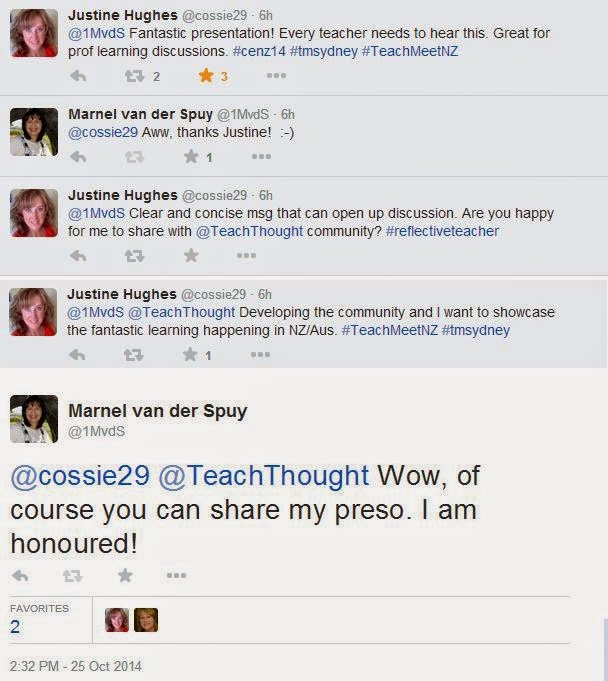
I was blown away when Justine asked if she can share my presentation.


I felt humbled when reading the kind words of Kimberley. I am privileged to have had the opportunity to be in a #TeachMeetNZ session with you, Kimberley.  I think you are doing amazing things with your students and  I do hope we can have a proper chat in the near future!


Reflection:
Having the opportunity to grow my own practice, to question, to experiment and to make mistakes is invaluable.
I acknowledge that I have grown immensely [personally and professionally] since becoming a connected educator.  However, this is just the beginning... I know that there is still a lot more to learn and experience.

So where to next?
I am going to utilize the Google Hangout tool to get in touch with educators around topics that would make learning even more rewarding and purposeful for my students. 

A Storify:


~ The purpose of learning is growth, and our minds, unlike our bodies, can continue growing as we continue to live. - Mortimer J. Adler ~


Wednesday, October 22, 2014

My #eFellow14 Reflection

For me, this year's eFellowship was an inspiring year of challenges, research, learning and laughing. I will always cherish the memories I was fortunate enough to build with Bec, Anne, Tim, Vicki, Rowan and Ben.

When I got THAT phone call from John, telling me that I was successful in my application, I did not know what I was really in for! However, I realised that I was going to be pushed [even further] out of my comfort zone. I felt a tad of fear, but at the same time I was filled with excitement as John's enthusiasm was really infectious!

With 80 eFellows to date, I feel extremely proud and privileged to be part of the influential eFellow community.

There were many days that I felt confused, not sure how to start/ where to begin.  And just when I thought I had it, Louise brought me back to earth with her endless "Why?"  We were reminded to maintain an objective perspective throughout and to question not only what we read, but also on our interpretations of responses.  Thank you for challenging my thinking all the way, Louise!

Together, we explored what 'transformation' means and I have enjoyed learning about it's relevance for my inquiry.  We unpacked what we learned during our 3 day Master classes - we worked hard, but we also had many laughs.

I feel honoured to have had the opportunity to be part of this incredible journey, thanks to CORE Education and our amazing mentors John and Louise, who guide us along in our inquiries.

We will definitely be #eFellows14 for life!

To conclude our journey, we also contributed to Connected Educator Month where each one of us presented a quick look into our inquiries.


~ It's not the end of the book, It's just the beginning of a new chapter - Unknown ~

Sunday, October 12, 2014

uLearn14 - "The ultimate modern learning & teaching conference"


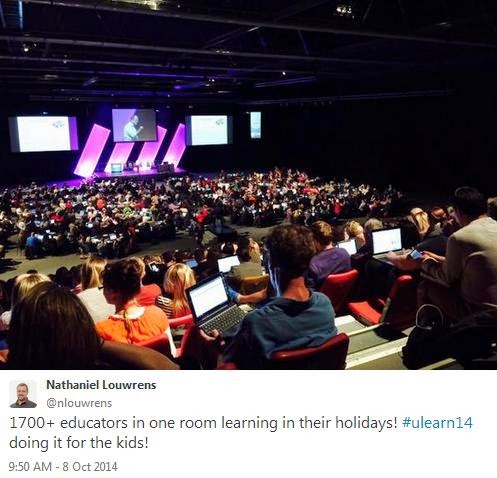
One of my highlights this year was the uLearn14 Conference.


Not only was this my first year attending, but the one in which I presented on my eFellow14 inquiry.


uLearn14 also gave me the chance to meet some of the wonderful people I have been interacting with on Twitter [and to catch up with the ones I've already met].


However, it was not all about 'socializing'...

The CORE Website stated: "The uLearn14 programme was structured around three key strands that focus on aspects of modern learning and leading:
- Modern learning practices
- Modern learning environments
- Modern learning technologies"

Therefore, I've chosen my breakouts carefully to as far as my eFellow schedule allowed, as uLearn was after all really about learning how I could enhance my practice.

Day1:
  • Breakout One:  Making the Most of the Early Years: Learning to Learn & Inquire at 5 with Bridget Casse
This workshop covered the SOLO Taxonomy, Inquiry & Pedagogy in the Early Years and we looked at how a learning environment can contribute to the education of young learners.


"Our youngest children are natural wonderers; from birth, every moment is a new experience. Our youngest children could well be the MOST experienced at creating new learning! What if we made more of a conscious effort to talk with them about how and why they think they are learning? What positive outcomes could result if we expect and encourage our youngest to explore the learning process while they explore the world around them?

We frequently converse with children about what they are seeing, doing, exploring and finding. How often are we talking with them about how this learning is being constructed?  What if we use the common language of learning to deconstruct their learning with them? Is ‘kidspeak’ really necessary? Are we making the most of the early years when our children are so creative and open to learning by empowering them and teaching them learning to learn strategies and skills?"
"We explored how the use of SOLO Taxonomy and modeling of an open to learning disposition can help overcome young learners’ fears of making mistakes. Together we realise ‘not knowing’ is the first step towards understanding! Even better, we know exactly how to meet our goal! Meeting our very next step is attainable. Ownership and pride in creating new understanding is contagious and intrinsic motivation is naturally triumphant."
  • Breakout Two:  iPads - a day in a junior classroom with Marion Kirby & Alison Willis
"Integrating technology, embedding technology, blended classrooms - all phrases for how we use modern technology in our classroom programmes."

In this workshop Marion & Alison shared their journey of how they use iPads throughout our day to enhance children’s learning.  From oral language to writing, reading, maths and more. We learned about the apps (Book Creator, Explain Everything, Dropbox, Camera app, Doodle Buddy) they're using - the how, why and when, activities


Day 2:
  • Breakout Four: It's bigger than Inquiry with Lane Clark
"What does it mean to learn?
Is there a difference between knowing and learning?
What is authentic learning?
What is integrated learning?
Is there a difference between theme and authentic integration?
What does real learning look like?
What are the similarities and differences between ‘real life’ learning and ‘in school learning’?"

According to Lane "If it‘s our goal to see an increase in student levels of engagement; an increase in levels of high school retention; an improvement in student performance standards; and learners skilled and ready to contribute to their world, we need to re-think what we are doing, and how we are doing what we are doing, in schools.  We need to teach our kids how to think and how to learn through a comprehensive learning process that mirrors the way in which learning occurs in the outside world.  We need to ensure that intellectual rigor, depth of knowledge and understanding, authentic, relevant and purposeful curriculum, our priorities   We need to change the way learning is planned, designed, implemented, assessed and evaluated."


And then time for the Gala Dinner...


Day 3:
  • Breakout Six: Developing a vision for school leaders with Rob Clarke
"This session shared an example of a facilitation approach for developing a shared vision. This approach ensures that everyone has a voice and an equal input into developing a consensus for the ideas generated." 
We've heard that the quality of questions we ask, will have a strong influence on the quality of dialogue. Also that a vision should not be static, but fluid.


Keynote Speakers:

Keynote 1: Prof Yoram Harpaz - The Ideologies of Education : In search of the pedagogical sentiment

Keynote 2: Adam Lefstein - Teacher Professional Discourse and Learning

Keynote 3: Dr Katie Novak - Universal Design for Learning

Keynote 4: Quinn Norton - MacGuffins, hackerkids and the troublesome 21st century
Note: I was unable to attend Keynote 4, as it was time for our last lunch as eFellows14 together... 


Two of my favourite Blog posts about uLearn14:
ULearn... I thank you - James Hopkins
Embracing the Tigger in Us - Reflections on #Ulearn14 - Annemarie Hyde

As part of Connected Educator Month some uLearn14 events were also Live Streamed.


~ "Man's mind once stretched by a new idea, never regains its original dimensions" - Oliver Wendell Holmes Sr. ~