
Friday, November 27, 2015

A new voyage - 'Being Good'

In our third session we looked at organisational change and strengths-based perspectives.

Dr. Vikram Murthy did a quick recap on:
- Leadership and self
- Leadership and others

This session also covered leadership and followership (positive emotions, appreciative inquiry, positive core, science of happiness, Robin Hood case, and the learning styles).

We learned about the principles of an appreciative inquiry and to find the root cause of the problem...


We touched on the Pygmalion effect which is "the phenomenon whereby higher expectations lead to an increase in performance". Here is an example how to use it in the classroom: 


In any system [if you want to change it] act as if it already be... Be mindful of the sort of questions to ask.
Left ('negative') - Right ('positive')

Insightful questioning is about
1. emphasising
2. focusing
3. recognising
4. understanding


The appreciative inquiry involves a shift, but remember the positive core (and to inquire into exceptionally positive moments) which can be used as the central energy for change initiatives. People don't mind going to a new place [change] when they can take something they know with them.

We can learn a lot from our own experience... We have an experience, pause and reflect. Trust the learning (don't get fixated on winning/losing. It is about learning).

Use Carol Dweck's Fixed - Growth mindset and make sure to balance fixed and learning beliefs. We need a balance to grow.
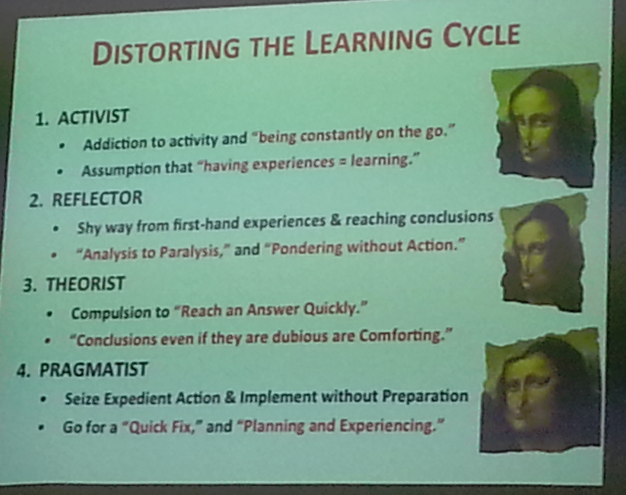
Using the Honey & Mumford learning styles questionnaire helped me to understanding my own learning styles.


After plotting our scores we had to move into our particular learning style group and were given the task of creating a challenge for another learning style group. We had fun while discussion and eventually coming up with a challenge for the Activist Learners...


With the guidance of our "principal mentor" and a tightly-scripted role-play, we learned how to use multiple-loop questioning with a case-study of Robin Hood in Sherwood Forest. Everyone in the group had to engage with and mastered insightful questioning and critical reflection. This activity helped in clarifying the current reality of any situation.

Discussing the leadership style of Robin Hood...


Reflection:
- Experts are experts of yesterday's issues.
- Opportunities and threats come from without (outside)
- Strengths and weaknesses comes from withing (inside)


~ "Out of your vulnerabilities will come your strength." - Sigmund Freud


Thursday, November 26, 2015

Learning Theories and Researched Informed Practice (Week 4)

Digital & Collaborative Learning (DCL) - Learning Theories

What is a theory?


Learning theory vs Learning style:

So what is the difference between a theory and a style? A theory is grounded in research. Style is the way in which something is done.


Ten learning theories that are relevant to digital and collaborative learning:
  1. Conditioning 
  2. Connectionism and the Law of Effect 
  3. Progressive Education 
  4. Constructivism: Social Development Theory 
  5. Constructivism: Equilibration
  6. Social Cognitive Theory
  7. Situated Learning / Cognition
  8. Community of Practice
  9. Constructionism
  10. Connectivism
Week 4 Task: Create a stop motion animation explaining the key principle of a learning theory.


Research informed teaching is based on evidence and it inform practice.

We don't research enough as teachers! ("few of those surveyed had any familiarity with major thinkers, writers or researchers in the field")

"What is self- evident today is tomorrows fallacy or tale of ridicule"


Leadership in Digital & Collaborative Learning (LDC) - Researched Informed Practice

Leading Research groups
Group Task: Read page 9 of 'Good practice in Leading and Supporting a research team

Group TaskCreate a graphic representation of the similarities and differences between leading a teaching team and leading a research team.


Good practice whether leading researchers or teachers
Wise tip: As a leader don't forget the inter personal skills that is so important in the classroom.

Wednesday, November 25, 2015

Google NZ Education Roadshow

A full house for the free professional learning Google NZ Roadshow hosted by Greg Reynolds who've highlighted trends in eLearning.
Photo by: Greg Reynolds

We explored how to:
  • optimise the Chrome experience
  • coordinate learning using classroom

Discussion happened around:
  • using Blogger as portfolio
  • Google Classroom as learning space
  • Google Sites as professional communities

Using technology we can build better digital learning flows for students. It is a given that 95% is more engaged, but more importantly, 80% produce higher quality work.

This made me even more determined to utilise GAFE at our school as it can opens up an amazing world of possibility. 

Linewize also shared what they were about and how they (with GAFE) can assist in digital citizen management.

One thing that really sparked my interest was the downloading of chromium to bring old and slow PC's, netbooks and MAC's back to life.


~ "Everyone you will ever meet knows something you don't." - Bill Nye ~


Saturday, November 21, 2015

Learning Activity using Google Maps (Week 3)

Leadership in Digital & Collaborative Learning (LDC) - Implementing Technology Innovation in the Classroom

Week 3 Task: Design a learning activity using either Google Earth or Google Maps informed by SAMR and/or TPACK


Thank you Mary, Callum, Joyce, Jackie and Tracey for your feedback on my activity:


Week 3 Homework Task: Do another group's Google Maps / Earth activity then rate it against a SAMR/TPAC rubric. Write your feedback, justifications and ideas to the Google Doc as comments

                    I choose the bucket list activity (below) created by Emma, Liz and Kumiko.


Thursday, November 19, 2015

Virtual & Augmented Reality and Innovations (Week 3)

Digital & Collaborative Learning (DCL) - Virtual and Augmented Reality and Innovations

Week 3 Task:
  • Reflect: Which sectors/industries have recently disrupted?
  • Reflect: Does your career path meant that you don't have to learn about technology?

The new reality... (disruption):

- We don't know what the future looks like... (The more overdue a disruption is, and the more sudden it is... when it finally occurs, the more off-guard the incumbents is)
- What (you never thought would be possible) is now possible? Cameras on phones, Google maps..
- We should remember to think further into the future.
- Self education is now the gateway to the world.
- What is the role of Key Competencies? (You need all these skills to study on line, you need time, motivation) Where does it leave us as teachers? What should we be doing?
The jobs in the future will still use the Key Competencies: Thinking, Using language symbols and text, Managing self, Relating to Others, Participating and contributing.

What needs to be learned?
Source: World Economic Forum, March 2015


The class of 2025... The oldest digital natives (currently 12 years old) are coming earlier than we think.

Project Loon: Balloons launched in New Zealand to learn what it will take to provide connectivity to everyone, everywhere. WIFI to the whole world, but not everyone has access to devices?


There is no comparison to be drawn from yesterday to tomorrow for occupations. So what opportunities and risks are there for tomorrow's students? Already plans for a future of driver-less taxi's, self-driving cars. Will I be using the services of an Uber driver? (Definition: One Tap to Ride. Uber uses your phone's GPS to detect your location and connects you with the nearest available driver. Get picked up anywhere — even if you don't know the exact address.)
Which careers are a safe bet? Find out: will a robot take your job?

Google Glass Project: You can choose what you want to see...


You don't need to go and watch a movie, you experience a movie - Magic Leap
Reality <- Augmented Reality -> Virtual Reality

AR - Augmented Reality:
- Daqri Smart helmet (realizes the true potential of augmented reality and 4D for the future of work)
- Oculus rift (to experience anything, anywhere, through the power of virtual reality)
- Google cardboard (to experience virtual reality in a simple, fun, affordable way)
- Ingress the game (turns the environment into a game - the world around you is not what it seems)

We explored: 
Anatomy 4D


Enchantium


Quiver


Week 3 Class Task: Use Aurasma (either the app or studio) to create a trigger image and an overlay.

Phew... and finally, here it is...!


There are many possibilities for using this app in education. Bring schools to life with Aurasma.

My Storify:


~ "Get ready for tomorrow, Today." - Jvongard ~

Sunday, November 15, 2015

Classroom conditions & technology innovations (Week 2)

Leadership in Digital & Collaborative Learning (LDC) - Reflective practice and Key Competencies in leading

Week 2 Required reading'Conditions for Classroom Technology Innovations'


The primary purpose of this study (by Yong Zhao, Kevin Pugh, Stephen Sheldon & Joe L Byers) was to look at why teachers don't innovate when they are given computers. It also looked into why teachers don't integrate computers into teaching in more effective ways. 

School site conditions that influence successful integration of technology with classroom instruction was measured and teachers in Michigan were given funds to innovate with technology in their classrooms.

The success of classroom technology innovations was found to be:
  1. influenced by teacher as the innovator, 
  2. the project as the innovation, 
  3. the school as the context.
An explanation of the three domains:
The Innovator/ The Teacher 
Technology proficiency: is not only about having the knowledge to use a specific piece of hardware or software, but also means the understanding of technologies and conditions that enable the use of it.
Pedagogical compatibility: is about the consistency between a teacher's pedagogical practice and the technology. When the technology to be integrated fits the content being taught and the teaching style of the teacher, odds are better to successfully implement a technology-based project.
Social awareness: is when a teacher understands and is able to negotiate social aspects of the school culture. Projects are more likely to be implemented successfully by social savvy teachers.

The Innovation/ The Project
- Distance: this was found to be important in three areas; distance from the existing school culture (Degree to which the innovation differs from the set values, pedagogical beliefs, and practices of the teachers and administrators in a school), distance from existing practice (how innovation differs from previous practice) and distance from available technological resources (new technology or purchases needed for completion of tasks) . 
- Dependencerefers to the degree that an innovation relies on other people or resources beyond the innovator’s immediate control. (i.e., technologies that the teacher controlled in his or her own classroom) as less dependent than innovations which required the involvement of other teachers, administrators, or outside technologies (such as a computer lab or district server).

The Context/ The School
Three aspects of the school context were identified to be of central importance to the success or failure of an innovation:
The human infrastructure (meaning the organizational arrangement to support technology integration in the classroom and a human infrastructure that would include a flexible and responsive technical staff, a knowledgeable and communicative group of people who can help the teacher understand and use technologies for his or her own classroom needs and a supportive and informed administrative staff) 
The technological infrastructure (is technological resources, such as hardware, software, and connectivity of a school. These were in most cases inadequate
- Social support (is important for the level of degree to which peers supported or discouraged the innovator)

Summing up:
The study outlines the impact technology can have on teaching and learning when systematically incorporated into the classroom lesson/unit plans and how available hardware, networks, and content applications will be used to help carry out instructional objectives. 
Another point addressed was the impact of technology on teaching and learning as a function and the extend to which it is systematically incorporated into instructional planning to include curriculum, technology and teaching strategies matched to students' learning needs.


Saturday, November 14, 2015

20th or 21st Century Skills (Week 2)

Digital & Collaborative Learning (DCL) - 21st Century Skills

Week 2 Task: Reflect how 20th century and 21st century skills differ? Do we need both?


One example...


and another one...


Reflection:
20th Century Skills were about knowledge and how to 'survive' in the industrial age whilst 21st Century Skills are all about collaboration, innovation, skilled communication, knowledge construction etc.

To put it simply, some stuff 'from the past' is still important, but the context needs to be different. Thanks for this insight Daniel Birch. (Mentioned in 'More than a beanbag' PL & D session.)


~ "Learning is more effective when it is an active rather than a passive process" - Euripides ~