Showing posts with label RTC 02 - Well-Being. Show all posts

Friday, December 15, 2017

End of Year - A Quick Reflection

With my 'Possibilities, Options and a Course of Action' post at the start of the year, I was looking forward to pursue the many things that was twirling around in my head...

Unfortunately, I did not always 'stand firm' mentally and emotionally when challenges arise, so my one word, prudent (adj) 'acting with or showing care and thought for the future' did not always come to fruition, as there were days I was not ready for some unexpected challenges / bumps in the road.

One of my biggest 'problems' was that I felt tired, tired and tired. I question myself constantly as to my lack in motivation to effectively use my PLN (Twitter, VLN, EduCampNZ) and colleagues to create productive working relationships by learning from others, asking questions to find out the thoughts of others and to reflect understanding. 

Many days, I felt like "Forget Everything and Run" rather than to "Face Everything and Rise." (the two meanings of F-E-A-R according to Zig Ziglar).

The following post on a closed group also made me wonder if this showed what teaching became for so many in 2017... yes there are other stories too... unfortunately.


Throughout my unexpected challenges, I think I stayed true to my students... one example:
Two of my ‘at risk’ Māori students (Student 2 and Student 3) experienced difficulty with oral language. 

I reflected on why this might be and came to the conclusion that the pronunciation of Māori vowels in relation to English is quite different, which could very well contribute to their specific areas of need. A ‘non-confident’ Māori student, can find this extremely difficult and result to them finding it hard to follow instructions, process information etc.
I planned deliberate activities that meet the needs of these learners, whilst also capitalising on spontaneous authentic learning opportunities that support oral language development. 
Steps was to:
- Locate, create and utilise a variety of activities/resources support sequencing development.
- Use Big Books and Cards, and use the planning support that accompanies these to develop oral language.
- Use guided reading lessons to continue modelling and promoting retelling of text with a focus on oral language.

Although Student 2 still requires some support, I am delighted with the overall progress - as this was a student who did not talk at all to start with.

Progress can be seen as shown in the end of year spreadsheet below. 
All the blue areas, were areas of concern. Now it is only the two green areas, which I am confident will be shifting further [as well] in the coming year.


One of the best parts of this year [for me] was working in classes alongside teachers and ākonga to develop capability in pedagogy (teaching and learning) and the use of technology as a tool to support learning in my role as 0.2 learning Facilitator with Ngā Pūmanawa e Waru. Part of our (my) role was to working through and with the wider community to enable ubiquity (every where, anytime) of learning, honouring an authentic Rotorua and Arawa context, foster collaboration for learning across Rotorua (I have a G+ community for junior school teachers where we share resources / ideas) and to build knowledge about Future Focused Learning. I have been working with teachers and school leaders (I engaged regularly with principals about growth in teacher adaptive confidence and professional development) by embedding effective future focused teaching, using learning technologies to build learner competencies. 

End of Year Highlight:
Received a choc bar with this lovely message from a student! #EndOfYear #FeelingBlessed


~ "Ships don't sink because of the water around them; ships sink because of the water that gets in them. Don't let what's happening around you get inside you and weigh you down... stay up." - Unknown ~

Saturday, December 9, 2017

Constant Improvement

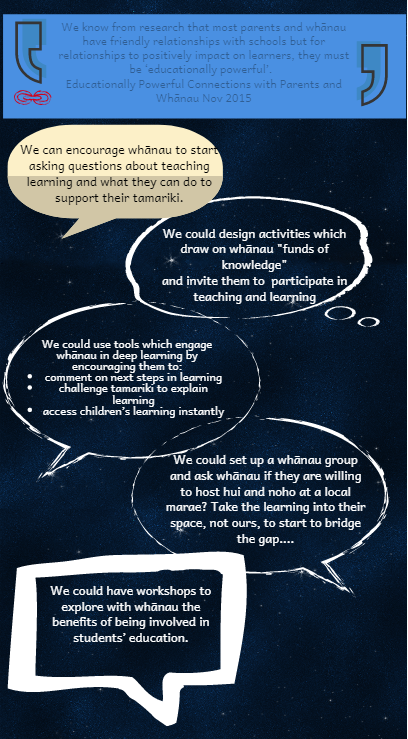
Our school had been very fortunate to secure Anne from CORE Eduaction and CLA as facilitator for our PD this year. One focus was on parent engagement... This has been something that I have been talking about in one of my past Inquiries... How can we get parents ENGAGED in their child's learning? Many people think that attending sports events means that parents are engaged, however; parents are here only 'involved' in what is happening at a school... therefore the importance of getting them engaged... in students' learning, especially class and individual student blogs as an ePortfolio is crucial.

A good starting point for us as a staff was to look at the elements of a positive learning environment for us individually. This also help us to understand each other a bit better (I think)...

Anne lead a session with parents around the eLearning Planning Framework. Feedback from parents and teachers both were very valuable...

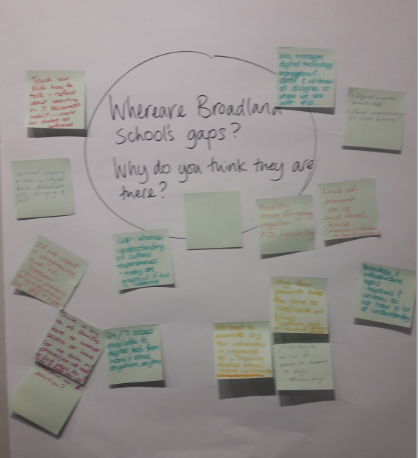
As teachers, we also brainstormed our ideas...

Closer to the end of our PD, we went back to a Padlet we started at the beginning of the year and revisited our ideas...

So where to next for us at this stage?

Exciting times ahead...


~ "Excellent schools don't believe in excellence - only in constant improvement and constant change." - Dan McCabe ~

Monday, March 13, 2017

Language and Learning

In this Language & Learning Intervention workshop I attended, speech-language therapists worked with teachers and some parents in our cluster to provide learning support for our children with high language and communication needs. The support we were given was around being reflective of our communicative behaviours and how we can adapt and differentiate our interactions with students who have communication disorders.

Module 1 (Planning Language and Learning Goals):
Some children might have language, but can’t retrieve it...
Incentive: Think about your day yesterday... What activities did you do that involved language? What activities did not involve language?

Three components of language:
  1. What? (are kids talking about) e.g. family, hunting, birthday, other children in class, farming, tractors, weekend activities, learning. This includes vocabulary labels, action and describing words. Think about the meaning of the message.
  2. How? (understanding content and express in various ways) This may involve pointing, gestures, facial expressions, smiling, physical leading, eye contact. 
  3. Why? (the reason for communicating?) e.g. gaining attention to express feeling / telling the rules, needs met / want something, greeting, ask questions - can I?, responding, re-tell.

We need all three these components, otherwise something might break down.

When a child do not have the language they need to use, it is like a can of coke that is being shook, waiting to explode. Pressure was building up, they feel like they are on the back foot all the time. Anxiety might be increasing. Some children might be holding it together at school, but explode when they get home. Simple change in routine could inflict as well (e.g. reliever). This could be tiring for children.

Language underpins all learning. The four language steps are: Early Words User, Word Combiner, Early Sentence User and Complex Sentence User.

Reflection: It is therefore important to build children's expression and feelings about things and to build vocabulary.

There are four Conversational styles: Participator, Responder, Do My Own Thing and Reserved Communicator.

Responder:
Children rarely start the conversation and may find it easier to respond more to adults than peers. Adults might say the child "takes awhile to warm up".

Do my own thing:
Children mostly communicate about their needs and interests. They rarely respond to attempts to engage them in conversation. Adults might think they are "in their won world".

Reserved Communicator:
Children often have little or no response to your efforts to engage them. They rarely initiate and show little interest in people or objects in their environment. Adult find it difficult to engage the child.

Participator:
Children who initiate and take part in interactions. They are responsive and will try (and keep trying) to communicate. Adults might describe them as "easy to talk to".

Reflection: Think about strategies children might use to figure out what might be happening in classroom e.g. categorize, body language, ask, sensory cues, process of elimination etc.

Module 2 (Language and Learning in Action):
The features of a great conversations is the opportunity to talk, ask questions or to clarify.

Incentive: Think about the 'ideal classroom'
Teacher (that you like)
Class Culture
Physical Setting
Motivator, interested, care/time, dynamic, calm, surprising, creative
Ask questions, safe - take risks, make mistakes, valued
Different props - creative, ties with children's name who will be the leader, classroom displays  (with care), work hanging up

Classroom conversations could include: Initiation, Response, Feedback.

Strategies to Encourage Engagement:
- Be face-to-face with children
- Respond to their attempts to initiate
- Notice children who are feeling 'left out' or uncomfortable
- Pause to give time for responses
- Make comments and wait for the child to initiate a comment
- Repeat and go slow
- Provide encouragement and explicit feedback

Acknowledge that you heard what child has said, by affirm, model, and extend.
Reflection: To extend is really important as you increase the opportunity for conversation. Don’t just label things for kids, otherwise they will do it back. Describe what happens in a picture, so that they can learn to do the same.

Idea: Feed in four 'comments' about the topic, before asking a question. That way language is 'fed in' and this will enable children to gather language to interact.

Reasons for asking Questions:
- To check children understand new information
- To check reading comprehension
- To prompt for more information
- To ask for clarification
- To stimulate thought

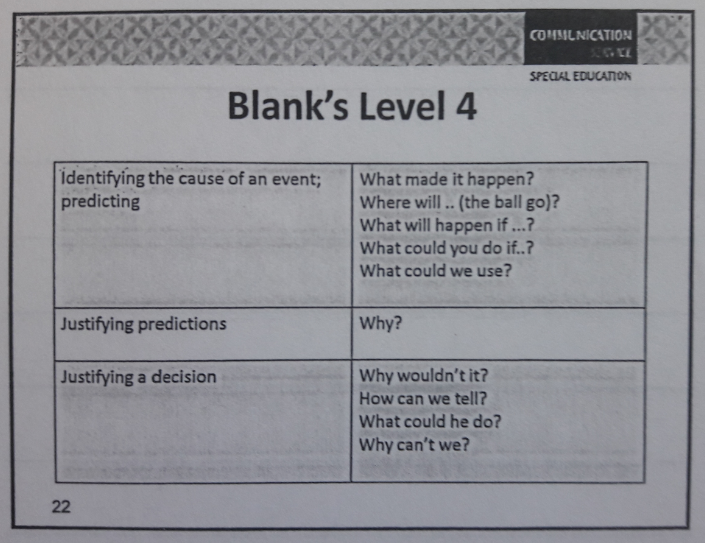
Blank’s Levels of questioning
Blank’s  Level 1 is about immediate
Blank’s  Level 2 is about properties, punctuation, comparing
Blank’s  Level 3 is about what they know, relating
Blank’s Level 4 is about reasoning and why something has happened, justify

Reflection: When the goal is successful communication, match the question complexity to the child's language level.


 ~ "Language is the blood of the soul into which thoughts run and out of which they grow." - Olivier Wendell Holmes ~

Sunday, September 18, 2016

Augmented Reality in an Educational Environment

An article I have written for New Zealand Interface magazine (Issue 74, September 2016) on using Augmented Reality (AR) with 5 year old students:

Inspiring and engaging my students to make their learning real is important to me and I know that technology has the power to enhance learning. I see it as essential to bring it into my classroom to focus the learning onto the students’ future.

One opportunity that it brings to learning is 'Augmented Reality'. I have been aware of using AR for a while, but it was when I was reintroduced during my postgraduate study (The Mind Lab by Unitec) that contextualised it for me.

Here are two ways in which I have used this in students’ learning through the AR app Quiver.

Cluster Summer Sports
Firstly, they had fun reflecting and talking about their participation in a Cluster Summer Sports Day in which they were involved. Without the students even knowing, in this activity they were also touching on the Speaking and Listening component in the NZ Curriculum.

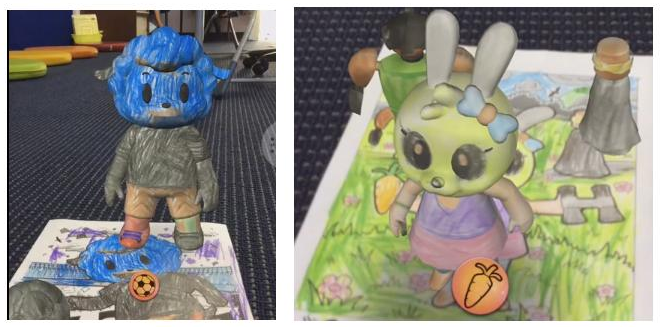
After choosing one of the two pictures provided (one for their ball kicking activity and the other for the game ‘rats and rabbits’), students coloured their choice using their favourite colours and then watched as their picture came to life just the way they'd made it.

Students took a screenshot and published their reflections verbally on their ePortfolios. (http://goals-r-us.blogspot.co.nz/2016/04/augmented-reality-using-quiver.html).

Erupting Volcanoes
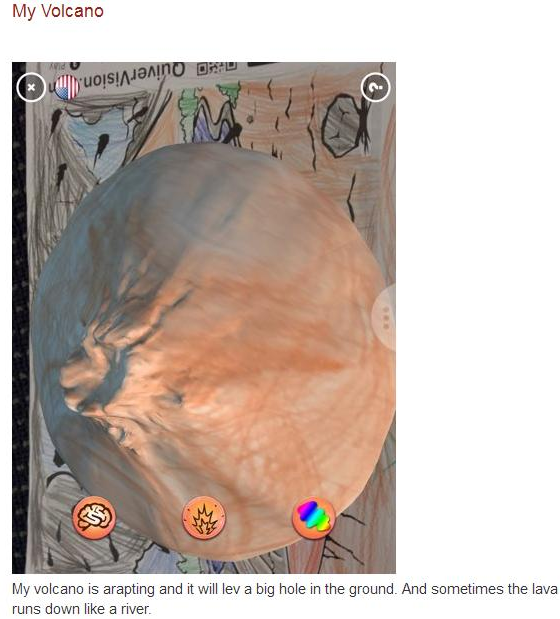
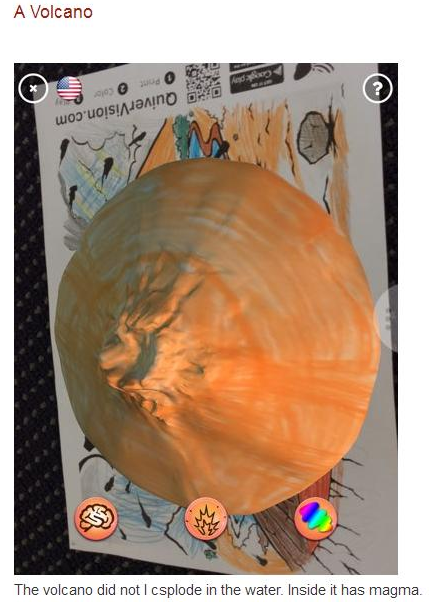
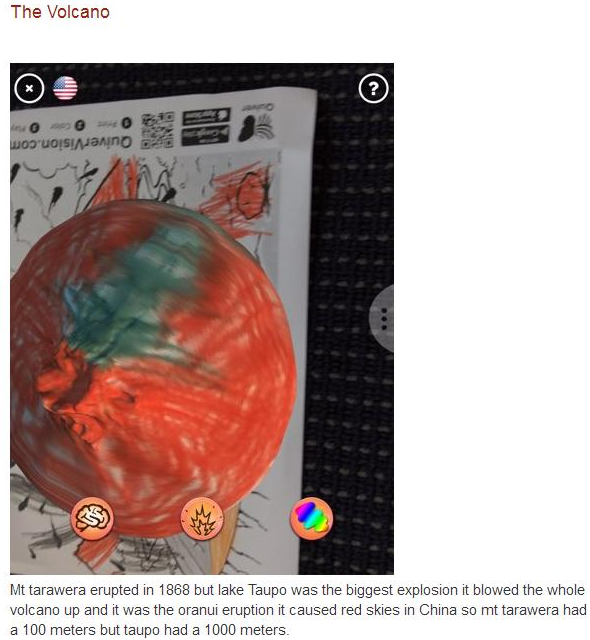
A second example was when students were learning and inquiring about volcanoes. I printed the volcano picture from the Quiver website.  Students took a screenshot and wrote a story about it.  They had the opportunity to choose how they would like to present what they knew and learnt about volcanoes. This has not only engaged them, but also enabled me to see what they have learnt. Writing has also becoming more fun, especially for the boys.

Some stories were published on our class blog


Excitement and engagement
To experience students’ excitement and engagement in their learning, is priceless and shows me that engagement is critical to their learning. The use of these digital tools gives them the opportunity to deepen their skills in engagement, communication, collaboration, critical thinking, as well as creation. It also allows students with various learning styles alternate modes to interpret ideas and understand challenging concepts, enhance their engagement & success.

As I see the difference in the learning of my engaged students, it becomes easier to find ways to incorporate technology into their learning. And, in my experience I have found that AR can be used in all learning areas of the NZ Curriculum. Making a difference and engaging students is not about what I teach, rather, it is about how I teach. This experience has been life-changing for me. It really gave me an opportunity to make a lasting difference in the lives of my young students.


Screenshots from Interface:


~ "Reality is merely an illusion, albeit a very persistent one." - Albert Einstein  ~

Monday, July 11, 2016

'It's all about maths'

The 'It's all about maths' symposium focused on connecting mathematics across the curriculum...

Using Digital Tech to learn maths: Transforming the learning?
Keynote: Dr Nigel Calder

"Digital technologies are everywhere in our lives. We use them to communicate, research, process, record and for for entertainment. They influence the way we interact in the world, the way we live. We use them in work and play. How might they change the learning process?" (Nigel Calder)
  • Overview
  • Affordances
  • Influences on the learning process
  • Research projects
  • Some effective apps
How do you use digital technologies in your maths programme?
Technology might take the student 'somewhere', but it might not always optimise the learning. It is about the pedagogy and the learning, thus pedagogy is critical and it is not a matter of having apps or having technology, the reason becomes the critical thing. Apps should be about purpose/pedagogy for learning.

Affordances - What are they?
"Affordance implies the complementarity of the animal and the environment. They are not just abstract physical properties" (Gibson, 1979)
Visual affordance: Tinkerplots, Multiplier
Interactive apps: Sketchpad (look at: ‘geometry for young learners’ site), Touchcounts 1.0, Maths shake.
Tech gives non-judgemental feedback which might facilitate: risk-taking, an investigative approach, collaborative approaches, engagement, alternative learning trajectories, reshaping of the learning.

Moyer-Packenham and Westenskow (2013) identified app affordances as focus constraint, creative variation, simultaneous linking, efficient precision, motivation. These affordances interact and appear to be mutually influential of each other.

A five-stage developmental process when learning to integrate a particular technology:
- Recognizing (knowledge)
- Accepting (persuasion)
- Adapting (decision)
- Exploring (implementation)
- Advancing (confirmation)

Teacher knowledge for learning with technology: (when considering apps)
- Focus on the mathematics and learning outcomes
- Facilitating teaching and learning
- Re-organising learning - seeing connections
- Mathematical thinking and problem solving
- Self-correction and reasoning
- Making mathematics attractive and motivating
- Recording thinking and opportunities for collaboration

Aspects that underpin all themes:
- Student-centred
- Encouraging ownership of learning, eventual self-assessment and direction
- Get students to explain their thinking, it is powerful
- Teacher open to new technologies, ongoing learning
- School support with access to devices, reliable wifi, technology
- Herding cats... this is kind of what we do... it is not an easy job

- Task and apps should focus on the learning
- Foster creativity and self-directed learning
- Use them to optimise the learning situation
- Facilitate learning
- Give insights into students strategies and mathematical thinking
- The apps are built for purpose


Workshop 1: Making the most out of e-ako
Having a class in e-ako maths enables you to monitor your whole class' progress. Pathways are unlocked so you can look ahead and see what your students will see, but students will still need to follow the pathway. You can unlock steps by emailing Andrew.

Tip: Collate all students' names on a spreadsheet with a class email account. You can do this from eTap. Save as CSV file. Student names can then be important as bulk.


Workshop 2: Problem solving with juniors
Explore problem solving in a junior context
Task design
Integrating digital technology

How to problem solve with juniors?
1. Launch the problem (try and get them to read out problem themselves - literacy link here)
2. Independent think time
3. Small group sharing
4. Reporting back
5. Student self-assessment

Hints for Launching the Problem:
- Staging the problem - acting it out
- What do we know about the context of this problem
- Retell this problem to your partner
- What information do you know? How are you going to use it?
- Where is the question? What is the problem asking you to do?
Reporting back - Why is it important?
- To expose students to a range of thinking
- To foster mathematical communication skills
- To increase students’ confidence
- To clarify common misunderstandings
- To provide a foundation for the extension of a problem
- To highlight the mathematics inherent in the problem

Sharing back
Get students to role model and show what they did

Self-Reflection Questions to consider
- What did you notice
- What are the students' next steps
- What went well
- Goals for next time

Sites that provide pictures and video clips useful for maths problems:
Enriching mathematics
Put your students in a pickle
- The Mathematics Shed
- 101questions
- Have you got maths eyes


Workshop 3: Developing student agency through a growth mindset 


Agency and Growth Mindsets are both big in their own right. The aim here is to put the learner in the driving seat. However, when you are in the passenger seat for the first time, it is a very weird feeling, as you have to let go of the controls. Giving students control is a risk, but they are also taking the risk as a learner...

Give students ways to talk and think in a 'Growth Mindset' way, rather than them saying "I can't do it, I will never get to do it". The word 'yet' is powerful to use.

How can we encourage students to develop student agency and a growth mindset?
Move away from making all the decisions, what books they are going to read, what maths equipment / tools they are going to use.
Teachers also have to develop a growth mindset:
- Use technology to make both their own and students' learning richer
- Risk trying new learning
- Bring their own student passion into learning activities
- Let go of the need to control all variables
- Find ways to change even under adversity
- Value relationships with students
- Make a difference in student lives
- Network and connect with others for resources, assistance and support

Learning Mindsets/beliefs:
- Growth Mindset: Value mistakes and use them. Talk more about struggles and strategies to overcome them
- Sense of Belonging: Student Voice (What can I do as a teacher to help you more? What can you do to help yourself?). Ethic of Care
- Relevance: students will be more engaged if learning is relevant and they are given a choice
- Self-efficacy: when students understand their goals, they can monitor their learning and it is going to be more meaningful for them

Student Self Assessment 'tools' to support self managing:

When teachers and students focus on improvement rather than on whether they're smart, kids learn a lot more when they had a deeper understanding of themselves as learners, so they could build their own autonomy to change and gain confidence in their academic abilities


Reflection:
My aim with attending this symposium was to learn further how I can take sensible steps to provide and maintain a teaching and learning environment through my planning. I wanted to make sure that I select the right approaches to address the needs of all my students. This day was worthwhile and I walked away with lots of new ideas to implement with my students.

Next Steps:
To put my learners in the driver seat by developing learner agency in our learning environment. To step back a bit and let the students taking a little bit more ownership. 


~ "Pure mathematics is, in its way, the poetry of logical ideas" - Albert Einstein ~

Friday, July 8, 2016

Reflection on Term 2, 2016

After a very busy ten weeks, the term has come to an end.

Although we worked hard on reading, writing and maths, other learning areas played a just as important part in helping students on their path to become risk takers and confident, life-long learners.

Areas that I [also] focused on was 'Digital Citizenship' to make students aware of the ‘dangers’ and to increase knowledge of how to keep themselves safe online and 'Digital Literacy' to enable students to create digital content and adding media independently. There were times that we had to revisit some topics more than once to ensure that students grasped the concept.

Students had a go at using the 'Quiver' app (for our inquiry topic) to colour a volcano picture and to then write a story about it. It was great to observe that some students were starting to think about how to share their learning, asking if they should write the story using the iPad (easy blogger jr) or in their books. I gave them the opportunity to choose.
The use of 'Explain Everything' to engage students with their reading books was really going well. My next step here would be to get them to use this ‘without instruction from the teacher’.
Students also enjoyed using the 'Write About This' app and we received some lovely feedback.

KidsedchatNZ had again proved to be a valuable tool to support our students' reading and writing abilities. One week I had one of the senior students running our tuakana/teina session, which was a great success.

I also included a lot more 'problem solving' maths activities and it was interesting to see how students approached the problem after it was launched. They were interested to hear what their peers had done. Some students were able to explain the process to others that struggled through the problem. This was powerful as students showed the solution in smaller steps to their peers.

To make our tuakana/teina buddy reading session with Room 3 effective, we looked again at the purpose of buddy reading and what needs to be focused on. Ideas were brainstormed on what effective buddy reading looks like, sounds like and feels like.

Students have been involved in many 'hands-on' and 'thinking' learning activities and their progress was evident when assessments were carried out. I feel incredibly proud of what my students and I achieved.

What is something new to try and where to next? 
To set up Skoolbo accounts for my learners to provide each one of them with a personalized learning experience to further improve their maths and language skills. 


~ "The expert in anything was once a beginner" - Anonymous ~

Thursday, May 12, 2016

Defining my Practice (Week 25)


Applied Practice in Context (APC) - Defining my Practice

Activity 1: 'My community of practice'

Wenger defines community of practices as 'groups of people who share a concern or a passion or about a topic, and who deepen their knowledge and expertise in this area by interaction on an ongoing basis'. He goes further and states 'The members of a community of practice are bound by three distinct elements: the domain, the practice and the community' (Wenger, McDermott & Snyder, 2002, p.4).

In their study on 'School cultures as contexts for informal teacher learning', Elena Jurasaite-Harbisona & Lesley A. Rex states 'A community of practice differs from other group types in terms of learning and knowledge and practice sharing rather than management objectives. In the school context, this occurs through informal learning via daily conversations, lesson reflections and other exchanges' (Jurasaite-Harbison & Rex, 2010).

Finlay mention that '...reflective practice invites professionals to engage in both personal reflection and broader social critique'. (Finlay, L., 2009, p.5).


My take on a Community of Practice is as follows:
A Community of Practice is a network of individuals with common problems or interests who get together to explore ways of working, identify common solutions, and share good practice and ideas. This group of people will share a concern or a passion for something they do and learn how to do it better as they interact regularly.

My specific learning communities (communities of practice) are:
1. My colleagues at the school I am currently at
2. Schools in the wider context as part of my role as Learning Facilitator with Ngā Pūmanawa e Waru (NPeW)

What is the purpose and function of my practice in these communities and in what ways do I contribute to them?
1. School: As Assistant Principal and ICT Lead, my purpose is to support colleagues with change and new digital technologies as well as making them aware of PL&D opportunities that will allow them to grow and improve their practice. Through discussions in our senior management team meetings it is evident that our shared goal is to ensure that colleagues and students have the opportunity to reach personal excellence. Throughout I am constantly reflecting on how I can lead effectively. Therefore I am grateful that I had the opportunity to grow myself professionally and personally through my involved in the [year long] Academy for Collaborative Futures' emerging leadership programme.
2. NPeW: My role is one of a Learning Facilitator and as a Junior School Teacher, after gauging interest from around the district, a Community of Practice for Junior Teachers have been started where we are able to discuss current issues and share best practice.

Although these are my two main communities, I am also part of these specific learning communities in which I aim to meet the goals and aims of my specific areas of my practice:
Online:
1. Twitter (share and partake in the many online "chats")
2. Virtual Learning Network (NZ) (and all the sub-groups that I belong to within)
3. New Entrant & Year 1 Modern Learning Pedagogy & Environment
4. Google+
5. TeachMeetNZ
Face to Face:
1. Whānau / Students / Local community
2. Connected Rotorua (Organiser and presenting at times)
3. Educamp NZ
4. uLearn

My final thoughts on a CoP:
Why having a Community of Practice?
It is not about bringing knowledge into the organisation but about helping to grow the knowledge that is needed internally within our organisations.

Benefits of a Community of Practice
1. Members share a repertoire of resources: experiences, stories, tools, ways of addressing recurring problems—in short a shared practice.
2. Various resources such as tools, documents, routines, vocabulary and symbols that in some way carry the accumulated knowledge of the community are being developed.
3. It involves ways of doing and approaching things that are shared to some significant extent among members.
4. Allows for sharing of experiences and learning from others.
5. Allows to collaborate and achieve common outcomes.
6. Provides the opportunity to innovate and create new ideas.

What are the key theories that underpins my practice?
1. Constructivism (Piaget, J., 1983 & Vygotsky, L., 1987)
This theory was formalised by Piaget who claimed that people construct new knowledge from prior experiences. He also believed children undergo stages of cognitive development that allows them to grow and develop as individuals, whilst Vygotsky claimed that learning is dependent on socio-cultural influences.

2. Pragmatism (John Dewey, 1916)
Within this theory it is believed that reality must be experienced. From Dewey's educational point of view, this means that students must interact with their environment in order to adapt and learn.

Evaluation of my practice with regard to these theories.
1. Constructivism: Vygotsky stated that peer work and cooperation lies at the heart of learning. However, the way that people become more knowledgeable is through increased actions and interactions with the environment, as Piaget suggested, but it is essential that pupils interact with their peers to gain a true experience of what they are learning. Therefore I do make use of Learning Buddies, Co-operative learning groups and Tuakana/Teina.
Drawing clearly from Constructivist ideas, it is claimed that pupils should be able to use speech and communication to make connections between what they already know and any new experiences and ideas they may encounter. Therefore, our learning environment is one in which students feel encouraged and secure enough to be able to express and explore their thoughts, feelings and emotions. 

2. Pragmatism: Dewey believed that human beings learn through a 'hands on' approach. I have change my practice significantly this year by giving students the opportunity to learn in this way. It became evident that learners were actively engaged in hands on activities as learning was rewarded immediately. Students also have a better grasp about the new concepts they are learning and realise that their learning goals are achievable.

What is the impact?
Reflection is crucial. I really like Rolfe et al's (2001) reflective model which is based on three questions only:
What?
So what?
Now what?
My opinion: Although this model is based on three simple questions, it should not indicate that reflections should lack depth, but it should rather be as comprehensive as possible. 
Finlay also states 'Other authors argue for the concept of critical reflection, which is seen as offering a more thorough-going form of reflection through the use of critical theory (Brookfield, 1995)'. 

A more comprehensive [and formal] way to reflect on my practice is to use our very own 'Teaching as Inquiry' model as “...effective pedagogy requires that teachers inquire into the impact of their teaching on their students.” (NZ Curriculum, p35)


References:

Finlayson,A.(2015). Reflective practice: has it really changed over time?. Reflective Practice: International and Multidisciplinary Perspectives, 16 (6), 717-730.

Jurasaite-Harbison, E., & Rex, L. (2010). School Cultures as Contexts for Informal Teacher Learning. Teaching and Teacher Education,26(2), 267-277.

Ministry of Education (2009) Teaching as Inquiry. Retrieved from http://nzcurriculum.tki.org.nz/Curriculum-stories/Case-studies/Teachers-as-learners-Inquiry/Teaching-as-inquiry

Wenger, E., McDermott, R., & Snyder, W. (2002). Cultivating Communities of Practice: A Guide to Managing Knowledge. Cambridge, MA: Harvard Business School Press,


~ "Without reflection, we go blindly on our way, creating more unintended consequences, and failing to achieve anything useful." - Margaret J. Wheatley ~

Friday, April 15, 2016

Reflection on Term 1, 2016

Whilst some students were known to me, our environment welcomed a couple of new students and I enjoyed making new connections and re-connecting with everyone. As I am not involved in Reading Recovery this year, I enjoyed being in class for the whole day and it was great for us getting to know one other.

KidsedchatNZ had been re-introduced to my Year 1 students as we had Room 3 working with us. Great Tuakana/Teina relationships were displayed when participating in topics such as 'Greatness', 'Digital Citizenship', 'Sport and Learning' and 'Term 1 Reflection'. Our participation has been one way of supporting students with increasing their reading and writing abilities.

After last year's reflection, I've decided to change my maths programme a bit and to start with introducing doubles [first] to my students. I've also included a lot more 'hands-on' maths activities and my students enjoyed learning doubles with hopscotch.

During reading time we worked hard on making their reading sound like talking and we valued our Tuakana/Teina reading time. I [once again] realised how powerful this experience was when one of my 5 year old's told me "I want to read like her."

Students also worked hard on learning the Essential Spelling Lists to help them when writing stories. I really enjoyed seeing them gaining independence and the excitement when they were able to use these words in their writing.

Students were exposed to many opportunities this term: Inquiry, Go4it, Swimming and many more (feel free to view the class blog). I have also introduce an app called Quiver to help them reflect in a fun way on our Cluster Summer Sports day.

Personally, I felt pleased and happy about the session I lead on our Teacher Only day where Easy Blogger Jr was introduced to colleagues. This was a result from our eLearning Plan where one of our key decisions were to have a collaborative environment with a move to GAFE and Junior Blogger to support students' ePortfolios.

I have been extremely busy [since last year], not only with assignments towards my Post Grad in Applied Practice in Digital and Collaborative learning, but also with establishing and finalising a whole school inquiry through the Academy for Collaborative Futures' Voyager Programme.

I feel happy getting slowly back onto twitter and enjoyed the opportunity to participate in and learn from others in chats like #ldrchatnz and #DigitalEdChat recently.


~ “We do not learn from experience... we learn from reflecting on experience.” 
- John Dewey ~


Thursday, March 31, 2016

"Let’s talk leadership well-being"

"Let’s talk leadership well-being" was a great topic chosen by #ldrchatnz.

Well-being is an important topic for education, for students, for teachers and for leaders alike. Too often leaders focus on the well-being of those around them and forget about themselves...

I really valued the input from leaders around New Zealand in this discussion. Here is my Storify:


Reflection:
A leader has to make a difference and is often the one who has to lead change. In order to accomplish that they have to take care of themselves by having 'me' time and... they have to be pro-active.

A resource to look at: Wellbeing at School | NZCER


~ "A leader is someone who demonstrates what is possible." - Mark Yarnell ~


Saturday, November 14, 2015

20th or 21st Century Skills (Week 2)

Digital & Collaborative Learning (DCL) - 21st Century Skills

Week 2 Task: Reflect how 20th century and 21st century skills differ? Do we need both?


One example...


and another one...


Reflection:
20th Century Skills were about knowledge and how to 'survive' in the industrial age whilst 21st Century Skills are all about collaboration, innovation, skilled communication, knowledge construction etc.

To put it simply, some stuff 'from the past' is still important, but the context needs to be different. Thanks for this insight Daniel Birch. (Mentioned in 'More than a beanbag' PL & D session.)


~ "Learning is more effective when it is an active rather than a passive process" - Euripides ~


Friday, November 13, 2015

Recognising and celebrating the Key Competencies (Week 2)

Leadership in Digital & Collaborative Learning (LDC) - Reflective practice and Key Competencies in leading

Week 2 Task: 

  • Reflect: How might teachers’ strengths in developing capabilities in thinking, using language, symbols and texts, managing self, relating to others, and participating and contributing, be recognised and celebrated?
  • Reflect: How might students’ capabilities in thinking, using language, symbols, and texts, managing self, relating to others, and participating and contributing, be recognised and celebrated?
Questions that need answering from the online form:
Personal KC strengths
  • Relating to others
  • Participating and Contributing
  • Managing Self
  • Using language, symbols and texts
Which KC's to develop:
  • Thinking
  • Managing Self (by creating a balance between work and personal life)
How does your own KCs have an impact on your leadership?
  • 'Relating to others': Positive relationships are essential to interact effectively and to go beyond the traditional bounds of leadership. To me the key to connecting with others is dialogue. I think it is important to genuinely listen to someone else's point of view. Most importantly you have to remember that you are working with a person. (A previous post 'Don't take it  personally' - Really? explained this more).
  • 'Participating and Contributing': Many, many years ago, my Personal Learning Network (PLN) used to consist only of school staff. Now I am actively involved in communities like Educamps, Education Conferences, the Virtual Learning Network, Twitter, Google+, N4L Pond and many more. I found all these tools to be valuable for making connections with others and can't imagine a more creative way to discuss the needs for future focus learning with fellow professionals and cherish the opportunity of having teachers and school leaders working together locally as well as globally.
  • 'Managing Self': I not only use my PLN to help me with my wondering, to help me grow as a leader and also as a LEARNER, but also find that setting personal goals and high standards are essential for self-motivation.
  • 'Using language, symbols and texts': By using technologies, I do think that I am providing information and communicate with others by expressing my personal view and ideas.

How does your own KCs help you to create an environment and activities that foster your students' KCs?
Being a role model and by modelling a 'Growth Mindset', I show that I am always learning.


Related Media:


Now for the reflection...

  • Reflect: How might teachers’ strengths in developing capabilities in thinking, using language, symbols and texts, managing self, relating to others, and participating and contributing, be recognised and celebrated?
In one of Dr Vikram Murthy's 'Voyager: Collaborative inquiry and Collective wisdom' sessions [that I am also involved in] we learnt about 'Signature Strengths' (which refers to those character strengths that are most essential to who we are). So, when you 'transform' your job to use your strengths and virtues more often, your work becomes more enjoyable and it will transform into a calling (which is the most satisfying form of work, because it is done for its own sake rather for the material benefit it might bring) Therefore, it should be quite easy to celebrate and recognise the outcome of how capabilities are being developed when using the Key Competencies and their impact on teaching and learning when all this is taken in consideration [I think].
  • Reflect: How might students’ capabilities in thinking, using language, symbols, and texts, managing self, relating to others, and participating and contributing, be recognised and celebrated?
Recognise students with awards in assembly, celebrate achievements, praise by using positive phrases and even a thumbs up accompanied with a smile.


~ "Learners are most likely to develop and strengthen their capabilities for living and learning when they learn with teachers in a school whose leadership creates conditions that stimulate key competencies." - NZC online

Thursday, November 12, 2015

21st Century Skills (Week 2)

This week's topic was 21st Century Skills and one of the tasks from week 1 was to Prepare for the Week 2 session by watching the video "What 60 Schools Can Tell Us About Teaching 21st Century Skills".

Digital & Collaborative Learning (DCL) - 21st Century Skills

Week 2 Task: Think about what skills do our learners need in this Knowledge Age and time of Hyper Change?
  • What are the most important skills in our classrooms (My thoughts: growth mindset, communication, critical thinking, collaboration, asking more questions than having/giving answers, curiosity) and how do they align with the ITL (Innovative Teaching and Learning) research?
  • What skills do 21st century learners need to thrive? Immediately my thoughts went to: citizenship, global awareness as classmates/ co-workers may live across the globe, critical thinking, communication, creativity, collaboration, creativity (but with only room to identify 5 skills, I opt for: Growth Mindset, communication, critical thinking, collaboration and global awareness).

Here are the 21st Century Skills chosen tonight:

Think of how the 21st century skills match up with the Key Competencies:
21st century skills
Key Competencies
Collaboration
Knowledge Construction
Self Regulation
Real World Problems/Innovations
ICT for learning
Skilled Communication
Thinking
Relating to others
Understanding language, symbols and texts
Managing Self
Participating and Contributing


We were introduced to film making and looked at the structure of what makes a good movie. Tip: Good FREE music to add to movies: http://freemusicarchive.org/


Digital & Collaborative Learning (DCL) - 21st Century Skills

Week 2 Group Task: Film, edit and publish a 21st Century Skills related short film

Our group (Clare, Graham, Brigitte, Liz and I) were given one of the ITL research 21st century skills and an activity rubric to create a video. Our set topic: ICT for Learning.


Here's our group, feeling relaxed after planning, designing and creating our video collaboratively.


~ "Investing in education and providing 21st century skills for students are fundamental components to the nation's continued growth and prosperity." - Craig Barrett ~

Saturday, November 7, 2015

Intend of learning and visibility in my classroom (Week 1)

Digital & Collaborative Learning (DCL) - The Purpose of Education

Week 1 Task: Reflect on how your understanding of the purpose of education is visible in your classroom.


The purpose of education (in my perception) is to empower my learners to embrace the 4 C’s (Communication, Collaboration, Critical Thinking and Creativity) which will enable them to:
  • use sources of information to share thoughts, questions, ideas and solutions
  • actively participate with other learners,  to enable them to work and learn effectively
  • ask questions to feed their curiosity, to develop their understanding and to make links to their learning
  • come up with new ideas and trying to do things differently

Positive relationships, knowledge of individual learners, giving learners a voice and choice (learner agency) and a happy and safe learning environment is crucial to facilitate learning.

How is education visible in my classroom?
  • Learning is prominently displayed in the classroom
  • Our learning is shared locally and globally by using our class blog and individual blogs
  • Class Wiki with Individual Learning Plan for learners (and many other learning areas)
  • Participate in KidsedchatNZ discussions using our class twitter account
  • Being involved in Quadblogging Aotearoa

The purpose of ‘why’ we are learning something should be very clear to all and learners should be able to be thinkers and risk takers in a sheltered environment.


~ "I never teach my pupils. I only attempt to provide the conditions in which they can learn." - Albert Einstein ~