Showing posts with label Our Standard 5 - Design for Learning. Show all posts

Sunday, July 16, 2023

Seesaw Refresher (2023)

I would like to start by thanking Seesaw for their continued work to develop this amazing learning platform where students can create, reflect, share, and collaborate.

Here is my thoughts after completing this year's refresher course. 

The 5 classroom needs that Seesaw provide to support my teaching and students' learning already are:

  1. Instruction
  2. Family Engagement
  3. Digital Portfolio
  4. Assessment
  5. Accessible and Differentiated Learning
Seesaw is now taking it even further with a Formative Assessment Expansion where you can choose between two flexible assessment modes: practice mode and assessment mode. Real time feedback can be given in the practice mode! Teachers will be equipped with live student response data that enables responsive instruction and differentiation. 

I love that a teacher will be able to: 

  • View students grouped by correct, incorrect and no response
  • Check the number of attempts a student made to get the correct answer
  • Uncover misconceptions by clicking into student responses
Another exciting addition is Infinite Cloning, which will allow the making of multiple copies of the object just by dragging one from the stack.

With the New Assign Flow, managing assigned activities in Seesaw will get easier! I like that due dates can now be added when scheduling activities. Another plus is that you can enable an Automatically archive activity option after due date.

Using the Present to Class button, whole class instruction will come to life on Seesaw. Present multimodal inputs on activities and lessons (like video, interactive texts, curated online artifacts, teacher modeling, and more). Presenting Seesaw activities to the whole class will be my new go-to tool for high-quality instruction!

I love and have already been using the new Scheduled Messages option. It is a real life and time saver!

Thank you Seesaw, I  am really excited about the new features!


The last 'task' to be completed in the course was to Connect with other Seesawers from around the world. This Seesaw status is to be shared on my favorite social media platforms to spark conversation.


As I would like to chat about Structured Literacy, Maths and Learner Agency, you are more than welcome to have a look at my Seesaw Activities that I created (especially for SL and Maths) and shared in the Community Library... 


Tama tu tama ora, tama noho tama mate - An active person will remain healthy while a lazy one will become sick. - Māori whakatauki (proverb) ~


Saturday, July 2, 2022

Seesaw Refresher (2022)

Just completed the Seesaw Refresh Course for 2022. So excited about all the features, especially student groups and messages!

I am [also] really excited about how my school uses Seesaw for Real Time Reporting to parents and the role that I am playing to make it happen!


~ "By doing what you LOVE, you INSPIRE and awaken the hearts of others". - Unknown ~ 


Monday, April 25, 2022

Try something new

 I recently came across this article saying that 'New research shows controversial Reading Recovery program eventually had a negative impact on children'.

As a trained reading recovery teacher [some years ago], I found this article very interesting and agree with many of the points raised.

As a reading recovery teacher many years ago, I kept track of the students I've had the privilege to 'help' and experienced first hand that those students who were with me for Reading Recovery did not receive any further support after being discontinued. Teachers in second grade also did not support these students' reading journey further and let them 'fall back' into the system and a "normal'' reading program. As a result, many of these students did indeed lose their gains, which was really disheartening to see. 

I am not involved in Reading Recovery any longer and have moved away from the "normal" reading program. My focus at present is on Structured Literacy and I can really see the advantage of this program - above any other that I came across thus far. I also use a book from Heggerty every day in a whole class setting. I notice that these sessions are great for introducing and reinforcing vital concepts relating to Structured Literacy.

In using Heggerty and Little Learners Love Literacy during my Structured Literacy program, I’ve managed to accomplish a huge gain in confidence and mana for my students. This program is so rewarding - for me and more importantly for students!

If I had any say in education, I would be an advocate for and encourage every teacher to use Structured Literacy as it is explicit, systematic teaching and follows a sequential order of skill introduction.

Maybe you are the change agent in your school, and ready to take that next step...


~ "The moment you doubt whether you can fly, you cease forever to be able to do it." - J.M. Barrie (Peter Pan) ~


Thursday, May 7, 2020

Thank you, teacher

Lovely to be receiving this during Lockdown: Alert Level 3 - Day 10! Thank you so much @AppleEDU!

We appreciate you today and every day. Thank you for making a difference in the lives of our students and in our communities.

We made this video to celebrate you

Apple Education


Friday, April 24, 2020

Distance Learning - End of Week 2 (Term 2, 2020)

Lockdown: Alert Level 4 - Day 30

Another week of online learning done and dusted. I've truly settled in and enjoy this new routine of living and working from home! However, I do miss the students and am thankful that we have technology to stay in touch... 

Students have been showing great engagement in their learning activities. Just loving some of the 'How are you feeling' responses I received from the 5 year old's during the week!


~ "What we know matters, but who we are matters more." - Brené Brown ~

Wednesday, April 15, 2020

Distance Learning - First Day (Term 2, 2020)

Our Distance Learning ('Home Learning') started today... first day of Term 2, 2020! I sent my students a little message yesterday... and really enjoyed listening to all their responses! They were all heartwarming and made me smile.

I feel very so proud of the way they handled their online learning activities today! Using devices in class definitely helped, so this 'experience' was nothing new to them... I am sure that they will ace their learning during this COVID-19 time.


~ “It’s not about ‘what can I accomplish?’ but ‘what do I want to accomplish?’  Paradigm shift.” 
- Brené Brown ~

Friday, December 27, 2019

A Year in Review and a quick Reflection

Looking back on my 'I see it..., I want it..., I dream it...' post at the start of the year, my one word was 'SEE'...

Reflecting on my 'SEE'

1. I will be open to seeing the possibilities, the problems, the solutions and the milestones that can be reached every day.
2. Focusing more on the “why”, not just the “what” and “how” when stepping back from the day-to-day planning and details of my work, will allow me to not only see the big picture, but also the immediate achievements and needs.
3. I would like to see that the link between our school, parents, whānau and community where our school's educational goals are concerned are understood and supported. This will enable us to further create and nurture relationships of trust.
4. My job will be done if I could see the simple question “What’s best for ________?” being asked and acted upon. After all, staff well-being is crucial, and it is also our responsibility to ensure that students are excited about learning and to inspire a deep love for learning.
5. I know that the insanely long hours I work, is not contributing to recuperating and focusing on myself. I achieve my goal of seeing myself take time out at least once a week, to 'de-stress' and to improve my work-life balance to avoid burnout.

Highlights for me this year
1. Some of my Professional Development included:

  • Strengths-based Leadership Development - Rob Clarke, Learning Architects (2019 - Current)
  • The Coaching Habit - Anne Giles, Direction Worx (2019)
  • Empowering Leaders to Empower Learning - Leanne Angland (2019)
  • Stress Management and WELL-being - Rotorua AP/DP Association (2019)
  • Igniting your imagination in Digital Technologies and Hangarau Matihiko meetup - MOE (2019)
  • Level 3 Special Learning Disabilities Course - SPELD NZ (2019)
  • HiveSummit (14 day) Virtual Educational Conference (2019)
  • Notice & Adjust: Supporting Students with Learning Difficulties workshop - Neil MacKay (2019)
  • Story Ways Literacy: Storytelling Schools NZ (students learn to develop great oral communication skills while mastering the language and ideas they need for subsequent writing) by Liz Swanson (2019)
  • Accelerated Learning in Literacy (ALL) start up workshop - Kath Jones & Colleen Wills (2019)
  • Developing an effective writing programme workshop by Sheena Cameron & Louise Dempsey (2019)
These PD opportunities opened the seeing of possibilities, the problems, the solutions and the milestones that could be reached every day. It also assist in often focusing more on the “why”, not just the “what” and “how” when stepping back from the day-to-day planning and details of my work, which allowed me to not only see the big picture, but also the immediate achievements and needs.


2. Teaching as Inquiry:
After administering an Oral assessment, I analysed the data, which helped me to identify target learners who are ‘at risk’ and their specific areas of need. I then started my 'Teaching as Inquiry' by asking: "How can I use a Storytelling approach to accelerate target learners and enhance their oral language skills through retelling of stories, news, after guided reading & using Seesaw, which will then also result in authentic writing experiences?"
~ 'He mana tō te kupu' - 'Words have great power' - a whakataukītanga kōrero (proverbial saying) ~

I planned deliberate activities that meet the needs of these learners, whilst also capitalising on spontaneous authentic learning opportunities that support oral language development.

Student achievement can be seen as shown in the end of year spreadsheet below.
It should be noted that the my student whom only made 1 Stanine’s progress received Speech Language Therapy support and also has had a Language Learning Intervention plan by an outside agency. Unfortunately, funding for this was only available and in place for Term 2. However, I am pleased with the overall outcome of this inquiry.


3. My Presentations:

  • Digital Technologies | Hangarau Matihiko: Build knowledge - Develop Knowledge - Follow up and teaching lessons, activities and resources provided (Staff meeting - 29 July 2019)
  • Digital Technologies | Hangarau Matihiko: Build knowledge - Develop Knowledge (Staff meeting - 1 April 2019)
  • Seesaw: The Learning Journal - Need to know (Staff meeting, especially for all new staff - 4 February 2019)


4. End of Year Highlights:
I received so many lovely messages and gifts... here's just a few messages... #EndOfYear #FeelingBlessed


~ "The attitude you bring to the day is what the day will bring to you. Great attitude. Great day." - Unknown ~

Saturday, February 2, 2019

Ideas to Supercharge a Literacy Programme

We began our year with the usual Teacher Only Days, with a focus on 'Writing' and 'Speaking'...

On 30 Jan 2019 our whole staff attended a professional learning workshop with Sheena Cameron and Louise Dempsey in Hamilton called 'Developing an effective writing programme'.

They shared practical ideas for planning and teaching writing at emergent, early and fluent levels, with reference to ‘The Writing Book’. Workshop aims were to:
- introduce the key principles of an effective writing programme
- break down the components of a balanced writing programme
- explore the features of both long and short writing lessons

Things mentioned and affirmation:

  • Images are good to use for writing
  •  Reiterate that punctuation helps a reader to understand what the writer is trying to tell
  • Spelling is important (have routines around it e.g. use a word card, listen for sound)
  • Make good word choices
  • Retelling is a very good first step to writing
  • You can keep going with criteria for some time, no need to change it all the time
  • No queue waiting for teacher to check,  just get them to put their book at designated spot after finishing their story
  • Picture plans are good to use in Y1

New ideas / What I've learned:

  • Activate kids prior knowledge about writing at start of year. Ask what they remember about writing from previous year
  • All kids need guiding during week not just lower kids, but don't overstretched yourself… you can't see everyone
  • Roving can be extremely powerful. Students will hear your feedback to others and fix up work
  • Don't waste time writing long, big comments in books
  • Not everyone will finish, be comfortable with it
  • Get kids to self-check / partner-check using stamps afterwards
Next Steps:

  • To use picture plans further as follow: e.g. one picture = 1 sentence, 2 pictures = 2 sentences, progress but not more than 4 pic (as too time consuming)

  • Use different images for kids to write a sentence of each picture


Goals:
  • Model and teach students to proofread their writing. Keep it manageable.
  • Take time to teach students to review and improve their writing with a partner

  • Resources mentioned:
    - The Writing Book
    - The Literacy Shed
    - The Kid Should See This

    --------------------------------------------------------------------------------------------

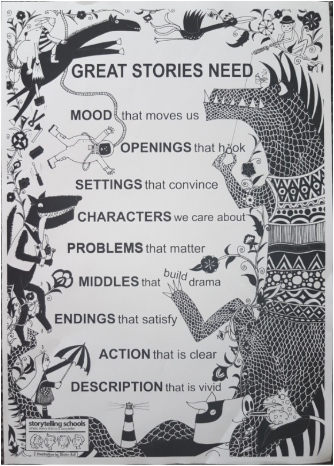
    On 1 February 2019 we had a professional learning workshop with Lisbeth Swanson from 'StoryWays Literacy' (Storytelling) who visited us at school.

    Purpose:
    - Consider the language needs of learners (Our school, societal, global)
    - Understand the pedagogy of learning and teaching with a storytelling approach
    - Learn how to prepare and teach the telling of a story using ‘Hear - Map - Step - Speak’
    - Know of the key elements in the Storytelling schools Teaching Model


    New ideas / What I've learned:

    • Use storytelling to motivate, energise and accelerate oral language and writing
    • Learning to tell stories from memory is a great way to learn all sorts of essential skills
    • Speaking, listening, confidence, empathy, ideas, facts, sequences, plots … you name it, storytelling can teach it.

    Goals: 
    • Tell a story (not just reading) with attention to voice, gesture, feature language 
    • 'Loiter' with the story - oral language at the center
    • Follow-up writing opportunities


    ~ "Knowledge isn't power until it is applied" - Dale Carnegie ~

    Tuesday, December 18, 2018

    A Year in Review

    Looking back on my 'Walking on a tightrope' post at the start of the year, my one word was 'DO'...

    Reflecting on my 'DO'
    1. Get-up-and-Go (be determined and full of energy) - This I have definitely achieved in all areas this year. 
    2. Stop and celebrate [even little] Successes - Yes, not only did Seesaw's ePortfolio enabled me to regularly check in and comment on students' progress, which has been celebrated weekly by a 'Virtue award', but progress was recognised and celebrated almost daily in our learning environment. 
    3. Look after myself (no school work after 6.00 pm) - Although I did look after myself, I was not able to do no school work after 6.00pm... in fact due to all my responsibilities, I have been working later than I have last year, even during weekends! Maybe this goal was a bit unrealistic?
    4. Continue DOing [something] despite difficulties (stick-to-it-iveness) - Thankfully, I did not experience any difficulties (personally)
    5. Do what I believe to be best for ALL my students as they are my number one priority - As I understand the importance of inclusive education and that for some learners to access the curriculum and realise their potential, I was able to focus effectively on curriculum adaptation and differentiation.
    6. In my role as Assistant Principal and ICT Lead, I will take the 'bad days' in stride and remember that I get to start fresh tomorrow - One of my leadership strengths, I believe, is to actively support colleagues, reframe dialogue/thought processes to eliminate deficit thinking and focus on the capabilities, progress and successes. I have been able to transfer this effectively in my leadership role, enabling and fostering a positive, safe and united culture where successes are celebrated with all staff. As an effective communicator, I demonstrated exceptional communication and interpersonal skills in my current roles, supporting staff as and when needed. 
    7. Blog more regularly - Not yet...

    Highlights for me this year
    1. Some of my Professional Development included:

    • SENCo Development and Training online course/study through Raising Achievement
    • Embedding Oral Language Across the Curriculum workshop by Sheena Cameron & Louise Dempsey 
    • Anxiety, Learning and Behaviour workshop by Dr. Izelda Pelser, Educational Psychologist, MOE 
    • ‘The Developing Brain’ workshop by Nathan Mikaere-Wallis 
    • Online training to be recognised as a Seesaw Ambassador
    • Digital Passport: Workshop One - Years 1 - 3 Certificate 
    • Digital Passport: Workshop Two - Years 3 - 5 Certificate 
    • ‘Setting your School up for Success’ seminar for SENCo / RTLB / RTLit
    2. My Presentations:

    • Digital Technologies & Hangarau Matihiko: Build awareness and mobilise (Staff meeting - 11 June 2018)
    • Collaboration for Success: SENCo and Learning Difficulties (Staff meeting - 28 May 2018)
    • Digital Citizenship & Cyber Safety (Staff meeting - 14 May 2018)
    3. Teaching as Inquiry:
    After administering an Oral assessment, I analysed the data, which helped me to identify target learners who are ‘at risk’ and their specific areas of need. I then started my 'Teaching as Inquiry' by asking 'How can I enhance students’ oral language skills through retelling (news & after guided reading) using Seesaw, which will then also result in authentic writing experiences?'

    I planned deliberate activities that meet the needs of these learners, whilst also capitalising on spontaneous authentic learning opportunities that support oral language development.

    Student achievement can be seen as shown in the end of year spreadsheet below. 
      
    Although Student 4 still requires some support (student had trouble with attendance), I am pleased with the overall progress.

    4. Other:


    5. End of Year Highlights:
    I received so many lovely messages and gifts... here's just a few messages... #EndOfYear #FeelingBlessed


    ~ "Teachers should not forget how far they take their students every year" ~

    Friday, August 3, 2018

    Further assessing children identified as 'at risk'

    As part of my online SENCo training, I had an opportunity to work with and learn from Jenny from Raising Achievement on assessing students identified as 'at risk' to further identify their specific learning difficulties using a Screening Assessment kit. This will be very helpful in my role as SENCo and will enable me to create a specific plan to help cater for the needs of these students.
    The purpose of the Screening Assessment is to find underpinning cognitive weaknesses. These are the underlying reasons why students are being held back and not able to achieve in academic subjects. Underpinning Cognitive Weaknesses are Auditory and Visual Processing problems. Other Underpinning Cognitive Weaknesses are things like processing speed, short term and working memory and gross and fine motor skills.

    I learned about the different Screening tools and what to use for students under the age of 7. Yes, it can be done under 7... and [in my opinion] early identification is vital.

    Reflection:
    I am absolutely loving my role (on top of everything else) as SENCo. It is rewarding to see how students progress when given extra support and to see their confidence grow!

    I am looking forward to implement my new learning into my role to support students, teachers and teachers' aides.


    ~ "A child with 'special needs' will inspire you to be a special kind of person. - Anonymous ~

    Wednesday, July 25, 2018

    Oral Language across the curriculum

    This workshop presented by Sheena Cameron and Louise Dempsey aimed "to support teachers to include more quality 'learning talk' in the classroom and to embed purposeful oral language opportunities across the curriculum." This was timely PD for my Teaching as Inquiry with my focus on developing Oral Language.

    We started the session with the Talking strip - Introductions' by turning to a partner and by follow the steps on the strip.

    We can use oral language strips to get children talking and using full sentences. Explicit teaching can include using pictures - lips closed, eyes open, ears listening etc.

    The types of talk:
    1. Exploratory talk (to help us understand and develop ideas)
    2. Presentational talk (to share ideas and information and to entertain others)
    3. Conversational talk (to build relationships)

    Types of listening:
    1. Informational listening (to obtain information and understand ideas)
    2. Critical listening (to evaluate ideas and form opinions)
    3. Appreciative listening (listen for enjoyment)
    4. Responsive listening (listen to build relationships)

    Establishing a 'think, pair, share' culture. Move away from the 'hands-up' approach as it is controlled by the teacher and severely limits student talk. This often results in a small group dominating the talk in a competitive manner.

    Listening activity ideas:
    1. Partner activity: call a friend - pretend to talk on the phone to a friend about something. Sit back to back and share.
    2. Barrier games - making shapes, use a barrier to hide. Two students have the same bag of sticks. One student makes a shape, the other has to make the same shape through listening to the other's description. Another one is the Pizza barrier game where one has to explain to the other how to add pieces on the pizza.

    Asking more open questions using:
    1. Question strip
    2. I wonder...?

    Students should be talking in full sentences and elaborating on ideas...

    Some elaboration questions / Prompts:
    - Tell us more about...
    - Why do you think that?
    - Can you give us an example?
    - What is your evidence?
    - Can you justify your opinion?
    - I have another example...
    - I have a different idea...

    Some alternatives to questions:
    1. Students sit in a circle. Introduce a talk topic. Students use a microphone for taking turns to talk and to generate questions.
    2. Shared Reading - predictions from cover. Do think-pair-share. Move away from hands up.
    3. Make a suggestion - "My idea is ..." can help with getting students into a discussion

    Talking groups:
    Use different groupings to increase opportunities for student talk
    1. Think, pair, share (partners)
    Pausing in a lesson engage students in 'think,pair, share' and benefit both students and teacher as students shift from passive to active learning.
    - Think:  allow students five seconds to think of what they will say
    - Pair: students talk for a short time with a partner. Teacher can end talking time with simple countdown from five
    - Share: a range of students can share back responses when appropriate and not necessary every time students talked to a partner.

    2. Think, pair, square
    Instead of sharing back as a class, partners can turn and face another pair and then share as four. Students can listen to ideas from one pair and summarise/add and new idea/ask a question.

    3. Doughnut circle
    Students sit or stand in two circles, outside one faces inward and inside one outward, so that all is facing a partner. Each student have a turn to speak. When it is time to change partners the teacher could call 'switch'. The inside circle then moves one partner to the left.

    4. Jigsaw
    Effective when planning an in-depth collaborative task. Each student in the group is given a number e.g. 1, 2, 3 or 4. Students with same number move to form a group. students then work together to learn about a topic and afterwards return to their home group and each team member shares his or her information.

    5. Listening triads
    Students work in groups of three taking on roles e.g. speaker, questioner, recorder [and/or] speaker, listener, questioner. The speaker talks about something specific and afterwards the other two students follow their roles by either asking questions (Questioner) and taking notes (Recorder) in order to feed back to the speaker, another group or whole class. Roles can be rotated.

    6. Circle
    This is a common grouping in the classroom. The idea is that everyone in the circle have a turn to say something. Students talk and listen to other's ideas and points of view. It is also good practice for speaking in full sentences.

    7. Line up
    Similar to the doughnut circle except students face their partner in two lines.

    8. Horse shoe
    Similar to the circle, but students are able to view the teaching area as well as each other.


    ~ "Children need writing to help them learn about reading, they need reading to help them learn about writing; and they need oral language to help them learn about both." - Anonymous ~

    Saturday, May 5, 2018

    Learning in a Digital World

    I have been delighted to hear that I have been successful in my application for a grant after completing a 200 words impact statement for a Robotics Kit to enable a group of selected students of our school to participate in the 2018 FIRST LEGO League, which is a project-based, STEM education program. My aim with this is to engage our students and to get them excited about learning through robotics, whilst also immersing them in the world of technology. Our students will learn to participate in real-life, hands-on activities which has been designed to develop critical thinking, creative problem solving, collaboration and teamwork - all skills that are needed to be successful in the today's world.

    One of our teachers, Matua Mel agreed to being the team coach / mentor. I will assist as 2nd coach / mentor as and when needed.
    Matua Mel and I are excited to join our students on their learning journey!


    ~ "The most important principle for designing lively eLearning is to see eLearning design not as information design but as designing an experience". - Cathy Moore ~

    Tuesday, April 17, 2018

    The Need for Change

    Back in 2017, Hon Nikki Kaye, @nikkikaye said "Digital fluency is now an essential life skill for our young people, so we must ensure they have the skills and knowledge they need to engage in an increasingly digital world." Personally, as Assistant Principal, ICT Lead and teacher, I have been excited about the announcement of this whole 'digital shakeup' for our NZ school curriculum. This change was needed for our education system and has made me carefully considering my goals in my respective areas of responsibility. I wrote a blog post after attending one of the Digital Technologies / Hangarau Matihiko (DT&HM) Consultation workshops in 2017 in which I've added some valuable links.

    Anand Timothy, eLearning Enthusiast and co-founder and Director: Business Development at eNyota Learning, also wrote: "Technology is making our world more interesting… it is changing our perspectives… it is redefining previous definitions of normal. Technology has become the great disruptor; the magic wand that gives us the power to make or do things that were previously unthinkable."

    One thing that makes me cringe lately, is when I read comments from educators who talk about how they hear and read about research that is warning educators about the effects of 'screen time' on our students....
    It makes me wonder how many educators are aware that Computer Science can also be taught through engaging games and puzzles that use cards, string, crayons and lots of running around (no 'screen time'!). This can then be integrated into the curriculum through activities and exercises.

    I also feel a bit frustrated, when people make comments like "this is a separate digital curriculum" and "we already do this at our school"... hmm, yes, but there is so much more to the [new] DT&HM curriculum...
    In my humble opinion, I do not see this as a separate digital curriculum. In fact, the re-organised Technology learning area still has the three strands of Technological Practice, Technological Knowledge, and Nature of Technology. The only difference is that there is now five technological areas instead of three. The new content covers Computational thinking for digital technologies and Designing and developing digital outcomes as Progress Outcomes.

    I can fully understand that there are [some] uncertainty, hopes and fears about what this means for schools from 2018 onward. However, there are opportunities to upskill... one such opportunity came through the 'Digital Passport' created by The Mind Lab by Unitec "which empowers teachers in New Zealand to realise the opportunities of the new digital curriculum and bring 21st century skills to today’s students."

    I gained some valuable insights after completing two of the Workshops, but do not consider myself an expert now. However, I truly believe that your attitude determines your direction... what you do with this [new] exciting change is up to you, my quest for knowledge will carry on... and I will guide my school colleagues along on their journey to the best of my abilities.


    'The Tweet'


    References:
    NZN. Major education shake-up as schools shift to digital focus, Retrieved from: Newshub 

    Timothy, A (2016). How Technology Benefits Learning. Article written for eLearning Industry

    The Mind Lab (Monday 19 March). New education platform empowers Kiwi teachers in the 21st century, Retrieved from their Media release


    ~ "People who are crazy enough to think they can change the world are the ones who do." - Steve Jobs ~

    Monday, April 16, 2018

    Seesaw... no turning back!

    Although I've always aimed for my students to have a digital portfolio (trialling and using many different platforms in the past), I had not been convinced that Seesaw was the way to go.... BUT oh boy, was I wrong! Seesaw is an excellent platform for housing student work and sharing it with parents. The feedback and communication is instant.

    The Ministry of Education have seven key principles (Ako, Focus and coverage, Foundations for learning, Student responsibility, Motivation, Technologies, Checking in with parents) that guide effective reporting and information sharing. After using Seesaw for almost 3 months now, I already recognise the benefits of this student-driven digital portfolio and I believe that if Seesaw is being used effectively it has all the tools to fulfill this MOE 'requirement'. Hence (after having a chat with my favourite online mentor Sonya, @vanschaijik) my decision to apply to become a Seesaw Ambassador to support teachers [further] with integrating technology effectively into their teaching and to serve as an expert resource to other teachers, by sharing how I use Seesaw in my class.

    I love that I can create and assign activities for my students when planning 'lessons', but that is not all... students can post to their journal and reflect on their learning instantly! It also gives me insight into their understanding and enable me to track progress over time. Parents can also look back at all the learning that their child added to their journal and see how much has been learned. This 'tracking' can easily be done when using folders when posting.

    Some examples of how I have been using Seesaw with 5 year olds:
    1. Goal Setting and Reflection...

    2. Reading / Phonics / Sightwords...

    3. Writing...

    4.  Maths...

    5. Discovery / STEAM / Key Competencies

    6. Some others...

    The Values that Seesaw stands for speak for itself... 

    Therefore, I consider myself lucky and feel proud to be part of the Seesaw family...

    Reference:


    ~ "It's more important than ever that educators collaborate to continually improve and support the success of each learner." - Dr. Gene Carter, CEO and Executive Director of ASCD ~

    Tuesday, January 30, 2018

    School Virtues and the Key Competencies

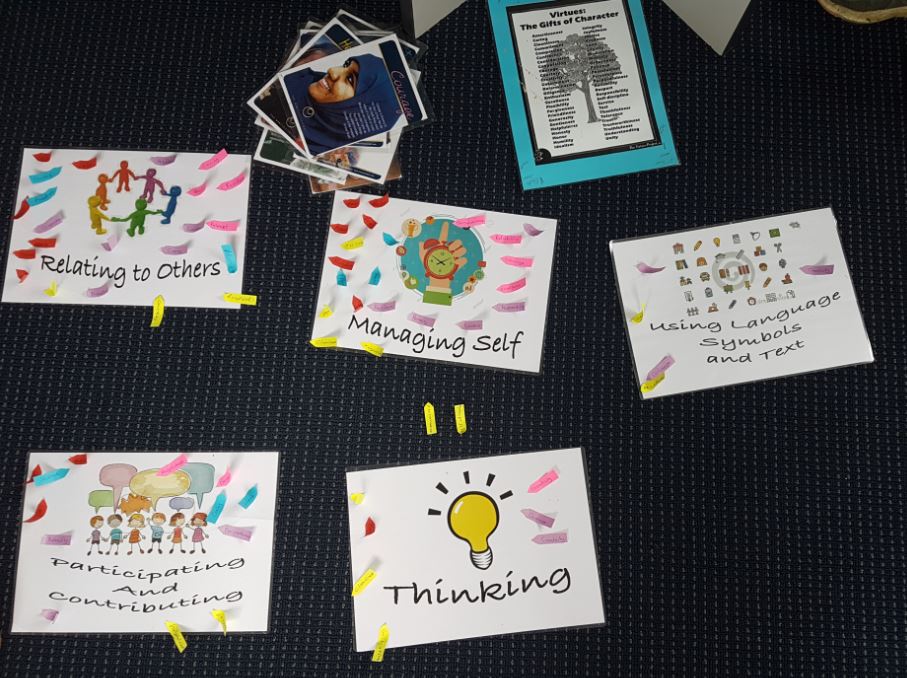
    As a staff we looked into prioritising the daily use of our 20 school Virtues in a natural and meaningful / contextual way. Therefore we decided to 'unpack' the Key Competencies and linking them with our school Virtues.

    In past years we have been weaving the Key Competencies and Virtues into the planning of learning experiences, but now we are reflecting on how we could / would make this work better for our students and how this could help them with their reflections on learning outcomes.

    As stated "The key competencies element of The New Zealand Curriculum brings with it exciting possibilities for making students’ experience of learning more relevant, engaging, meaningful, and useful. Key competencies-rich programmes will enable students to be confident, connected, actively involved learners in the present and in the future. They will encourage lifelong learners who are equipped to participate in rapidly changing local, national, and global communities." (NZ Curriculum Online, 2014)


    Why do key competencies matter?
    Constant change in the nature of work and technologies means that learning is a life long pursuit and students should be taught to think, to work collaboratively, to be creative and to discover. The key competencies support this and brings with them a future-focused outlook to teaching and learning, where students are at the centre.

    Some things to ponder...
    - Skills required 'today' is not being taught in today's schools
    - Think about how many students might finish school without knowing their potential...


    References:
    NZ Curriculum Online (2014). TKI - Culture / Leadership and the key competencies


    ~ 'Thinking': "We can't solve problems by using the same kind of thingking we used when we created them" - Albert Einstein ~
    ~ 'Participating and Contributing': "Alone we can do so little, together we can do so much." - Helen Keller ~
    ~ 'Relating to Others': "Always put yourself in the other's shoes. If you feel it hurts you, it probably hurts the person too." - Rachel Grady ~
    ~ 'Understanding Language, Symbols and Texts': "The more you read, the more things you know. The more that you learn the more places you'll go." - Dr Seuss ~
    ~ 'Managing Self': "The moment you take responsibility for everything in your life is the moment you can change anything in your life." - Hal Elrod ~