Showing posts with label RTC 08 - Akonga Learning. Show all posts

Friday, December 15, 2017

End of Year - A Quick Reflection

With my 'Possibilities, Options and a Course of Action' post at the start of the year, I was looking forward to pursue the many things that was twirling around in my head...

Unfortunately, I did not always 'stand firm' mentally and emotionally when challenges arise, so my one word, prudent (adj) 'acting with or showing care and thought for the future' did not always come to fruition, as there were days I was not ready for some unexpected challenges / bumps in the road.

One of my biggest 'problems' was that I felt tired, tired and tired. I question myself constantly as to my lack in motivation to effectively use my PLN (Twitter, VLN, EduCampNZ) and colleagues to create productive working relationships by learning from others, asking questions to find out the thoughts of others and to reflect understanding. 

Many days, I felt like "Forget Everything and Run" rather than to "Face Everything and Rise." (the two meanings of F-E-A-R according to Zig Ziglar).

The following post on a closed group also made me wonder if this showed what teaching became for so many in 2017... yes there are other stories too... unfortunately.


Throughout my unexpected challenges, I think I stayed true to my students... one example:
Two of my ‘at risk’ Māori students (Student 2 and Student 3) experienced difficulty with oral language. 

I reflected on why this might be and came to the conclusion that the pronunciation of Māori vowels in relation to English is quite different, which could very well contribute to their specific areas of need. A ‘non-confident’ Māori student, can find this extremely difficult and result to them finding it hard to follow instructions, process information etc.
I planned deliberate activities that meet the needs of these learners, whilst also capitalising on spontaneous authentic learning opportunities that support oral language development. 
Steps was to:
- Locate, create and utilise a variety of activities/resources support sequencing development.
- Use Big Books and Cards, and use the planning support that accompanies these to develop oral language.
- Use guided reading lessons to continue modelling and promoting retelling of text with a focus on oral language.

Although Student 2 still requires some support, I am delighted with the overall progress - as this was a student who did not talk at all to start with.

Progress can be seen as shown in the end of year spreadsheet below. 
All the blue areas, were areas of concern. Now it is only the two green areas, which I am confident will be shifting further [as well] in the coming year.


One of the best parts of this year [for me] was working in classes alongside teachers and ākonga to develop capability in pedagogy (teaching and learning) and the use of technology as a tool to support learning in my role as 0.2 learning Facilitator with Ngā Pūmanawa e Waru. Part of our (my) role was to working through and with the wider community to enable ubiquity (every where, anytime) of learning, honouring an authentic Rotorua and Arawa context, foster collaboration for learning across Rotorua (I have a G+ community for junior school teachers where we share resources / ideas) and to build knowledge about Future Focused Learning. I have been working with teachers and school leaders (I engaged regularly with principals about growth in teacher adaptive confidence and professional development) by embedding effective future focused teaching, using learning technologies to build learner competencies. 

End of Year Highlight:
Received a choc bar with this lovely message from a student! #EndOfYear #FeelingBlessed


~ "Ships don't sink because of the water around them; ships sink because of the water that gets in them. Don't let what's happening around you get inside you and weigh you down... stay up." - Unknown ~

Friday, August 11, 2017

Learner Engagement... 'Me and My School'

I was privileged to attend a NZCER 'Me and My School' Learner Engagement Survey Workshop.

"Me and My School is a unique, research-based student engagement survey designed for New Zealand students Years 4 to 10. It offers a snapshot of the learning culture in your school, standardised data to track progress over time and a nationally referenced gender, ethnicity, and year level comparison." - NZCER

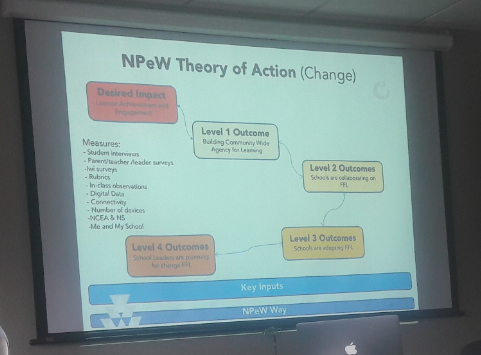
Why 'Me and My School'? (Theory of Action)

Outcomes of using 'Me and My school':
- Impact of NPeW
- Potential link to other data
- Useful assessment at multiple level (schools, CoLs, District)
- Input into school strategic plans for 2018

What does the survey measures? 3 main aspects: - Behavioural - Effective / emotional - Cognitive (willing to try new things??) Links to the Key Competencies

Getting staff ready for online survey:

- Use demo sites to introduce staff - Teachers need to talk students through 'instructions' & 'about me' parts - When students start with survey, advised that teacher should not be walking around, due to anonymous nature

Results: - With online reports you can view interim reports - Making sense of the reports - lots of different ways that data can be looked at / intrepid. Tips: Think about protocols on how to administer - maybe get students to all do it together in class or think about how it works best for your students. If someone is away, get them to do it when they are back. Aim to get all students to partake.

Conclusion:
This assessment tool is designed to give a school robust and systematic information about student engagement.


~ "Measure what you value instead of valuing only what you can measure" - Andy Hargreaves ~

Wednesday, August 2, 2017

Digital Technologies / Hangarau Matihiko Consultation

I have been really interested in attending the consultation sessions, since the official announcement in regards to the addition to the New Zealand Curriculum from Education Minister Nikki Kaye and as Digital Technologies|Hangarau Matihiko is to be formally added into the NZ Curriculum by 2018 and fully integrated by 2020.

My notes:
Leadership / BOT session - 9.00am - 12.00pm
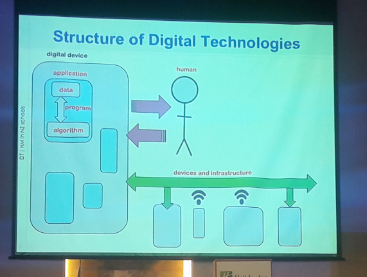
When thinking of DT, think about people using it.
Digital supports arts, science etc. It is not standing alone.

Timeline:

What is needed to teach DTIHM?:

Algorithms are not new to us. Give students the opportunity to learn the language.


- Writing a program brings the algorithm to life.
- Computational thinking is about how to create something new.


In Technological Areas part - (‘Computational thinking for digital technologies’ & ‘Designing and developing digital outcomes’) are the new part of the Curriculum.

How would you start a conversation about DT in your school? What does it look like? What is it about? 
- Take away the ‘plugged’ element
- Unplugged/ de-plugged (http://csunplugged.org/)


It is not about the pc that sits on the desk, but the pc that sits in the mind. Schools have autonomy on how to implement.


Teachers' session - 1.00pm - 3.00pm

Students should be "doing" computational thinking without computer / numbers (using alphabet)
How would you explain this whole new digital world to primary schools?
This is not about tech hardware, it’s about our brain.
We have a role as navigators and guides to our children

Creating with technology can have students feel ownership.


Algorithm comes up quite a lot in the new curriculum. All data is represented by using 2 values (binary code). A bit is the smallest bit of information...


As I am really passionate about technologies and how it can be used to support learning, I am looking forward to the implementation and embedding of ‘Computational thinking for digital technologies’ & ‘Designing and developing digital outcomes’ in learning by 2020.


Additional links:
Strengthening Digital Technologies Hangarau Matihiko in the Curriculum - A collaborative Doc created by Allanah King.
- Digital technology | Hangarau matihiko curriculum consultation: Workshop video
- Blog post by Sonya Van Schaijik


~ "Technology opens the door to the world. It's up to us to walk through it in a meaning ful and respectful way." - Unknown ~

Thursday, May 18, 2017

Phonics awareness - a great place in setting students up for literacy

I've always incorporated Phonics into my literacy programme, but as I am constantly reflecting on my teaching and how it can be improved, I jumped when the opportunity to attend the 'Yolanda Soryl workshop' arose.

Yolanda confirmed the view I have that students need a range of basic phonics strategies so they can easily work out new words in reading and spelling.

Teaching tips and pointers
  • Allow only lower case letters to be written in phonics
  • Only have a reason for a capital letter like writing your name. When they write a capital letter in writing ask what the reason was for writing letter in capital - if no reason, rub out.
  • Only teach capital after lower case is secure

Summary:
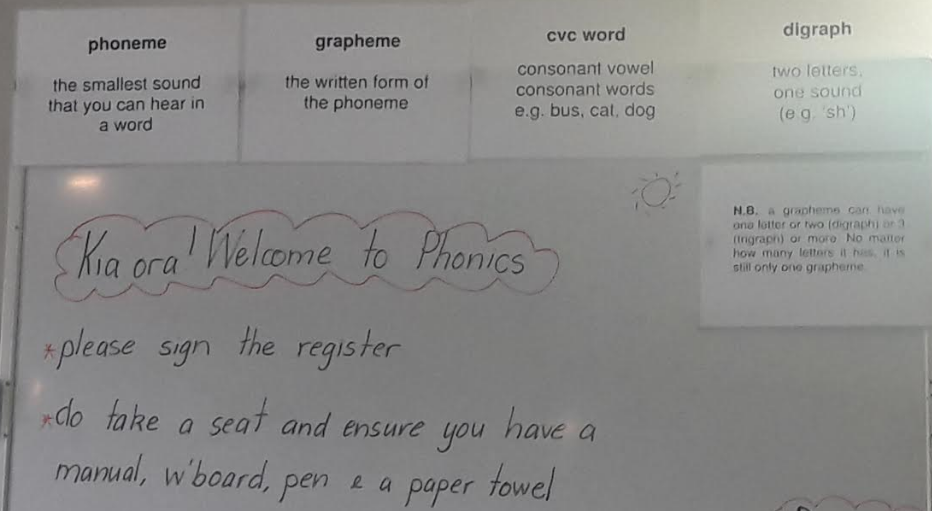
  • Blending important for reading: d, d-o, d-o-g = dog
  • Break up word to write- segmentation
  • Some students know their sound, but don’t know how to break it up
  • Teach kids how to hear
  • The aim is to look at work and recognize it instantly
  • Read name before school - this is recognition of graphic knowledge
  • Teach high frequency words fast
  • Phonics is for low reading learners
  • Grammar - does it sound right. Get them to read their sentences back
  • Ingrain a sense of a sentence - repetitive reading
  • Teach students to re-read their writing, to check if it sounds right. 
  • 3 levels that students use to connect (sounds, words, sentences). Students that struggle don’t connect these three
  • Important to decode to enable them to comprehend
  • Book introduction important - look and introduce unfamiliar words
  • Teach fluency at word level - then you have chance to read page
  • Dyslexic kids tend to use both sides of the brain
  • Hear low level reader read out loud every day to improve reading outcome
  • Phonics is about using sounds, not only knowing sounds

I am also looking forward to the release of the Phonics App which can be used to learn/revise the alphabet sounds. It also follows a Phonics 'Hear, Read, Write' lesson plan and can stand alone or be used to revise a lesson. The App features a New Zealand accent which is so important for helping students learn the short vowel sounds.


~ "It shouldn't matter how slowly a child learns, as long as we are encouraging them not to stop" - Robert John Meehan ~

Friday, December 16, 2016

What have I learnt this year?

Teaching as Inquiry and Appraisal is a process to help improve teaching practice and to prove that you are meeting the obligations and requirements of being a professional. Our school’s appraisal process integrates the two of these into a process that is based upon evidence, mutual trust and respect.
“...effective pedagogy requires that teachers inquire into the impact of their
teaching on their students.” NZ Curriculum, p35

This year I 'connected' this with our eLearning Plan and focused on Digital Citizenship (to make students aware of the ‘dangers’ and to increase knowledge of how to keep themselves safe online) and Digital Competency - Literacy (enable students to create digital content and adding media).

Baseline date compiled, showed a “current state” where my Year 1 students lack confidence in Digital Competency - Literacy. Although only a limited number of students were interviewed, my inquiry had a whole class focus and was not limited to specific students.

My Focus Questions were:
How can I  use eLearning tools (digital resources/ iPads /ePortfolios to support the class) to:
- Teach students about digital literacy and citizenship
- Support students to be engaged with what they are doing to improve learning outcomes
- Use eLearning to enable students to become thinkers and risk takers and reduce          dependence on teacher

eLearning tools and learning opportunities I trialed [with success] were:
- Easy blogger Jr
- Explain Everything
- Write About This NZ
- Quiver (Augmented Reality)
- KidsedchatNZ

I made sure that eLearning tools served a purpose when digital content was created to enhance learning as I strongly believe that the tool should be used to support learning.

We worked hard together to achieve the desired 'outcome' and getting positive feedback along the way sure helped and served as motivation.


Through consistent reflection it became evident when I had to revisit or changed what (and how) I do and where I needed to change direction and start again.

What have I learnt?
- I had to learn to ‘let go’ to enable students to become thinkers and risk takers to reduce dependence on teacher
- Things don’t always pan out in the best way possible and I had to consider theories about why something might be happening, which helped in my critiquing.

Reflection / Next Steps:
I feel that in many cases, the 'task' set contributed to students' critical thinking as they had to think what's needed to focus on for the learning outcome. I'd also hoped that students would 'integrate' / use technology naturally to explain their work. However, many times I still had to ask [them] if they would like to share their work on their blogs, using one of the apps. I don't think they see / understand the possibility of an iPad as tool to create / explain learning yet. Therefore, something I will need to work on next year is to make them aware of the potential this holds for learning.


Resources:


~ “To be digitally literate is to have access to a broad range of practices and cultural resources that you are able to apply to digital tools. It is the ability to make and share meaning in different modes and formats; to create, collaborate and communicate effectively and to understand how and when digital technologies can best be used to support these processes.” - (Hague & Payton, 2010) ~

Sunday, September 18, 2016

Augmented Reality in an Educational Environment

An article I have written for New Zealand Interface magazine (Issue 74, September 2016) on using Augmented Reality (AR) with 5 year old students:

Inspiring and engaging my students to make their learning real is important to me and I know that technology has the power to enhance learning. I see it as essential to bring it into my classroom to focus the learning onto the students’ future.

One opportunity that it brings to learning is 'Augmented Reality'. I have been aware of using AR for a while, but it was when I was reintroduced during my postgraduate study (The Mind Lab by Unitec) that contextualised it for me.

Here are two ways in which I have used this in students’ learning through the AR app Quiver.

Cluster Summer Sports
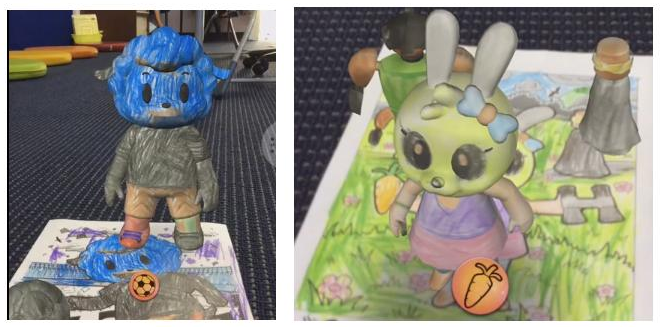
Firstly, they had fun reflecting and talking about their participation in a Cluster Summer Sports Day in which they were involved. Without the students even knowing, in this activity they were also touching on the Speaking and Listening component in the NZ Curriculum.

After choosing one of the two pictures provided (one for their ball kicking activity and the other for the game ‘rats and rabbits’), students coloured their choice using their favourite colours and then watched as their picture came to life just the way they'd made it.

Students took a screenshot and published their reflections verbally on their ePortfolios. (http://goals-r-us.blogspot.co.nz/2016/04/augmented-reality-using-quiver.html).

Erupting Volcanoes
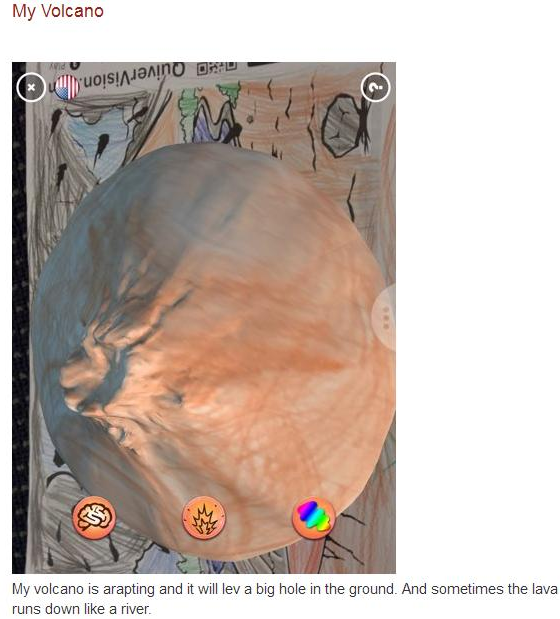
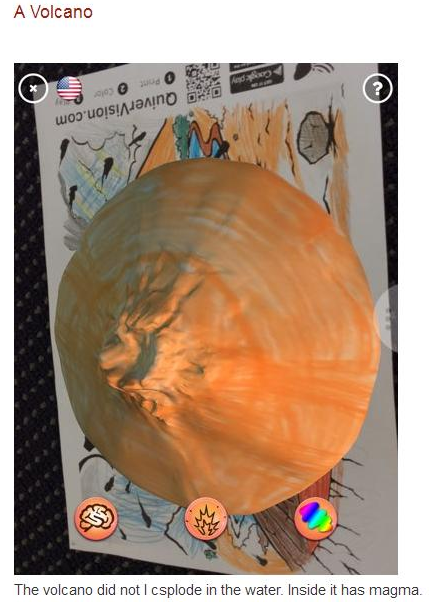
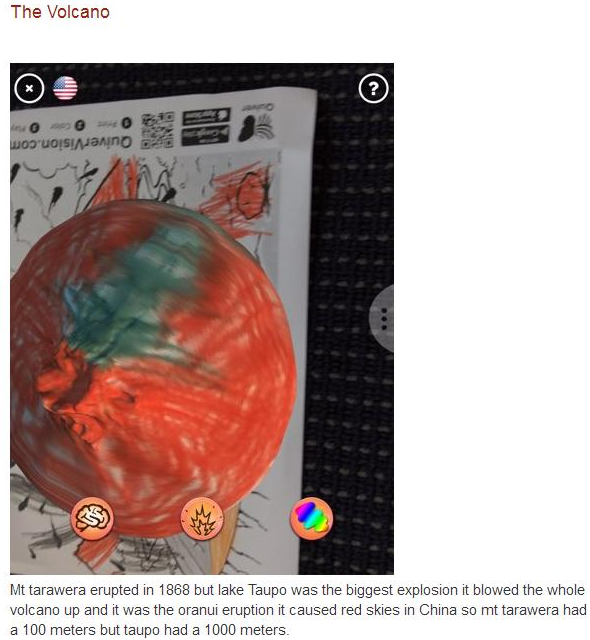
A second example was when students were learning and inquiring about volcanoes. I printed the volcano picture from the Quiver website.  Students took a screenshot and wrote a story about it.  They had the opportunity to choose how they would like to present what they knew and learnt about volcanoes. This has not only engaged them, but also enabled me to see what they have learnt. Writing has also becoming more fun, especially for the boys.

Some stories were published on our class blog


Excitement and engagement
To experience students’ excitement and engagement in their learning, is priceless and shows me that engagement is critical to their learning. The use of these digital tools gives them the opportunity to deepen their skills in engagement, communication, collaboration, critical thinking, as well as creation. It also allows students with various learning styles alternate modes to interpret ideas and understand challenging concepts, enhance their engagement & success.

As I see the difference in the learning of my engaged students, it becomes easier to find ways to incorporate technology into their learning. And, in my experience I have found that AR can be used in all learning areas of the NZ Curriculum. Making a difference and engaging students is not about what I teach, rather, it is about how I teach. This experience has been life-changing for me. It really gave me an opportunity to make a lasting difference in the lives of my young students.


Screenshots from Interface:


~ "Reality is merely an illusion, albeit a very persistent one." - Albert Einstein  ~

Friday, July 8, 2016

Reflection on Term 2, 2016

After a very busy ten weeks, the term has come to an end.

Although we worked hard on reading, writing and maths, other learning areas played a just as important part in helping students on their path to become risk takers and confident, life-long learners.

Areas that I [also] focused on was 'Digital Citizenship' to make students aware of the ‘dangers’ and to increase knowledge of how to keep themselves safe online and 'Digital Literacy' to enable students to create digital content and adding media independently. There were times that we had to revisit some topics more than once to ensure that students grasped the concept.

Students had a go at using the 'Quiver' app (for our inquiry topic) to colour a volcano picture and to then write a story about it. It was great to observe that some students were starting to think about how to share their learning, asking if they should write the story using the iPad (easy blogger jr) or in their books. I gave them the opportunity to choose.
The use of 'Explain Everything' to engage students with their reading books was really going well. My next step here would be to get them to use this ‘without instruction from the teacher’.
Students also enjoyed using the 'Write About This' app and we received some lovely feedback.

KidsedchatNZ had again proved to be a valuable tool to support our students' reading and writing abilities. One week I had one of the senior students running our tuakana/teina session, which was a great success.

I also included a lot more 'problem solving' maths activities and it was interesting to see how students approached the problem after it was launched. They were interested to hear what their peers had done. Some students were able to explain the process to others that struggled through the problem. This was powerful as students showed the solution in smaller steps to their peers.

To make our tuakana/teina buddy reading session with Room 3 effective, we looked again at the purpose of buddy reading and what needs to be focused on. Ideas were brainstormed on what effective buddy reading looks like, sounds like and feels like.

Students have been involved in many 'hands-on' and 'thinking' learning activities and their progress was evident when assessments were carried out. I feel incredibly proud of what my students and I achieved.

What is something new to try and where to next? 
To set up Skoolbo accounts for my learners to provide each one of them with a personalized learning experience to further improve their maths and language skills. 


~ "The expert in anything was once a beginner" - Anonymous ~

Friday, June 10, 2016

Sandpit with Google Classroom at Connected Rotorua

What a fantastic turn out for our session on using Google Classroom as a structure to support Future Focused Learning, with staff from nine out of the [current] twenty Ngā Pūmanawa e Waru schools attending.

Hancine and I came prepared with our presentation slides, but with the number of attendees, decided to change 'the plan' and Hancine quickly sussed out that the knowledge were in the room.

There were many new faces and we got underway with the usual introductions, whereafter people that felt comfortable, took up the role of leading a small group in setting up and using Google Classroom. The collaboration among our educators were great.

If you are interested in learning more about Google tools for the classroom have a look at Monica's Google Site 101. Thank you for sharing this, Anne.

A warm thank you to all who attended the session on a wet Friday afternoon/evening.


~ "Everyone you will ever meet knows something your don't." - Bill Nye ~

Thursday, June 2, 2016

Using ICT to Enhance Literacy

I have been asked by the Waiariki Literacy Association to present and run a workshop on how ICT can be used to enhance literacy.

Thinking back to when I first started presenting in 2013 under the wing and guidance of an amazing woman Sonya van Schaijik, and then to my CORE Education #eFellows14 presentation at uLearn in 2014 with the support of mentors Louise and John and the fabulous people in our 2014 eFellows group, I know I have come a long way.

Previously, I would be scared to bits just by the thought of giving a presentation, but lately I feel quite excited by the prospect of presenting to a group of people and then giving them the opportunity to 'have a play', whilst supporting and answering questions.

These opportunities also helps me to grow personally, as I get challenged with questions that I [sometimes] do not have all the answers for. Then... back to learning I go!


~ "Too many people spend too much time trying to perfect something before they actually do it. Instead of waiting for perfection, run with what you go, and fix it along the way…” - Paul Arden ~

Friday, April 15, 2016

Reflection on Term 1, 2016

Whilst some students were known to me, our environment welcomed a couple of new students and I enjoyed making new connections and re-connecting with everyone. As I am not involved in Reading Recovery this year, I enjoyed being in class for the whole day and it was great for us getting to know one other.

KidsedchatNZ had been re-introduced to my Year 1 students as we had Room 3 working with us. Great Tuakana/Teina relationships were displayed when participating in topics such as 'Greatness', 'Digital Citizenship', 'Sport and Learning' and 'Term 1 Reflection'. Our participation has been one way of supporting students with increasing their reading and writing abilities.

After last year's reflection, I've decided to change my maths programme a bit and to start with introducing doubles [first] to my students. I've also included a lot more 'hands-on' maths activities and my students enjoyed learning doubles with hopscotch.

During reading time we worked hard on making their reading sound like talking and we valued our Tuakana/Teina reading time. I [once again] realised how powerful this experience was when one of my 5 year old's told me "I want to read like her."

Students also worked hard on learning the Essential Spelling Lists to help them when writing stories. I really enjoyed seeing them gaining independence and the excitement when they were able to use these words in their writing.

Students were exposed to many opportunities this term: Inquiry, Go4it, Swimming and many more (feel free to view the class blog). I have also introduce an app called Quiver to help them reflect in a fun way on our Cluster Summer Sports day.

Personally, I felt pleased and happy about the session I lead on our Teacher Only day where Easy Blogger Jr was introduced to colleagues. This was a result from our eLearning Plan where one of our key decisions were to have a collaborative environment with a move to GAFE and Junior Blogger to support students' ePortfolios.

I have been extremely busy [since last year], not only with assignments towards my Post Grad in Applied Practice in Digital and Collaborative learning, but also with establishing and finalising a whole school inquiry through the Academy for Collaborative Futures' Voyager Programme.

I feel happy getting slowly back onto twitter and enjoyed the opportunity to participate in and learn from others in chats like #ldrchatnz and #DigitalEdChat recently.


~ “We do not learn from experience... we learn from reflecting on experience.” 
- John Dewey ~


Monday, April 4, 2016

Auditory Processing Disorder

I was lucky enough to be part of a workshop presentation by Angela Alexander, Doctor of Audiology, from the Auditory Processing Network. She shared with us information on APD and some quick tips and tricks to enhance life and learning for students with an auditory processing disorder. Students with this condition can't process what they hear in the same way other kids do because their ears and brain don't fully coordinate.

There are two basic functions of hearing that are extremely important: sensitivity and processing. Sensitivity refers to the softest sound an ear can hear.

There are four levels of auditory skills:
  • Awareness to sound (hearing sensitivity/basic hearing function)
  • Discrimination of sound (being able to not only hear a sound, but be able to process it. Able to hear difference between 'n' and 'm' sound)
  • Identification of sound (the ability to hear the difference in one sound from another and to hear that sound in isolation. eg. know that we refer to the sound' 'm' with the letter 'm')
  • Comprehension (understanding a spoken message)
When the first three is not happening students can have a problem with comprehension as the brain might process sounds differently.


10 ideas to support a child with hearing problems
  • Memory: short term to long term and echoic (making it fun/ weird to remember)
  • The importance of repetition and consonant production
  • Simplify instructions
  • Breaks are important
  • Remove this sentence from your language ("I am just going to say it once")
  • Be positive
  • Decrease your distance & 'yacker tracker'
  • Allow preview/review at home
  • You are an amazing referral source
  • And most importantly... The greatest factor in success for a person with auditory processing disorder is the attitude and understanding of their teachers, caretakers and health professionals.


~ "Remember: everyone in the classroom has a story that leads to misbehavior or defiance. 9 times out of 10, the story behind the misbehavior won't make you angry. It will break your heart." - Annette Breaux ~


Friday, March 11, 2016

Future Focussed Learners and GAFE at Connected Rotorua

In the first Connected Rotorua meeting for 2016 the following topics have been discussed:
1. Engaging future focussed learners in an Authentic Rotorua context
2. GAFE (keeping the learner at the center)

We were fortunate to have had Hancine and Helen leading the discussions and it was a privilege to be MC on behalf of the Ngā Pūmanawa e Waru Learning Team.


      ~ When dealing with children there is greater need for observing than of probing” 
                                                      - Maria Montessori ~


Thursday, November 12, 2015

21st Century Skills (Week 2)

This week's topic was 21st Century Skills and one of the tasks from week 1 was to Prepare for the Week 2 session by watching the video "What 60 Schools Can Tell Us About Teaching 21st Century Skills".

Digital & Collaborative Learning (DCL) - 21st Century Skills

Week 2 Task: Think about what skills do our learners need in this Knowledge Age and time of Hyper Change?
  • What are the most important skills in our classrooms (My thoughts: growth mindset, communication, critical thinking, collaboration, asking more questions than having/giving answers, curiosity) and how do they align with the ITL (Innovative Teaching and Learning) research?
  • What skills do 21st century learners need to thrive? Immediately my thoughts went to: citizenship, global awareness as classmates/ co-workers may live across the globe, critical thinking, communication, creativity, collaboration, creativity (but with only room to identify 5 skills, I opt for: Growth Mindset, communication, critical thinking, collaboration and global awareness).

Here are the 21st Century Skills chosen tonight:

Think of how the 21st century skills match up with the Key Competencies:
21st century skills
Key Competencies
Collaboration
Knowledge Construction
Self Regulation
Real World Problems/Innovations
ICT for learning
Skilled Communication
Thinking
Relating to others
Understanding language, symbols and texts
Managing Self
Participating and Contributing


We were introduced to film making and looked at the structure of what makes a good movie. Tip: Good FREE music to add to movies: http://freemusicarchive.org/


Digital & Collaborative Learning (DCL) - 21st Century Skills

Week 2 Group Task: Film, edit and publish a 21st Century Skills related short film

Our group (Clare, Graham, Brigitte, Liz and I) were given one of the ITL research 21st century skills and an activity rubric to create a video. Our set topic: ICT for Learning.


Here's our group, feeling relaxed after planning, designing and creating our video collaboratively.


~ "Investing in education and providing 21st century skills for students are fundamental components to the nation's continued growth and prosperity." - Craig Barrett ~

Saturday, November 7, 2015

Intend of learning and visibility in my classroom (Week 1)

Digital & Collaborative Learning (DCL) - The Purpose of Education

Week 1 Task: Reflect on how your understanding of the purpose of education is visible in your classroom.


The purpose of education (in my perception) is to empower my learners to embrace the 4 C’s (Communication, Collaboration, Critical Thinking and Creativity) which will enable them to:
  • use sources of information to share thoughts, questions, ideas and solutions
  • actively participate with other learners,  to enable them to work and learn effectively
  • ask questions to feed their curiosity, to develop their understanding and to make links to their learning
  • come up with new ideas and trying to do things differently

Positive relationships, knowledge of individual learners, giving learners a voice and choice (learner agency) and a happy and safe learning environment is crucial to facilitate learning.

How is education visible in my classroom?
  • Learning is prominently displayed in the classroom
  • Our learning is shared locally and globally by using our class blog and individual blogs
  • Class Wiki with Individual Learning Plan for learners (and many other learning areas)
  • Participate in KidsedchatNZ discussions using our class twitter account
  • Being involved in Quadblogging Aotearoa

The purpose of ‘why’ we are learning something should be very clear to all and learners should be able to be thinkers and risk takers in a sheltered environment.


~ "I never teach my pupils. I only attempt to provide the conditions in which they can learn." - Albert Einstein ~


Sunday, October 4, 2015

Observe, Reflect, Plan and Act

I've attended (virtually) another successful collaboration between Sonya van Schaijik (host of TeachMeetNZ) and Matt Esterman (host of TMSydney) as part of Connected Educator Month.

A great line up of educators presented on:
  1. Being Cybersmart - Fiona Grant
  2. Project Based Literacy Learning - Isaac Crandell-Tanner
  3. Critical Friendships - Ros MacEachern
  4. Flipped Learning in Early Childhood - Hannah Dodd
  5. TMSydney - Matt Esterman
Reflection:
I value the opportunity I have to learn from other educators and hearing what they have been doing and implementing in their learning environments. I truly believe that you will not grow if you only have yourself as role-model and to be honest, these people have challenged my thinking! 

So, what's next for me?
  1. Working on empowering my students to be [more] connected and to be confident decision makers when blogging. (Thanks Fiona!)
  2. To connect with my 'Critical Friend' (Thanks Ros!) and to be an effective one.

My Storify:


Presentation:


~ "Observe and reflect, and become a little wiser every day." - Doe Zantama ~


Wednesday, September 2, 2015

Workshop on Student Voice


When students express their understanding of their learning process, we use the term 'student voice'. This term can also describes how students give their input to what happens within their learning environment and school.

We brainstormed ideas around 'quality' teacher, students and environment and looked at the benefits for students, for teachers and school:


Factors that influence student engagement:
  1. Relationships with teachers and peers
  2. Relational learning
  3. Dispositions to be a learner
  4. Motivation and interest
  5. Personal agency
  6. Self-efficacy
  7. Goal orientation
  8. Academic self-regulated learning

So what should we do?
  • Listen to students
  • Build a culture of inclusion
  • Encourage student to student and student to teacher conversations
  • Expect students to engage in dialogue
  • Use IT to assist in the gathering of of voice
  • Be open to change


Further resources:


    ~ "Student voice is the road to change" - Unknown ~

    Sunday, August 9, 2015

    The hunt is still on...

    This weekend I learnt that the platform I have been using with my 5 year old students for their ePortfolios will be moving to paid memberships in September. 

    When reading the content of the email, I became really frustrated as I have been using Kidblog for a number of years successfully with my students. After a while I realised that although I felt disappointed that I now had to look for other alternatives, I had to look at the positive in this situation.

    I am aware of Easy Blog Jr, but I need something that can also work on Notebooks. So I had been asking on Twitter if anyone knew of an easy platform to use with junior students to blog.  


    One platform that stood out was Blogger.  As a Blogger user myself, I was happy to hear that one can't go past Blogger. I was already considering this, but then... the age requirements for students to have Gmail accounts is actually 13 years or older. 

    I also had concerns about how my 5 year old students will be able to logon with remembering a gmail account and password. Again there was a solution offered that I could QR code the logon details. That was a brilliant idea, but I wondered how that would work when students were choosing to use Notebooks.

    I am no closer to a solution yet and the hunt is still on! Any ideas would be greatly appreciated!


    ~ "Don't get discouraged. It is often the last key that opens the lock" - Unknown ~


    Saturday, July 18, 2015

    "It's not about the bean bag!"

    I attended a great professional learning day run by Daniel Birch, Lisa Squire and Sharyn Afu from Hobsonville Point Primary School during the recent school holiday. We learnt about 'why' MLE and MLP is important and 'how' to make this happen in a class.


    There was also time for discussions.... 


    Reflection:
    Much was around inquiring into our own practice and thinking about what learning should be like. The school vision and values and how we unpack them is equally important.
    It was good to hear that some of the '19th Century' stuff is still important, but that the context needs to be different.

    My conclusion:
    Transformation is so important and change happens when we strive to improve what we are doing. By considering new ideas and different ways of 'doing' things, we would be able to provide our students with the very best we can.


    My Storify:


    ~ "First comes thought; then organization of that thought, into ideas and plans; then transformation of those plans into reality. The beginning, as you will observe, is in your imagination." - Napoleon Hill ~


    Saturday, June 20, 2015

    Revisiting transformation & teaching practice

    As Term 2 is about to conclude, I feel that I should reflect once more on my teaching practice.

    I have made my students the focus, placed them in the centre and built on prior knowledge. I made a huge effort to individualize (but not personalize) the learning for each student.

    Last year, during eFellow Master class sessions, we had numerous discussions about transformation. Therefore, I have revisited my reading on the 'Keys to transformation', a blog post by Derek.

    Reflection time:
    Have I used 'the three keys to unlock transformation potential'?

    Firstly - My students were provided with choices and they had the ability to act on those choices. However, I feel that I should guide my students [even] more when making good and appropriate choices and assist them to act on them in their learning.

    Secondly - In using my class wiki for several years now, I believe I found a way of embracing the wide range of contexts in which learning occurs. I acknowledge that learning is not confined to the classroom's four walls and students have an individual learning plan which they can access anytime, anywhere.

    Thirdly - I feel that knowledge building is supported through the SOLO Inquiry model and Learning Buddy (Tuakana/Teina) system I use in class. My students also have the opportunity to interact and make connections with other students and classes through the weekly KidsedChatNZ twitter chat.

    Next steps:
    - Personalize the learning experience for all students (using progressions in 'kid-speak')
    - To recognise my students as active participants at all levels of their learning.


    ~ "Learning and innovation go hand in hand. The arrogance of success is to think that what you did yesterday will be sufficient for tomorrow." - William Pollard ~