Showing posts with label RTC 06 - Planning. Show all posts

Friday, December 15, 2017

End of Year - A Quick Reflection

With my 'Possibilities, Options and a Course of Action' post at the start of the year, I was looking forward to pursue the many things that was twirling around in my head...

Unfortunately, I did not always 'stand firm' mentally and emotionally when challenges arise, so my one word, prudent (adj) 'acting with or showing care and thought for the future' did not always come to fruition, as there were days I was not ready for some unexpected challenges / bumps in the road.

One of my biggest 'problems' was that I felt tired, tired and tired. I question myself constantly as to my lack in motivation to effectively use my PLN (Twitter, VLN, EduCampNZ) and colleagues to create productive working relationships by learning from others, asking questions to find out the thoughts of others and to reflect understanding. 

Many days, I felt like "Forget Everything and Run" rather than to "Face Everything and Rise." (the two meanings of F-E-A-R according to Zig Ziglar).

The following post on a closed group also made me wonder if this showed what teaching became for so many in 2017... yes there are other stories too... unfortunately.


Throughout my unexpected challenges, I think I stayed true to my students... one example:
Two of my ‘at risk’ Māori students (Student 2 and Student 3) experienced difficulty with oral language. 

I reflected on why this might be and came to the conclusion that the pronunciation of Māori vowels in relation to English is quite different, which could very well contribute to their specific areas of need. A ‘non-confident’ Māori student, can find this extremely difficult and result to them finding it hard to follow instructions, process information etc.
I planned deliberate activities that meet the needs of these learners, whilst also capitalising on spontaneous authentic learning opportunities that support oral language development. 
Steps was to:
- Locate, create and utilise a variety of activities/resources support sequencing development.
- Use Big Books and Cards, and use the planning support that accompanies these to develop oral language.
- Use guided reading lessons to continue modelling and promoting retelling of text with a focus on oral language.

Although Student 2 still requires some support, I am delighted with the overall progress - as this was a student who did not talk at all to start with.

Progress can be seen as shown in the end of year spreadsheet below. 
All the blue areas, were areas of concern. Now it is only the two green areas, which I am confident will be shifting further [as well] in the coming year.


One of the best parts of this year [for me] was working in classes alongside teachers and ākonga to develop capability in pedagogy (teaching and learning) and the use of technology as a tool to support learning in my role as 0.2 learning Facilitator with Ngā Pūmanawa e Waru. Part of our (my) role was to working through and with the wider community to enable ubiquity (every where, anytime) of learning, honouring an authentic Rotorua and Arawa context, foster collaboration for learning across Rotorua (I have a G+ community for junior school teachers where we share resources / ideas) and to build knowledge about Future Focused Learning. I have been working with teachers and school leaders (I engaged regularly with principals about growth in teacher adaptive confidence and professional development) by embedding effective future focused teaching, using learning technologies to build learner competencies. 

End of Year Highlight:
Received a choc bar with this lovely message from a student! #EndOfYear #FeelingBlessed


~ "Ships don't sink because of the water around them; ships sink because of the water that gets in them. Don't let what's happening around you get inside you and weigh you down... stay up." - Unknown ~

Thursday, May 18, 2017

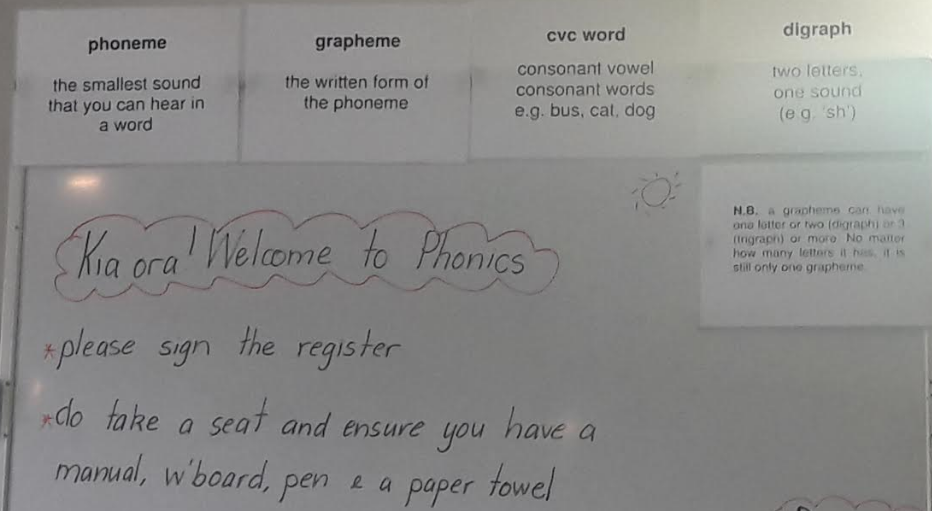
Phonics awareness - a great place in setting students up for literacy

I've always incorporated Phonics into my literacy programme, but as I am constantly reflecting on my teaching and how it can be improved, I jumped when the opportunity to attend the 'Yolanda Soryl workshop' arose.

Yolanda confirmed the view I have that students need a range of basic phonics strategies so they can easily work out new words in reading and spelling.

Teaching tips and pointers
  • Allow only lower case letters to be written in phonics
  • Only have a reason for a capital letter like writing your name. When they write a capital letter in writing ask what the reason was for writing letter in capital - if no reason, rub out.
  • Only teach capital after lower case is secure

Summary:
  • Blending important for reading: d, d-o, d-o-g = dog
  • Break up word to write- segmentation
  • Some students know their sound, but don’t know how to break it up
  • Teach kids how to hear
  • The aim is to look at work and recognize it instantly
  • Read name before school - this is recognition of graphic knowledge
  • Teach high frequency words fast
  • Phonics is for low reading learners
  • Grammar - does it sound right. Get them to read their sentences back
  • Ingrain a sense of a sentence - repetitive reading
  • Teach students to re-read their writing, to check if it sounds right. 
  • 3 levels that students use to connect (sounds, words, sentences). Students that struggle don’t connect these three
  • Important to decode to enable them to comprehend
  • Book introduction important - look and introduce unfamiliar words
  • Teach fluency at word level - then you have chance to read page
  • Dyslexic kids tend to use both sides of the brain
  • Hear low level reader read out loud every day to improve reading outcome
  • Phonics is about using sounds, not only knowing sounds

I am also looking forward to the release of the Phonics App which can be used to learn/revise the alphabet sounds. It also follows a Phonics 'Hear, Read, Write' lesson plan and can stand alone or be used to revise a lesson. The App features a New Zealand accent which is so important for helping students learn the short vowel sounds.


~ "It shouldn't matter how slowly a child learns, as long as we are encouraging them not to stop" - Robert John Meehan ~

Friday, December 16, 2016

What have I learnt this year?

Teaching as Inquiry and Appraisal is a process to help improve teaching practice and to prove that you are meeting the obligations and requirements of being a professional. Our school’s appraisal process integrates the two of these into a process that is based upon evidence, mutual trust and respect.
“...effective pedagogy requires that teachers inquire into the impact of their
teaching on their students.” NZ Curriculum, p35

This year I 'connected' this with our eLearning Plan and focused on Digital Citizenship (to make students aware of the ‘dangers’ and to increase knowledge of how to keep themselves safe online) and Digital Competency - Literacy (enable students to create digital content and adding media).

Baseline date compiled, showed a “current state” where my Year 1 students lack confidence in Digital Competency - Literacy. Although only a limited number of students were interviewed, my inquiry had a whole class focus and was not limited to specific students.

My Focus Questions were:
How can I  use eLearning tools (digital resources/ iPads /ePortfolios to support the class) to:
- Teach students about digital literacy and citizenship
- Support students to be engaged with what they are doing to improve learning outcomes
- Use eLearning to enable students to become thinkers and risk takers and reduce          dependence on teacher

eLearning tools and learning opportunities I trialed [with success] were:
- Easy blogger Jr
- Explain Everything
- Write About This NZ
- Quiver (Augmented Reality)
- KidsedchatNZ

I made sure that eLearning tools served a purpose when digital content was created to enhance learning as I strongly believe that the tool should be used to support learning.

We worked hard together to achieve the desired 'outcome' and getting positive feedback along the way sure helped and served as motivation.


Through consistent reflection it became evident when I had to revisit or changed what (and how) I do and where I needed to change direction and start again.

What have I learnt?
- I had to learn to ‘let go’ to enable students to become thinkers and risk takers to reduce dependence on teacher
- Things don’t always pan out in the best way possible and I had to consider theories about why something might be happening, which helped in my critiquing.

Reflection / Next Steps:
I feel that in many cases, the 'task' set contributed to students' critical thinking as they had to think what's needed to focus on for the learning outcome. I'd also hoped that students would 'integrate' / use technology naturally to explain their work. However, many times I still had to ask [them] if they would like to share their work on their blogs, using one of the apps. I don't think they see / understand the possibility of an iPad as tool to create / explain learning yet. Therefore, something I will need to work on next year is to make them aware of the potential this holds for learning.


Resources:


~ “To be digitally literate is to have access to a broad range of practices and cultural resources that you are able to apply to digital tools. It is the ability to make and share meaning in different modes and formats; to create, collaborate and communicate effectively and to understand how and when digital technologies can best be used to support these processes.” - (Hague & Payton, 2010) ~

Sunday, September 18, 2016

Augmented Reality in an Educational Environment

An article I have written for New Zealand Interface magazine (Issue 74, September 2016) on using Augmented Reality (AR) with 5 year old students:

Inspiring and engaging my students to make their learning real is important to me and I know that technology has the power to enhance learning. I see it as essential to bring it into my classroom to focus the learning onto the students’ future.

One opportunity that it brings to learning is 'Augmented Reality'. I have been aware of using AR for a while, but it was when I was reintroduced during my postgraduate study (The Mind Lab by Unitec) that contextualised it for me.

Here are two ways in which I have used this in students’ learning through the AR app Quiver.

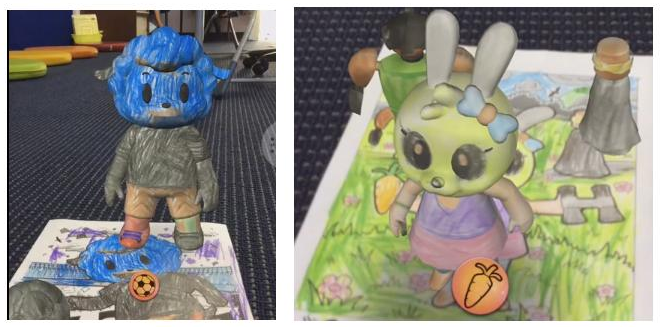
Cluster Summer Sports
Firstly, they had fun reflecting and talking about their participation in a Cluster Summer Sports Day in which they were involved. Without the students even knowing, in this activity they were also touching on the Speaking and Listening component in the NZ Curriculum.

After choosing one of the two pictures provided (one for their ball kicking activity and the other for the game ‘rats and rabbits’), students coloured their choice using their favourite colours and then watched as their picture came to life just the way they'd made it.

Students took a screenshot and published their reflections verbally on their ePortfolios. (http://goals-r-us.blogspot.co.nz/2016/04/augmented-reality-using-quiver.html).

Erupting Volcanoes
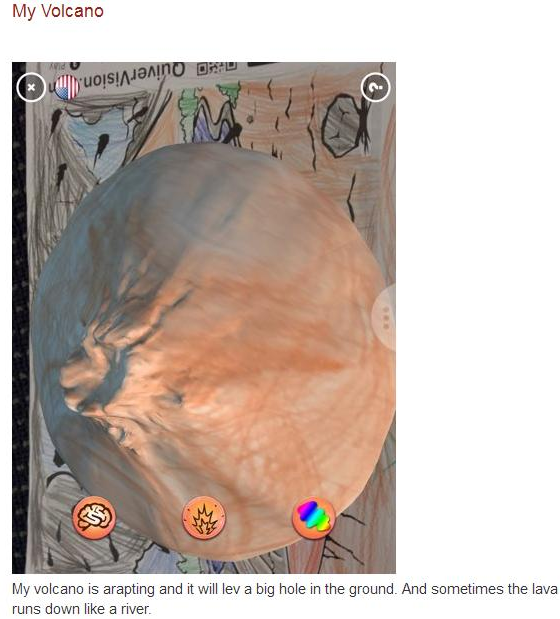
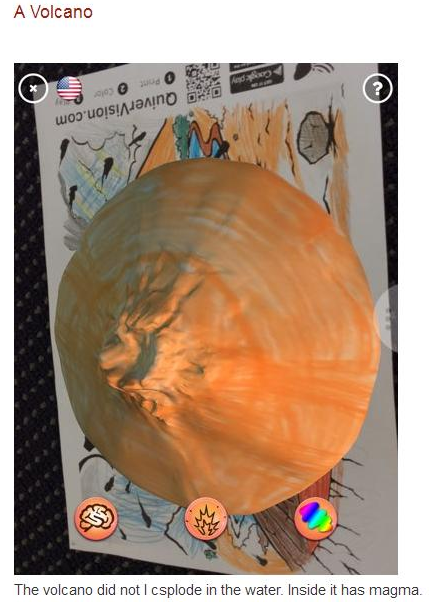
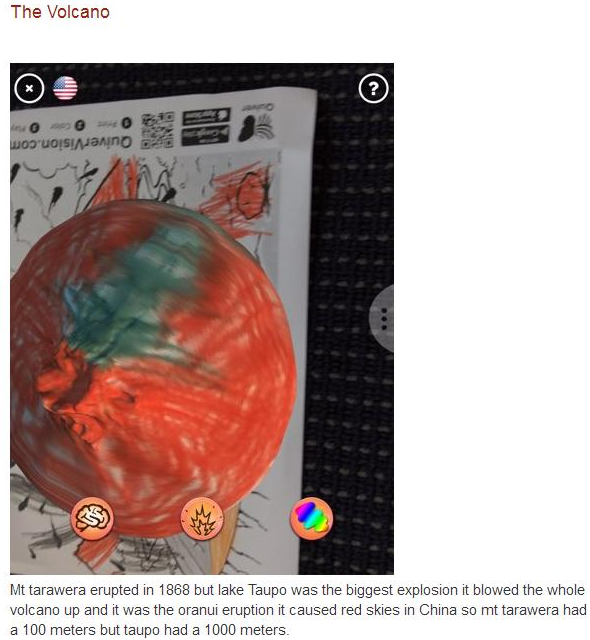
A second example was when students were learning and inquiring about volcanoes. I printed the volcano picture from the Quiver website.  Students took a screenshot and wrote a story about it.  They had the opportunity to choose how they would like to present what they knew and learnt about volcanoes. This has not only engaged them, but also enabled me to see what they have learnt. Writing has also becoming more fun, especially for the boys.

Some stories were published on our class blog


Excitement and engagement
To experience students’ excitement and engagement in their learning, is priceless and shows me that engagement is critical to their learning. The use of these digital tools gives them the opportunity to deepen their skills in engagement, communication, collaboration, critical thinking, as well as creation. It also allows students with various learning styles alternate modes to interpret ideas and understand challenging concepts, enhance their engagement & success.

As I see the difference in the learning of my engaged students, it becomes easier to find ways to incorporate technology into their learning. And, in my experience I have found that AR can be used in all learning areas of the NZ Curriculum. Making a difference and engaging students is not about what I teach, rather, it is about how I teach. This experience has been life-changing for me. It really gave me an opportunity to make a lasting difference in the lives of my young students.


Screenshots from Interface:


~ "Reality is merely an illusion, albeit a very persistent one." - Albert Einstein  ~

Friday, July 8, 2016

Reflection on Term 2, 2016

After a very busy ten weeks, the term has come to an end.

Although we worked hard on reading, writing and maths, other learning areas played a just as important part in helping students on their path to become risk takers and confident, life-long learners.

Areas that I [also] focused on was 'Digital Citizenship' to make students aware of the ‘dangers’ and to increase knowledge of how to keep themselves safe online and 'Digital Literacy' to enable students to create digital content and adding media independently. There were times that we had to revisit some topics more than once to ensure that students grasped the concept.

Students had a go at using the 'Quiver' app (for our inquiry topic) to colour a volcano picture and to then write a story about it. It was great to observe that some students were starting to think about how to share their learning, asking if they should write the story using the iPad (easy blogger jr) or in their books. I gave them the opportunity to choose.
The use of 'Explain Everything' to engage students with their reading books was really going well. My next step here would be to get them to use this ‘without instruction from the teacher’.
Students also enjoyed using the 'Write About This' app and we received some lovely feedback.

KidsedchatNZ had again proved to be a valuable tool to support our students' reading and writing abilities. One week I had one of the senior students running our tuakana/teina session, which was a great success.

I also included a lot more 'problem solving' maths activities and it was interesting to see how students approached the problem after it was launched. They were interested to hear what their peers had done. Some students were able to explain the process to others that struggled through the problem. This was powerful as students showed the solution in smaller steps to their peers.

To make our tuakana/teina buddy reading session with Room 3 effective, we looked again at the purpose of buddy reading and what needs to be focused on. Ideas were brainstormed on what effective buddy reading looks like, sounds like and feels like.

Students have been involved in many 'hands-on' and 'thinking' learning activities and their progress was evident when assessments were carried out. I feel incredibly proud of what my students and I achieved.

What is something new to try and where to next? 
To set up Skoolbo accounts for my learners to provide each one of them with a personalized learning experience to further improve their maths and language skills. 


~ "The expert in anything was once a beginner" - Anonymous ~

Thursday, June 2, 2016

Using ICT to Enhance Literacy

I have been asked by the Waiariki Literacy Association to present and run a workshop on how ICT can be used to enhance literacy.

Thinking back to when I first started presenting in 2013 under the wing and guidance of an amazing woman Sonya van Schaijik, and then to my CORE Education #eFellows14 presentation at uLearn in 2014 with the support of mentors Louise and John and the fabulous people in our 2014 eFellows group, I know I have come a long way.

Previously, I would be scared to bits just by the thought of giving a presentation, but lately I feel quite excited by the prospect of presenting to a group of people and then giving them the opportunity to 'have a play', whilst supporting and answering questions.

These opportunities also helps me to grow personally, as I get challenged with questions that I [sometimes] do not have all the answers for. Then... back to learning I go!


~ "Too many people spend too much time trying to perfect something before they actually do it. Instead of waiting for perfection, run with what you go, and fix it along the way…” - Paul Arden ~

Friday, April 15, 2016

Reflection on Term 1, 2016

Whilst some students were known to me, our environment welcomed a couple of new students and I enjoyed making new connections and re-connecting with everyone. As I am not involved in Reading Recovery this year, I enjoyed being in class for the whole day and it was great for us getting to know one other.

KidsedchatNZ had been re-introduced to my Year 1 students as we had Room 3 working with us. Great Tuakana/Teina relationships were displayed when participating in topics such as 'Greatness', 'Digital Citizenship', 'Sport and Learning' and 'Term 1 Reflection'. Our participation has been one way of supporting students with increasing their reading and writing abilities.

After last year's reflection, I've decided to change my maths programme a bit and to start with introducing doubles [first] to my students. I've also included a lot more 'hands-on' maths activities and my students enjoyed learning doubles with hopscotch.

During reading time we worked hard on making their reading sound like talking and we valued our Tuakana/Teina reading time. I [once again] realised how powerful this experience was when one of my 5 year old's told me "I want to read like her."

Students also worked hard on learning the Essential Spelling Lists to help them when writing stories. I really enjoyed seeing them gaining independence and the excitement when they were able to use these words in their writing.

Students were exposed to many opportunities this term: Inquiry, Go4it, Swimming and many more (feel free to view the class blog). I have also introduce an app called Quiver to help them reflect in a fun way on our Cluster Summer Sports day.

Personally, I felt pleased and happy about the session I lead on our Teacher Only day where Easy Blogger Jr was introduced to colleagues. This was a result from our eLearning Plan where one of our key decisions were to have a collaborative environment with a move to GAFE and Junior Blogger to support students' ePortfolios.

I have been extremely busy [since last year], not only with assignments towards my Post Grad in Applied Practice in Digital and Collaborative learning, but also with establishing and finalising a whole school inquiry through the Academy for Collaborative Futures' Voyager Programme.

I feel happy getting slowly back onto twitter and enjoyed the opportunity to participate in and learn from others in chats like #ldrchatnz and #DigitalEdChat recently.


~ “We do not learn from experience... we learn from reflecting on experience.” 
- John Dewey ~


Sunday, February 28, 2016

Teaching with KidsedchatNZ


Using our class twitter account to participate in KidsedchatNZ this year is showing an engagement in writing and reading as well as building great tuakana/teina relationships between the junior and senior students.

Students enjoy taking part, sharing their thoughts and ideas with other classes.

Some chats that we already have been involved in includes topics such as 'Greatness' with KidsedchatNZ, 'Learning about Digital Citizenship' and 'Making Connections'.

I have also written an article for VLN Primary School about KidsedchatNZ which can be read here.


~ "Writing should be meaningful for children, that an intrinsic need should be aroused in them, and that writing should be incorporated into a task that is necessary and relevant for life." - Lev Vygotsky ~


Saturday, November 21, 2015

Learning Activity using Google Maps (Week 3)

Leadership in Digital & Collaborative Learning (LDC) - Implementing Technology Innovation in the Classroom

Week 3 Task: Design a learning activity using either Google Earth or Google Maps informed by SAMR and/or TPACK


Thank you Mary, Callum, Joyce, Jackie and Tracey for your feedback on my activity:


Week 3 Homework Task: Do another group's Google Maps / Earth activity then rate it against a SAMR/TPAC rubric. Write your feedback, justifications and ideas to the Google Doc as comments

                    I choose the bucket list activity (below) created by Emma, Liz and Kumiko.


Saturday, November 14, 2015

20th or 21st Century Skills (Week 2)

Digital & Collaborative Learning (DCL) - 21st Century Skills

Week 2 Task: Reflect how 20th century and 21st century skills differ? Do we need both?


One example...


and another one...


Reflection:
20th Century Skills were about knowledge and how to 'survive' in the industrial age whilst 21st Century Skills are all about collaboration, innovation, skilled communication, knowledge construction etc.

To put it simply, some stuff 'from the past' is still important, but the context needs to be different. Thanks for this insight Daniel Birch. (Mentioned in 'More than a beanbag' PL & D session.)


~ "Learning is more effective when it is an active rather than a passive process" - Euripides ~


Wednesday, September 2, 2015

Workshop on Student Voice


When students express their understanding of their learning process, we use the term 'student voice'. This term can also describes how students give their input to what happens within their learning environment and school.

We brainstormed ideas around 'quality' teacher, students and environment and looked at the benefits for students, for teachers and school:


Factors that influence student engagement:
  1. Relationships with teachers and peers
  2. Relational learning
  3. Dispositions to be a learner
  4. Motivation and interest
  5. Personal agency
  6. Self-efficacy
  7. Goal orientation
  8. Academic self-regulated learning

So what should we do?
  • Listen to students
  • Build a culture of inclusion
  • Encourage student to student and student to teacher conversations
  • Expect students to engage in dialogue
  • Use IT to assist in the gathering of of voice
  • Be open to change


Further resources:


    ~ "Student voice is the road to change" - Unknown ~

    Sunday, August 9, 2015

    The hunt is still on...

    This weekend I learnt that the platform I have been using with my 5 year old students for their ePortfolios will be moving to paid memberships in September. 

    When reading the content of the email, I became really frustrated as I have been using Kidblog for a number of years successfully with my students. After a while I realised that although I felt disappointed that I now had to look for other alternatives, I had to look at the positive in this situation.

    I am aware of Easy Blog Jr, but I need something that can also work on Notebooks. So I had been asking on Twitter if anyone knew of an easy platform to use with junior students to blog.  


    One platform that stood out was Blogger.  As a Blogger user myself, I was happy to hear that one can't go past Blogger. I was already considering this, but then... the age requirements for students to have Gmail accounts is actually 13 years or older. 

    I also had concerns about how my 5 year old students will be able to logon with remembering a gmail account and password. Again there was a solution offered that I could QR code the logon details. That was a brilliant idea, but I wondered how that would work when students were choosing to use Notebooks.

    I am no closer to a solution yet and the hunt is still on! Any ideas would be greatly appreciated!


    ~ "Don't get discouraged. It is often the last key that opens the lock" - Unknown ~


    Saturday, July 18, 2015

    "It's not about the bean bag!"

    I attended a great professional learning day run by Daniel Birch, Lisa Squire and Sharyn Afu from Hobsonville Point Primary School during the recent school holiday. We learnt about 'why' MLE and MLP is important and 'how' to make this happen in a class.


    There was also time for discussions.... 


    Reflection:
    Much was around inquiring into our own practice and thinking about what learning should be like. The school vision and values and how we unpack them is equally important.
    It was good to hear that some of the '19th Century' stuff is still important, but that the context needs to be different.

    My conclusion:
    Transformation is so important and change happens when we strive to improve what we are doing. By considering new ideas and different ways of 'doing' things, we would be able to provide our students with the very best we can.


    My Storify:


    ~ "First comes thought; then organization of that thought, into ideas and plans; then transformation of those plans into reality. The beginning, as you will observe, is in your imagination." - Napoleon Hill ~


    Saturday, June 20, 2015

    Revisiting transformation & teaching practice

    As Term 2 is about to conclude, I feel that I should reflect once more on my teaching practice.

    I have made my students the focus, placed them in the centre and built on prior knowledge. I made a huge effort to individualize (but not personalize) the learning for each student.

    Last year, during eFellow Master class sessions, we had numerous discussions about transformation. Therefore, I have revisited my reading on the 'Keys to transformation', a blog post by Derek.

    Reflection time:
    Have I used 'the three keys to unlock transformation potential'?

    Firstly - My students were provided with choices and they had the ability to act on those choices. However, I feel that I should guide my students [even] more when making good and appropriate choices and assist them to act on them in their learning.

    Secondly - In using my class wiki for several years now, I believe I found a way of embracing the wide range of contexts in which learning occurs. I acknowledge that learning is not confined to the classroom's four walls and students have an individual learning plan which they can access anytime, anywhere.

    Thirdly - I feel that knowledge building is supported through the SOLO Inquiry model and Learning Buddy (Tuakana/Teina) system I use in class. My students also have the opportunity to interact and make connections with other students and classes through the weekly KidsedChatNZ twitter chat.

    Next steps:
    - Personalize the learning experience for all students (using progressions in 'kid-speak')
    - To recognise my students as active participants at all levels of their learning.


    ~ "Learning and innovation go hand in hand. The arrogance of success is to think that what you did yesterday will be sufficient for tomorrow." - William Pollard ~


    Saturday, February 28, 2015

    Teaching Inquiry (Writing)

    This teaching inquiry will see me working collaboratively with another teacher.

    The main question for us is: "How can we accelerate the progress of our group of students to where they should be in relation to the National standards?"  Using some initial data and knowledge of our students, we were able to establish a baseline and direction.

    Focusing Inquiry questions:
    • What assessment information do we have?
    • What are our students' strengths?
    • What are our students' learning needs?
    Our Inquiry: "How can we support students to learn/know alphabet names and sounds, which leads them to build words and ultimately putting words into sentences?"

    Teaching Inquiry questions:
    • What instructional strategies will we use to help students achieve?
    • What resources will we need?
    • How will we differentiate to meet student needs?
    • How will we encourage student ownership of their learning?
    • What personal learning do we need to undertake? (Research/Readings/Support from others/Professional Development/Observations/videos)
    Actions:
    • Encourage student recording: Whiteboard, Student books, iPad - voice/ video, Student blogs, Shared Writing book
    • Relevant problems
    • Using materials: Flashcards, Class Wiki (ILP), Practice letter names & sounds
    • Providing challenge: Students relate writing to a picture
    • Learning buddy work: Share their writing/ story with a buddy
    • Questioning: provide thinking time

    Our Learning Inquiry will look at:
    • What impact has our teaching had on our students?
    • How do we know, what is the evidence? (Assessment/Student feedback - feed forward/Observations)
    • What do we need to do next?
    • What changes could we implement?

    Reflection: (To be elaborated on in due course)
    See outcome in Teaching Inquiry (Writing) Reflection


    "Success doesn't happen overnight. Keep you eyes on the prize and don't look back." 
    - Erin Andrews ~

    Saturday, December 20, 2014

    End of year reflection (2014)

    One of my goals this year: 'Educating Life-long Learners'

    Reflecting on My opinion:
    I was able to build good relationships with my learners and had build their confidence and skills to ensure their learning is successful, enjoyable, meaningful and lifelong.

    Reflecting on: My aim this year?
    Learners were motivated to be active, engaged and connected learners for life, whilst getting them to use and apply the NZC Key Competencies and any other resources available to them through KidsedchatNZQuadblogging Aotearoa and 'Pass the Blog'.

    Reflecting on: How will I do this?
    1.  Learners were educated on how to make choices, how to think and learn
    3.  Each learner were valued for what they do well (using weekly assembly awards)
    4.  Learners knew they matter

    With my 'Teaching as Inquiry (Maths)' my main question was: "How can I accelerate the progress of my focus group of students to where they should be in relation to the National standards?" and My Inquiry became about: "How can I support these students to show and explain their thinking?"

    Reflection:
    • What impact has my teaching had on my students? -> After introducing a concept, I encouraged student recording. Outcome:  Students were happily engaged in maths activities and considered it to be "their favourite time of the day".
    • How do I know, what is the evidence? (Assessment/Student feedback - feed forward/Observations) -> Outcome:  Evidence about it here
    • What do I need to do next? -> I provided students with the opportunity to [independently] explore and experiment further. -> Outcome:  Students created their own problems. See some examples here
    Taking everything in consideration (as well as positive feedback from classroom observations), I feel confident that this inquiry was completed successfully.


    I have also completed reflections on my eFellow14 inquiry, Reading Recovery training, uLearn14 experience and TeachMeetNZ presentation.


    ~ "Working hard becomes a habit, a serious kind of fun. You get self-satisfaction from pushing yourself to the limit, knowing that all the effort is going to pay off." - Mary Lou Retton ~


    Tuesday, December 2, 2014

    Reading Recovery - a year in reflection

    I have always been keen to try out new things to enhance my learning and improve my teaching, but when I learned that I will be involved in training as a Reading Recovery Teacher this year, I was almost struck with fear. However, that fear was quickly laid to rest when I experienced the specialist guidance, incredible support and positive feedback from our tutor, Wendy.  As a group, we fitted in well with each other and we were able to discuss many aspects of our teaching and training together. 

    My thoughts, reflections and general comments on this year:
    • The training course give me insight into how children read and write and I realised that many children who have managed to learn almost all letters and sounds and to read and write several words still cannot read the simplest text.  To successfully read texts children must divide their attention between meaning and other sources of information and make decisions in the same way that mature readers do, but within their limited repertoire of knowledge.
    • I became aware that I've changed my teaching to focus on strategies to enable children to use efficient strategies to get meaning from texts as they read for meaning as this increased their ability to use print as cues and phonological cues to generate, confirm or alter their responses.

    What aspect of the course did I find most challenging?
    • What? Making sure I use & complete the right forms at the right time (Observation Survey excluded). Why? Everything was new and there are multiple forms to be completed for different aspects in the programme.

    My biggest highlight and lowlight:
    • Highlight: The problem-solving that the children did as they pursue meaning through the reading and writing of whole texts that built the store of words and word-parts that they can identify and recall.  To experience how proud the children are of their progress and how their self-confidence has grown.

    Feeling grateful to have received this positive feedback from a parent:


    Lowlight:  Slow progress/acceleration and limited support from home for some children.


    Thank you Wendy (our Tutor), Gayle, Angela, Karen, Robyn, Haylee, Sharon and Heather for a wonderful year of learning and laughs!  We have worked hard and although we felt unsure at times, it was great to experience how we've started to believe in ourselves and how we have grown in confidence. Yay, we've made it!

    Our Celebration lunch and last get together as a group....


    ~ "The capacity to learn is a gift; The ability to learn is a skill; The willingness to learn is a choice" - Brian Herbert ~


    Wednesday, November 5, 2014

    My eFellow Inquiry presentation to the Cluster Principals

    One thing that is being expected of you as an CORE Education eFellow ito share your learning, approaches, practices and inquiries with the wider teaching community.  

    Thus, when asked by my Principal to present on my inquiry at the Cluster Principal meeting, I agreed (as I have had already presented my inquiry at uLearn14 and at #cenz14)

    Some of my presentation slides:


    A short extract of my presentation:
    • Where and how do I start to facilitate personalised learning was just one of my questions. Through my networks and discussions with other teachers, I found that many were asking the same questions (especially in the junior school area)
    • I focused my inquiry on pedagogy and technologies (rather than the physical aspect of MLE) and although I was already using technology with great success in my classroom, I was driven by a desire to make learning even more rewarding and purposeful for my students
    • Questions arise about how I could support my students to carry out learning in purposeful and meaningful ways
    • I started working on supporting students to take more responsibility for their learning and how to make choices.  They have a choice of how they want to present their learning (iPads/Notebooks or via their Individual blogs).  When students know they have to share with peers, family or the teacher, it gives them accountability as well.  When they know they have to reflect on how that activity went, they have to have done it. With this I ensure no one is falling through the gaps under the guise of just "doing my own thing"
    • Is this working in our learning environment? Definitely! I will now walk into class after lunch and students will be engaged in a learning activity without me telling them what to do. Where as earlier they were just sitting on the mat, waiting for me to direct them

    I left them with these questions:
    • What is your vision for your school, you learners?
    • What changes need to happen at your school / classroom level?
    • What would be the first thing you will be thinking of changing in your pedagogy?
    • Do you think Personalised Learning has potential in your school environment and what would be your first step to support teachers to implement this?

    Conclusion:
    In the end it all came down to Student Agency and the "power to act" as Derek explained in Trend 1 of CORE's Ten Trends for 2014.


    ~ "Tell me and I forget. Teach me and I remember. Involve me and I learn." - Benjamin Franklin ~

    Monday, August 4, 2014

    Learning together with Coding!

    I want my students to code, I want to learn to code...

    And as usual the question was: "How and where do I start"?
    I therefore started looking for further information and found this interesting read. Getting involved in coding chats on Twitter, also helped.

    Then [at Educamp Auckland] Lesley shared her coding slide in the 'Smackdown'... and I was intrigued.


    I am now part of that G+ "Code Club for Teachers" and have completed my first Hour of Code.  I am looking forward to further coding challenges and to ongoing personal learning & development.


    Last week I used 'Lightbot' to introduce my 5 year old students to coding. What an amazing experience for all. They really enjoyed the session and seeing the engagement and co-operation amongst peers, were priceless.

    I am looking forward to having this learning journey continue alongside my students. I am certain that we will make lots of mistakes, but [most importantly] we will all learn together!

    I have also participated in an #aussieED chat, where we had interesting discussions around coding.


    ~ "In fifteen years we'll be teaching programming just like reading and writing... and wonder why we didn't do it sooner" - Mark Zuckerberg~