Showing posts with label RTC 03 - Bicultural Relationships. Show all posts

Friday, December 15, 2017

End of Year - A Quick Reflection

With my 'Possibilities, Options and a Course of Action' post at the start of the year, I was looking forward to pursue the many things that was twirling around in my head...

Unfortunately, I did not always 'stand firm' mentally and emotionally when challenges arise, so my one word, prudent (adj) 'acting with or showing care and thought for the future' did not always come to fruition, as there were days I was not ready for some unexpected challenges / bumps in the road.

One of my biggest 'problems' was that I felt tired, tired and tired. I question myself constantly as to my lack in motivation to effectively use my PLN (Twitter, VLN, EduCampNZ) and colleagues to create productive working relationships by learning from others, asking questions to find out the thoughts of others and to reflect understanding. 

Many days, I felt like "Forget Everything and Run" rather than to "Face Everything and Rise." (the two meanings of F-E-A-R according to Zig Ziglar).

The following post on a closed group also made me wonder if this showed what teaching became for so many in 2017... yes there are other stories too... unfortunately.


Throughout my unexpected challenges, I think I stayed true to my students... one example:
Two of my ‘at risk’ Māori students (Student 2 and Student 3) experienced difficulty with oral language. 

I reflected on why this might be and came to the conclusion that the pronunciation of Māori vowels in relation to English is quite different, which could very well contribute to their specific areas of need. A ‘non-confident’ Māori student, can find this extremely difficult and result to them finding it hard to follow instructions, process information etc.
I planned deliberate activities that meet the needs of these learners, whilst also capitalising on spontaneous authentic learning opportunities that support oral language development. 
Steps was to:
- Locate, create and utilise a variety of activities/resources support sequencing development.
- Use Big Books and Cards, and use the planning support that accompanies these to develop oral language.
- Use guided reading lessons to continue modelling and promoting retelling of text with a focus on oral language.

Although Student 2 still requires some support, I am delighted with the overall progress - as this was a student who did not talk at all to start with.

Progress can be seen as shown in the end of year spreadsheet below. 
All the blue areas, were areas of concern. Now it is only the two green areas, which I am confident will be shifting further [as well] in the coming year.


One of the best parts of this year [for me] was working in classes alongside teachers and ākonga to develop capability in pedagogy (teaching and learning) and the use of technology as a tool to support learning in my role as 0.2 learning Facilitator with Ngā Pūmanawa e Waru. Part of our (my) role was to working through and with the wider community to enable ubiquity (every where, anytime) of learning, honouring an authentic Rotorua and Arawa context, foster collaboration for learning across Rotorua (I have a G+ community for junior school teachers where we share resources / ideas) and to build knowledge about Future Focused Learning. I have been working with teachers and school leaders (I engaged regularly with principals about growth in teacher adaptive confidence and professional development) by embedding effective future focused teaching, using learning technologies to build learner competencies. 

End of Year Highlight:
Received a choc bar with this lovely message from a student! #EndOfYear #FeelingBlessed


~ "Ships don't sink because of the water around them; ships sink because of the water that gets in them. Don't let what's happening around you get inside you and weigh you down... stay up." - Unknown ~

Saturday, December 9, 2017

Constant Improvement

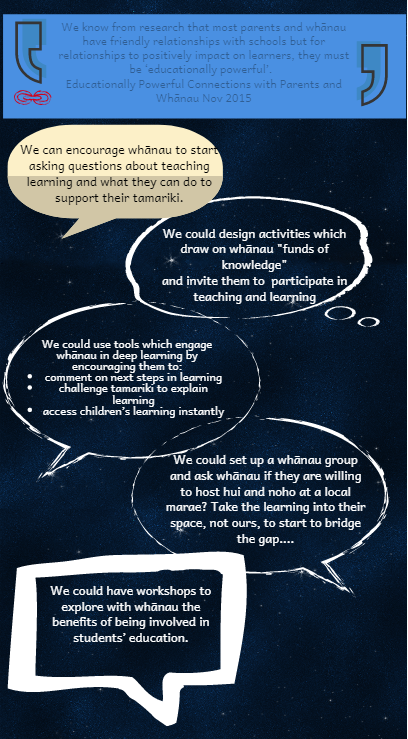
Our school had been very fortunate to secure Anne from CORE Eduaction and CLA as facilitator for our PD this year. One focus was on parent engagement... This has been something that I have been talking about in one of my past Inquiries... How can we get parents ENGAGED in their child's learning? Many people think that attending sports events means that parents are engaged, however; parents are here only 'involved' in what is happening at a school... therefore the importance of getting them engaged... in students' learning, especially class and individual student blogs as an ePortfolio is crucial.

A good starting point for us as a staff was to look at the elements of a positive learning environment for us individually. This also help us to understand each other a bit better (I think)...

Anne lead a session with parents around the eLearning Planning Framework. Feedback from parents and teachers both were very valuable...

As teachers, we also brainstormed our ideas...

Closer to the end of our PD, we went back to a Padlet we started at the beginning of the year and revisited our ideas...

So where to next for us at this stage?

Exciting times ahead...


~ "Excellent schools don't believe in excellence - only in constant improvement and constant change." - Dan McCabe ~

Thursday, January 26, 2017

Brave, Resilient learners & Change

Our school was fortunate to secure Anne Robertson for one of our Teaching Only Days. After posing the Key Question for this session: "How do we challenge the way that professional learning has traditionally been structured and make it more consistent with modern learning practice, that is collaborative, creative, daring and challenging and meets the needs of all teachers in your school?" we introduced ourselves and discussed what motivates us to learn. One interesting thing that came to the front was that learning styles can change and develop. Therefore, Professional Learning has to be meaningful, relevant and focused on how it is going to support our learners.

“The first rule of learning is that people learn what they need to learn, not what someone else thinks they should learn” Peter M Senge: The Fifth Discipline: The Art and Practice of the Learning Organisation

An exercise we had to complete was to think about three people on staff, think about their needs and put ourselves in their shoes when thinking about learning. It is vital that teachers should be considered in the same way we think about planning for our learners. We have to allow for different ways for teachers to engage in PL&D. One size does not fit all! Ownership and agency is essential if teachers are to engage positively.

Consider Knowles’ 6 principles of adult learning...
- Adults are internally motivated and self-directed
- Adults bring life experiences and knowledge to learning experiences
- Adults are goal oriented
- Adults are relevancy oriented
- Adults are practical
- Adult learners like to be respected

This can be easily applied to students as well, although not all of them might be motivated to learn, because they have to be in class / at school. What happens at home in the morning, might very well impact on how they learn...
Think UDL and cater for all learning needs in class, this however needs to be the same for teachers.

Image credit: Anne Robertson @robeanne 2016

Each of us had to think about our three teachers again while imagining one came across this small cave entrance with our three teachers... consider... What is my first instinct? What is their first instinct How would you feel if someone said to you - right we are all going to go into this cave now? Think about why your reaction is as is. What is it based on?
It might be hard for some to go in, having a fear of the unknown. This might be the same for people when having to learn new things. It might be easier to motivate kids, rather than motivate adults. Getting people out of their comfort zone. Tip for whānau engagement... think about cultural situations, think about that acting in a different culture could be quite scary.

We bring a whole lot of baggage with us when it comes to making decisions about what we do. Our Mental Model is shaped by the unspoken, unacknowledged, unrecognised assumptions we have just beneath the surface that guide our actions - positively and negatively.  Our prior experience plays a huge part as does our situation and context - age, gender, family situation, school setting. And mental models often resist change.
It is important to remember that we all see thing from different perspective, due to our experiences. This underpins our values/virtues and beliefs.

Enablers and Blockers challenge... 
What do we see as the ENABLERS to engagement in professional Learning at our school and what are the things that BLOCK people from engaging?


Sheryl Nussbaum talks about schools being “Future Ready” - there are 4 elements to being future ready. However, it is very important to consider as we develop Professional Learning programmes, that teachers are learners too.

An environment where the message is always ‘we are not good enough’ can be demoralising and counterproductive for all stakeholders. George Couros #Innovatorsmindset

ln the book “The Innovator’s Mindset” George Couros talks about the need for leaders to trust, to allow a positive space for people to grow and develop their skills, to focus on strengths not weaknesses. 
Something to ponder... Do we look at strengths of people or do we always look at the negative? Finding people's strengths is so important.

"When we build on our strengths and daily successes - instead of focusing on failures - we simply learn more” Tom Rath


Simon Sinek talks of how 'why' should be first, even before the 'how' and the 'what'. This seems a deceptively simple idea... But teachers also need a sort of personalised why… e.g. why should I adopt new practice. It has to be contextual to the way they teach and learn, to the students in their classes and the way that they are as teachers and learners themselves.
It is possible for the ‘why’ to evolve too and it doesn’t have to be static. However, you can’t just change the ‘why’ without a moral purpose or reflecting on it and considering why it might have changed.  Which is where Spirals of Inquiry come in…


Anne talked about an analogy that she heard of recently... consider a fire - what does it need to keep burning? (fuel and oxygen and space between the sticks for the fire to develop). If more sticks are being piled up on the fire, it collapses and has no space for the oxygen to keep fanning the flames so it suffocates and dies out. This is the same with teachers... they need to have space and time to keep motivated to learn and care should be taken not to overload them. 

One thing that came through strongly though was the idea of time for reflection and consolidation which is represented in the Poutama - the Maori representation of steps that symbolise levels of learning and that after each step there is an opportunity to consolidate, to take a breather (rekindle the fire) and assimilate skills learned before moving onward and upwards.

Key idea: We need to provide space for people to have inspiration. Don't keep on piling up... What can we take away... Allow teachers to take a step, and then have time to get an understanding and put learning into practice, before taking the next step.

Engagement in PL&D isn’t an option but leaders need to model good practice, be sensitive and respectful of the learners’ needs and be warm but demanding just as we are with the students in our classes…

Image Credit: https://mymindabout.files.wordpress.com/2013/03/infinite-staircase-olafur-eliasson1.jpg

Building on the Poutama steps of knowledge acquisition with time for assimilation and consolidation of skills discussed earlier - and the spiral of inquiry - this idea of a spiral staircase that can provide space for teachers to focus on their practice and the needs of their learners, that encourages constant, ongoing reflection, and further inquiry is very powerful. A never ending spiral staircase of learning...


~ "You are never too old to learn. At no time ever say, 'It's too late to learn,' not until the day you die." - Kimani Ng'ang'a ~

Friday, April 1, 2016

NPeW Education Conference

The Ngā Pūmanawa e Waru Team

Ngā Pūmanawa e Waru hosted its inaugural education conference yesterday. The programme for the day was divided into four sessions.

Session 1: 
'Iwi involvement in Education' with guest speaker Sir Mason Durie. The panelists were Professor Angus MacFarlane, Lady Aroha Durie and Mere Berryman.
Sir Mason Durie summed up the session on iwi involvement in education saying that our loyalty has to be to the students.

Session 2: 
'Leadership and a Future Mindset' (video) with Dr Vikram Murthy as presenter. He touched on the following:
  • Each one of us is an expert at something. Are we changing as fast as the world around us? The problem is to "let go"
  • The uncertainty & the leadership challenge. We live in challenging times...
  • What we pay attention to,  and how we pay attention, determines the content & quality of life
  • Attacking a problem with diversity & collaboration yields more powerful results. #CollectiveWisdom #CollaborativeInquiry
  • Learning is the process of enhancing our capacity for effective action. Learning contributes to adaptiveness.
  • The identification and engagement of an individual's competencies - "the areas of his or her greatest strength"

Leadership and a Future Mindset discussion panel with Nicky Brell as facilitator.


Session 3:
'Covey's Seven Habits' with presenter Kerryanne Knox. In the session she discussed the 7 Habits of Highly Effective People.


The First Three Habits surround moving from dependence to independence (self-mastery).

1. Be Proactive: Work from the centre of your influence and constantly work to expand it. 
2. Begin with the End in Mind: Envision what you want in the future so you can work and plan towards it.
Here she challenged us with "What are you doing to ensure that you are going to achieve what you have identified as your end in mind?"
3. Put First Things First: This is about the difference between Leadership and Management. Leadership in the outside world begins with personal vision and personal leadership. Think about what is important and what is urgent.


The next three habits talk about Interdependence (e.g. working with others).

4. Think Win-Win: Value and respect people by understanding a "win" for all is ultimately a better long-term resolution than if only one person in the situation had gotten his way.
5. Seek First to Understand, Then to be Understood: Use empathic listening to genuinely understand a person, which compels them to reciprocate the listening and take an open mind to being influenced by you. This creates an atmosphere of caring, and positive problem solving.
6. Synergize: Combine the strengths of people through positive teamwork, so as to achieve goals that no one could have done alone.

The final habit is that of continuous improvement in both the personal and interpersonal spheres of influence.

7. Sharpen the Saw: Balance and renew your resources, energy, and health to create a sustainable, long-term, effective lifestyle. 

Session 4:
'Future-focused Learning' with keynote Brett O'Riley. The panelists were Frances Valintine, Laurence Zwimpfer and Dr Niki Davis.


Reflection:
Listening to the presenters and realizing what we're achieving [already] was a mind-blowing experience.
The conference was a huge success and I felt honoured to be part of the Ngā Pūmanawa e Waru Team. We worked together as a team and manaakitanga was the winner on the day.  


~ "Celebrate what you've accomplished, but raise the bar a little higher each time you succeed." - Mia Hamm ~


Tuesday, December 22, 2015

Leaning Forward as Learning Facilitator


The Ngā Pūmanawa e Waru Team

This term I started working [one day a week] at Ngā Pūmanawa e Waru (NPeW) as part of the Learning team, which is lead by Sue Winters as our Director. We had many discussions around future focused learning and teaching and what a review of literature suggest this will 'look like'.

The Learning team was heavily involved in co-constructing eLearning plans for NPeW schools alongside the schools' eLearning Leadership teams.

Towards the end of the year I gauge interest around setting up a Community of Practice for Junior School teachers and am delighted by the responses I've received from teachers who are interested in becoming part of this. I look forward to putting this into place in 2016.

I found it to be such a rewarding and stimulating time, working alongside many educators and parents in our district. What a privilege!

Ngā Pūmanawa e Waru also published our first Newsletter, Te Pūmanawa which is available to read at your leisure.


We concluded a very successful year with a 'Festive Season Lunch' at the beautiful Lake Tarawera.


~ "Build the capacity of individuals and groups to accomplish more on their own in the future."  - Unknown ~

Thursday, November 5, 2015

The Purpose of Education, Thought Leadership & Epistemology (Week 1)

I have started my Post Grad study in Applied Practice (Digital and Collaborative Learning) through the MindLab by Unitec. 

In our first session we met our directors Linley and Milla and were introduced to the different platforms available to support our study. We explored the Moodle course and Mind Lab Google+ community.


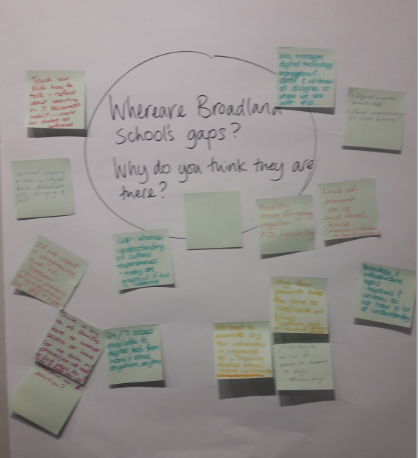
Everyone had to add three post-it notes on the wall about why we were here. An ice breaker helped with making some new connections and talking to other people.


Using play-doh we demonstrated [in a group] our view on 'What is knowledge?' I felt challenged with having to create a video with 'your device available' as I have never used my Phablet for this purpose before! Then to find it on my device to publish in the 'My Media' Moodle section..!


Further questions to challenge thinking...


Thank you to the Next Foundtion for the the scholarship and to Ngā Pūmanawa e Waru for giving us this exciting opportunity.


~ "Life is about taking chances, trying new things, having fun, making mistakes and learning from it." - Unknown ~

Thursday, April 2, 2015

Reflection on Term 1, 2015

This has been an extremely busy and exciting term, in which I was involved in three great PL&D sessions at school, making valuable connections with students and parents, setting up my teaching inquiry on writing, being involved in the organising of Educamp Rotorua and the two termly Connected Rotorua events. I have also been heavily involved in discussions about the setting up of our new school website and established our school's Facebook page.

However, something that I missed was my regular participation in twitter chats. Things were just too busy [for me] many days and I felt exhausted by the time I got home. I really do need to get this work-life balance sorted...!

One of the highlights was when I was able to be part of our school's 80th Reunion on Saturday, 21 March. People came from afar and relived many memories, which many of them shared with me during short, mingled chats. Needless to say, that I am extremely proud to be associated with our school.

This term our staff took part in the yearly indoor bowls and as a rookie I really enjoyed this experience. It was also about building relationships with some teachers from other schools and one time I was able to caught up with a tutor from the 'Incredible Years Teacher Classroom Management Training Series' that I attended back in 2011!


Some feedback from a parent... 
This is why I teach, to make a difference in student's lives, to try and give them the best learning opportunities possible. Working long hours is nothing, if it is going to benefit my students.

I have also learned and grew so much as a leader (my first term as Assistant Principal) and have chosen to stay positive among adversity.  
After being accepted into the National Aspiring Principals Programme 2015, I choose to withdraw (due to some personal reasons). 
It was necessary to re-evaluate my goals, knowing what is happening for me now and what do I want to achieve. This was no easy decision, but I contemplated and came to the conclusion that I can still learn and grow where I am at the moment. Being part of a positive and supportive management team, is something to not underestimate.

I can't wait to see what challenges next term will bring...


~ "Teaching:  You laugh, you cry and you work harder than you ever thought you could.  Some days you're trying to change the world and some days you're just trying to make it through the day. Your wallet is empty, your heart is full, and your mind is packed with memories of kids who have changed your life. Just another day in the classroom" - Anonymous ~

Wednesday, July 16, 2014

Get into action and seize the moment

Māori Language week is almost here...

Sometimes things seem to creep up on me.  I have planned my class' involvement in this event a long time ago on our class wiki, and thanks to Stephen's heads up, I jumped for the opportunity to compile questions for the KidsedchatNZ blog (thank you to Stephen who've added some questions as well) and to moderate this chat.


Due to my learning in the weekly Te Reo Māori Course during Term 2 , this was just another way for me to demonstrate my commitment to the bicultural partnership in Aotearoa New Zealand.


~ "It's the little choices everyday that lead to the final results we're striving for." Jason Bartels ~


Monday, June 30, 2014

Te Reo Māori Course - Term 2 Reflection

Since 12th May, I have been involved in the weekly Te Reo Māori Course organised by Literacy Taupō. What an incredibly journey this has been!  Experiencing the customs of another culture, is a wonderful opportunity.

I've learned to write my Pepehā and Kupu Mihimihi and am just beginning to memorize my Pepehā for future use.

I have practiced saying some sentences using rākau, nga tatai (numbers) and nga tae (colours).  This was quite challenging at times, but the support from the tutor and others were amazing.  Never have I felt that I could not do it and best of all, we had fun while learning.

Beginning to learn some whakatauki (proverbs) was an eye-opener.  I could find so much wisdom in each and every one of them.  My favourite so far is, He harore rangi tahi, which can be interpreted as: a mushroom lives for one day, so don't waste time...

Having some knowledge of Te Reo Māori, enables me to build relationships with ākonga and whānau and [in my opinion] shows that I respect their language, culture and heritage.

I am definitely looking forward to continue my learning next term.


~ Embracing diversity is one adventure after another, opening new paths of discovery that connect an understanding to caring, listening, and sharing with others who are different than ourselves. - April Holland ~


Sunday, February 23, 2014

Culture - Delving beyond the tip of the iceberg via #GlobalClassroom

Last night I participated in my first Global Classroom chat session, as I think culture plays a major role in the vision and values of New Zealand's unique identity.

My involvement in this chat session helped to clear some ideas about culture as well as reaffirmed my view on the importance of beliefs and values of a group of people.  I am convinced that if we treat others with dignity regarding different cultures, positive relationships will be build on trust.  Positive communication is the key.

Thanks to Sonya, who informed me about this chat, I had the privilege of learning more about this valuable topic from all the participants.


~ "No culture can live, if it attempts to be exclusive" - Mahatma Ghandi ~