Showing posts with label Our Standard 4 - Learning-focused Culture. Show all posts

Monday, April 25, 2022

Try something new

 I recently came across this article saying that 'New research shows controversial Reading Recovery program eventually had a negative impact on children'.

As a trained reading recovery teacher [some years ago], I found this article very interesting and agree with many of the points raised.

As a reading recovery teacher many years ago, I kept track of the students I've had the privilege to 'help' and experienced first hand that those students who were with me for Reading Recovery did not receive any further support after being discontinued. Teachers in second grade also did not support these students' reading journey further and let them 'fall back' into the system and a "normal'' reading program. As a result, many of these students did indeed lose their gains, which was really disheartening to see. 

I am not involved in Reading Recovery any longer and have moved away from the "normal" reading program. My focus at present is on Structured Literacy and I can really see the advantage of this program - above any other that I came across thus far. I also use a book from Heggerty every day in a whole class setting. I notice that these sessions are great for introducing and reinforcing vital concepts relating to Structured Literacy.

In using Heggerty and Little Learners Love Literacy during my Structured Literacy program, I’ve managed to accomplish a huge gain in confidence and mana for my students. This program is so rewarding - for me and more importantly for students!

If I had any say in education, I would be an advocate for and encourage every teacher to use Structured Literacy as it is explicit, systematic teaching and follows a sequential order of skill introduction.

Maybe you are the change agent in your school, and ready to take that next step...


~ "The moment you doubt whether you can fly, you cease forever to be able to do it." - J.M. Barrie (Peter Pan) ~


Friday, April 24, 2020

Distance Learning - End of Week 2 (Term 2, 2020)

Lockdown: Alert Level 4 - Day 30

Another week of online learning done and dusted. I've truly settled in and enjoy this new routine of living and working from home! However, I do miss the students and am thankful that we have technology to stay in touch... 

Students have been showing great engagement in their learning activities. Just loving some of the 'How are you feeling' responses I received from the 5 year old's during the week!


~ "What we know matters, but who we are matters more." - Brené Brown ~

Wednesday, April 15, 2020

Distance Learning - First Day (Term 2, 2020)

Our Distance Learning ('Home Learning') started today... first day of Term 2, 2020! I sent my students a little message yesterday... and really enjoyed listening to all their responses! They were all heartwarming and made me smile.

I feel very so proud of the way they handled their online learning activities today! Using devices in class definitely helped, so this 'experience' was nothing new to them... I am sure that they will ace their learning during this COVID-19 time.


~ “It’s not about ‘what can I accomplish?’ but ‘what do I want to accomplish?’  Paradigm shift.” 
- Brené Brown ~

Monday, May 20, 2019

UBRS Workshops (Modules 1 - 4)

A blog summary of my notes...

First Session:

Aim:
  • Preventing behaviours that challenge and if necessary de-escalating the situation
  • How to stop behaviours from happening 
  • How to support child without putting more demand on them

Intro: 
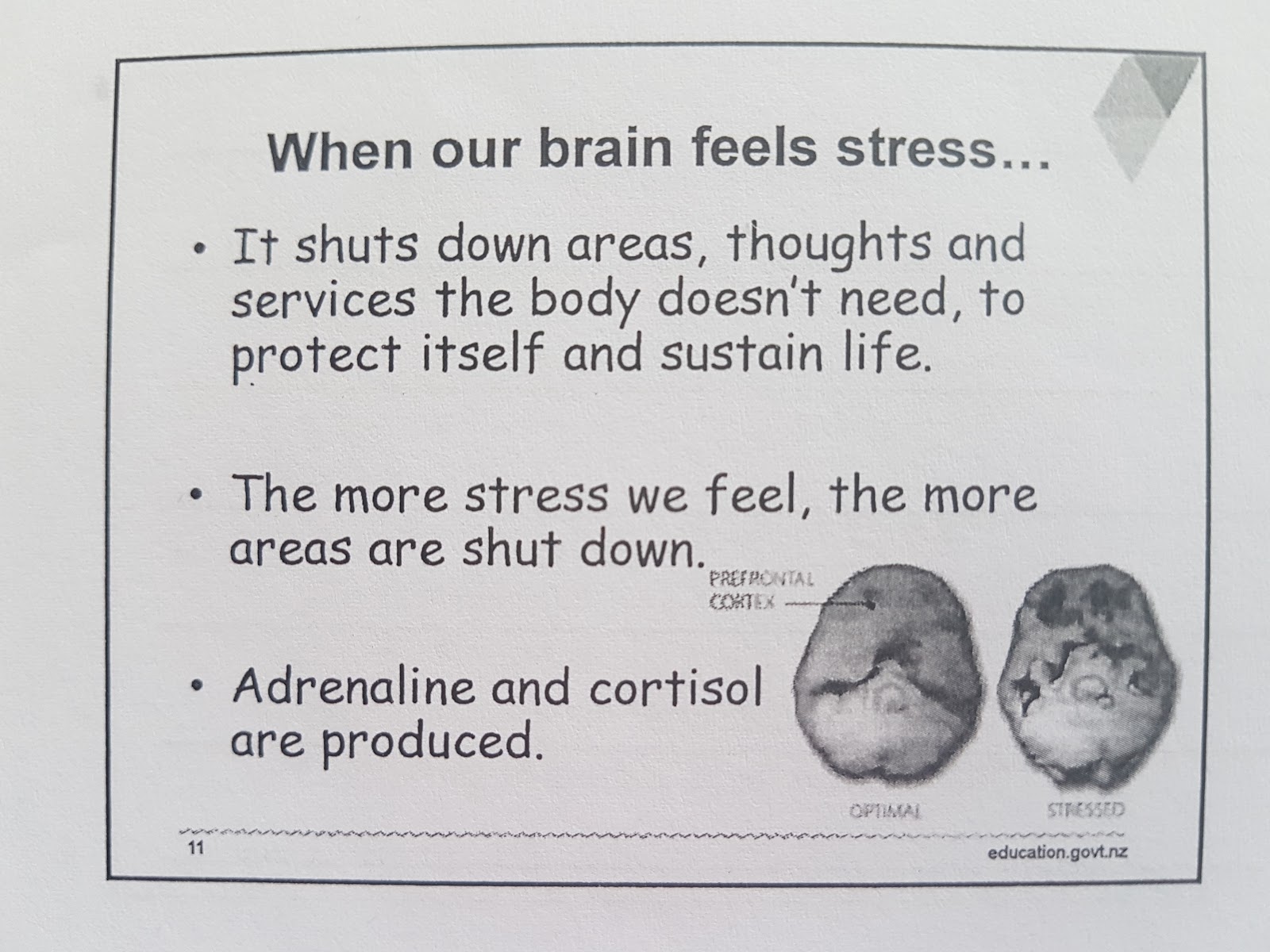
  • Understand what is happening in the brain when it’s under stress…
  • When seeing difficult behaviours, think what might be happening in the brain


Summary:
  • When the brain is under stress Adrenaline and Cortisol are produced
  • These shut down the layers of brain activity starting with logic and self-control
  • Calm the situation - don’t inflame by punitive approaches
  • BUILD behaviours by ignoring, figuring out what the driver is, replacing with positive behaviours, praise and encouragement, frequent positive restatement, reminders and redirection


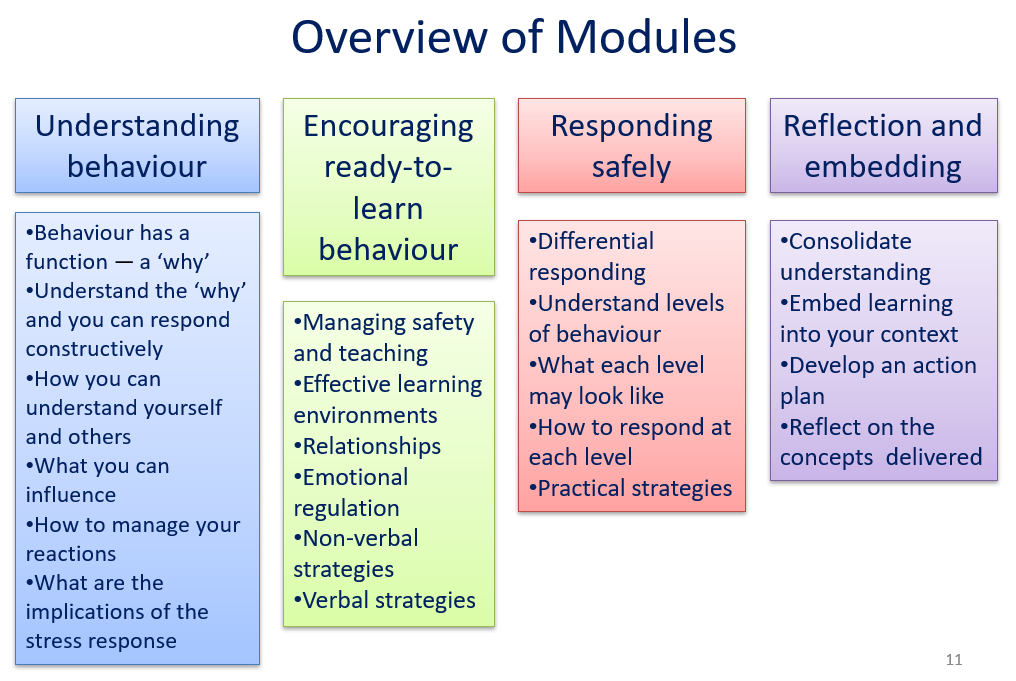
Module 1: Understanding behaviour - Why? How? What?

Remember the can of coke ‘analogy’ - shake it and it explode...
  • Being mindful of the factors that occur in a child's life that is baggage when they come to school
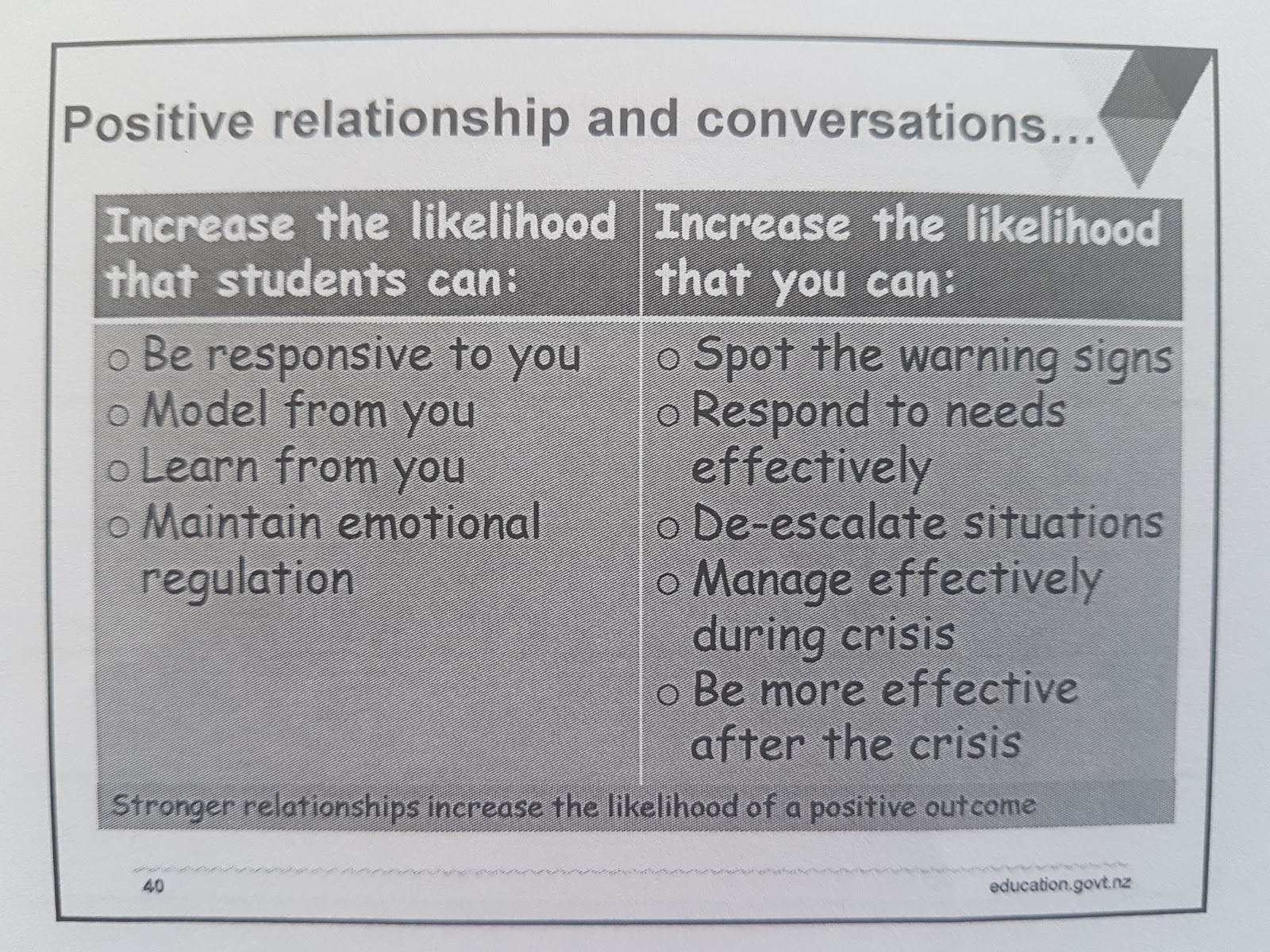
  • If you want to be supportive, shift your perspective by not judging and instead offer support to build that relationship

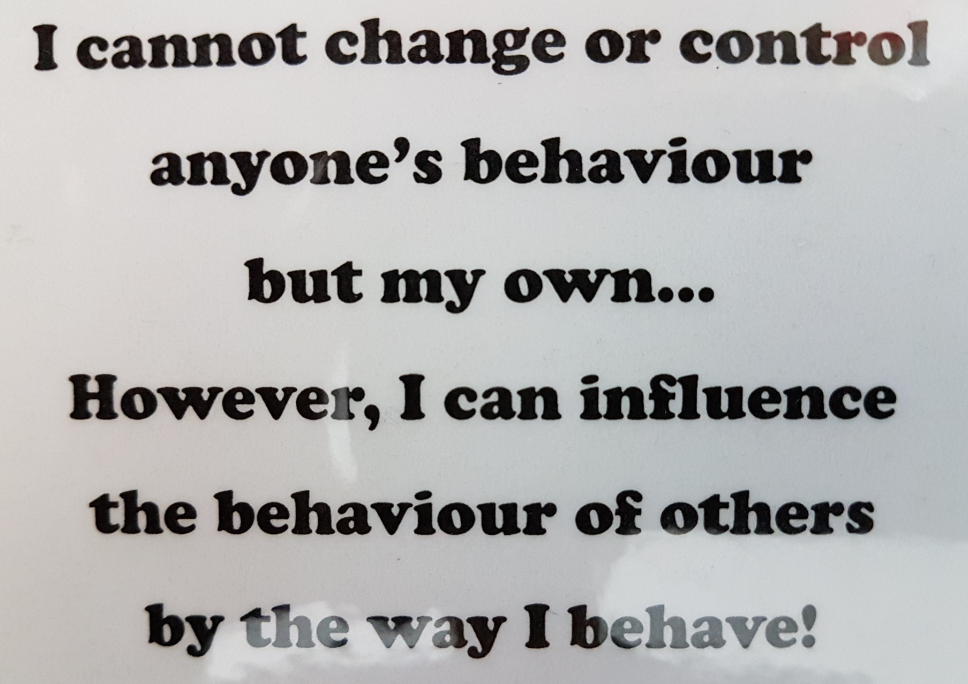
What can YOU influence?:
  • The only thing we can control is what we do, think and believe…
  • … and what we do, think and believe can influence the outcome to increase the likelihood of de-escalation


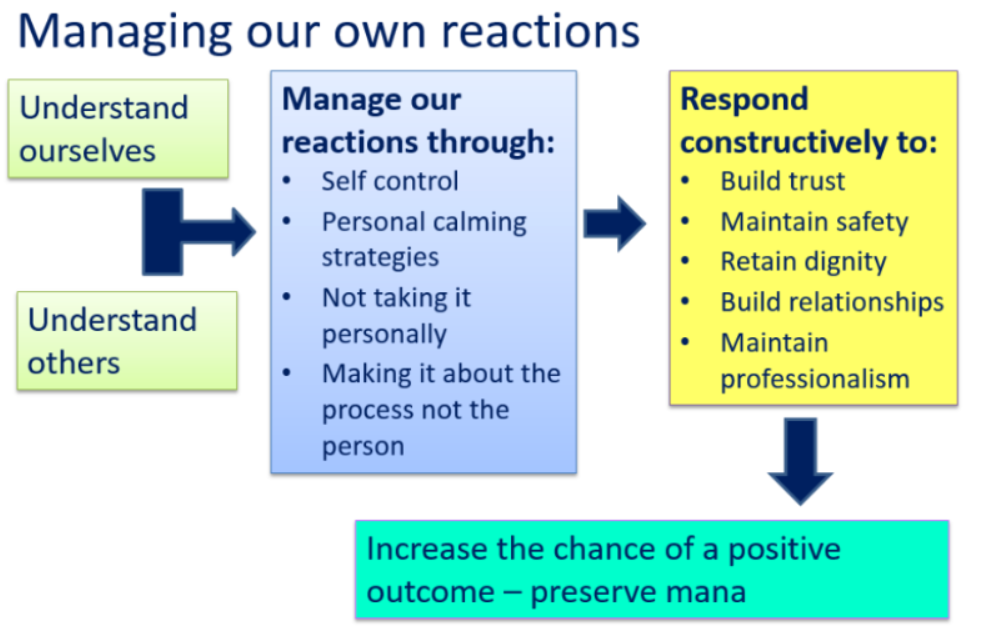
Understand, then manage your actions:


Stress Response: Psychological effects…


Module 2: Encouraging ready-to-learn behaviour

Establishing a learning focused culture by exploring strategies that prevent and de-escalate challenging situation through:
  • Creating supportive learning environments
  • Teaching for positive behaviour - revisiting the brain and stress
  • Strengthening positive relationships
  • Exploring strategies that support emotional regulation
  • Exploring communication - what we say and how we say it
  • Exploring strategies that prevent and de-escalate challenging situations


Exploring communications - what we say and how we say it:
  • Create win-win scenarios with two winners
  • Talk to students with compassion and respect
  • Address private or sensitive issues in private
  • Take the student seriously and address issues
  • Give focused attention
  • Avoid humour like sarcasm, inappropriate remarks or mocking - be polite

Summary:
  • De-escalation refers to a set of verbal and non-verbal responses which, if used selectively and appropriately, reduces the level of a student’s anxiety or anger to prevent loss of control
  • Research tells us that knowing the student, building trusting relationships and using effective de-escalation techniques can all minimise the likelihood of restraint


Module 3: Responding Safely

Intro:
  • Often behaviour is done for an audience
  • How do your actions escalate or de-escalate the situation?
  • Whatever goes bad, it will pass and things will get better


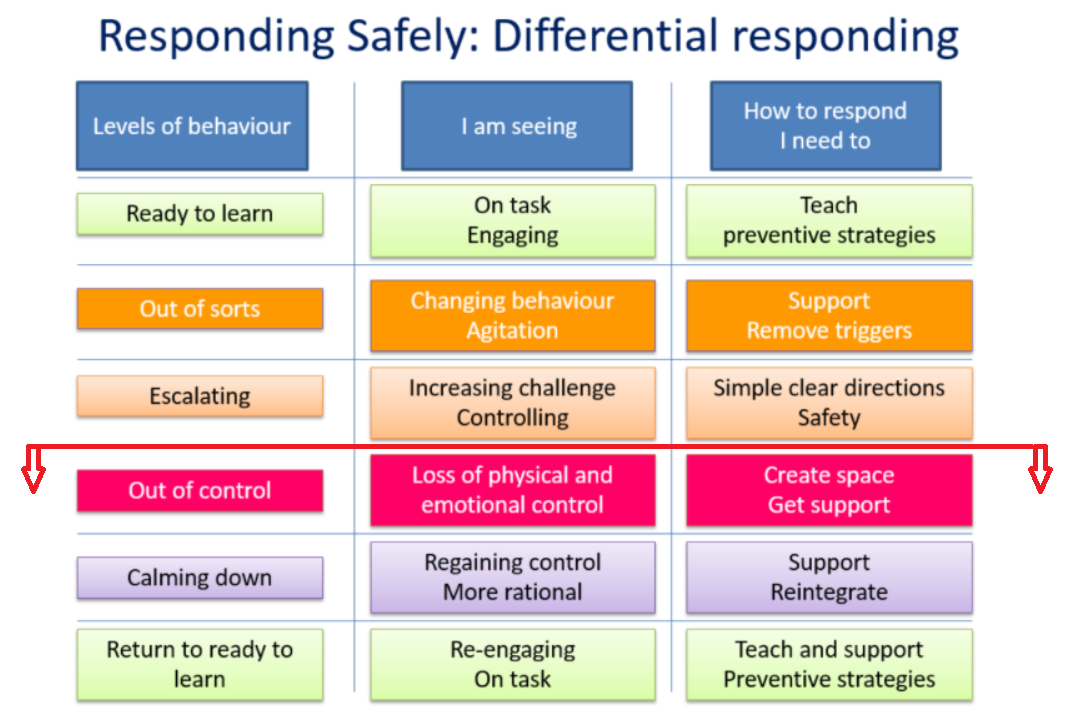
Responding Safely - Differential Responding:

(Note: when students are below ‘red line’, you will have trouble with bringing them back. A student that often go below this line would normally have a ‘safety plan’ - through SENCo / RTLB) 


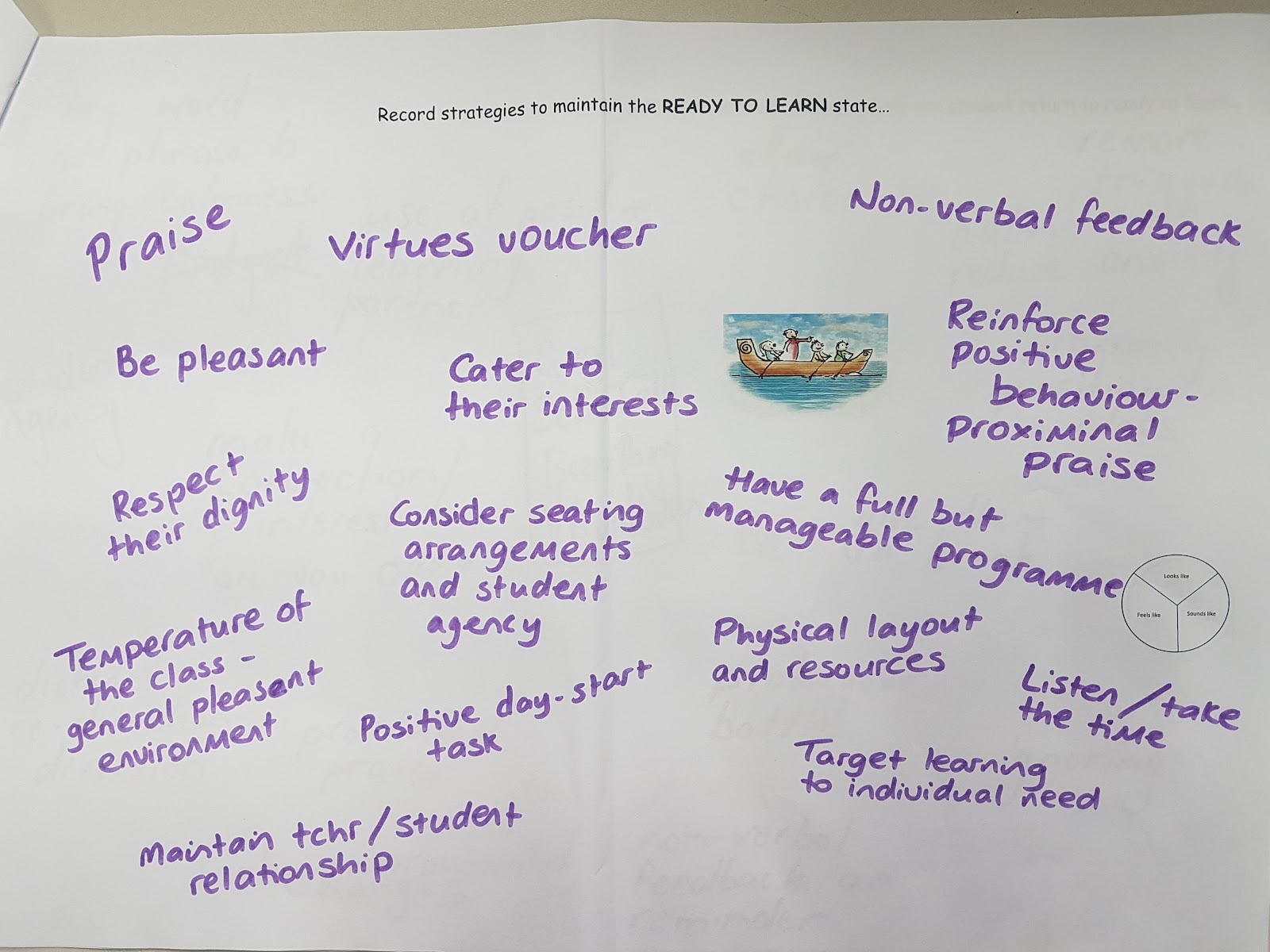
Strategies to maintain the 'Ready to Learn' state:

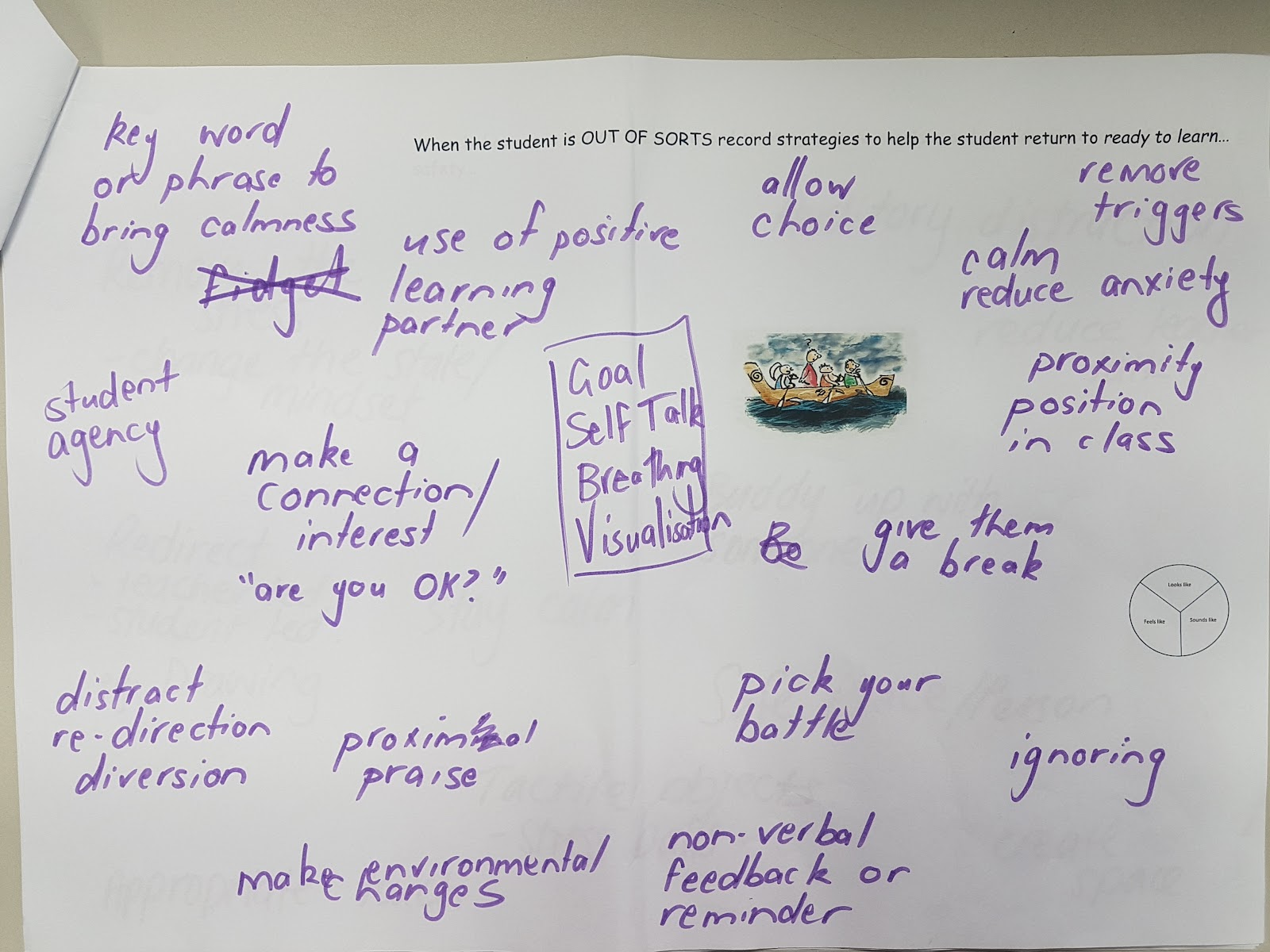
When the student is 'Out of Sorts' - Strategies to help the student return to Ready to Learn:

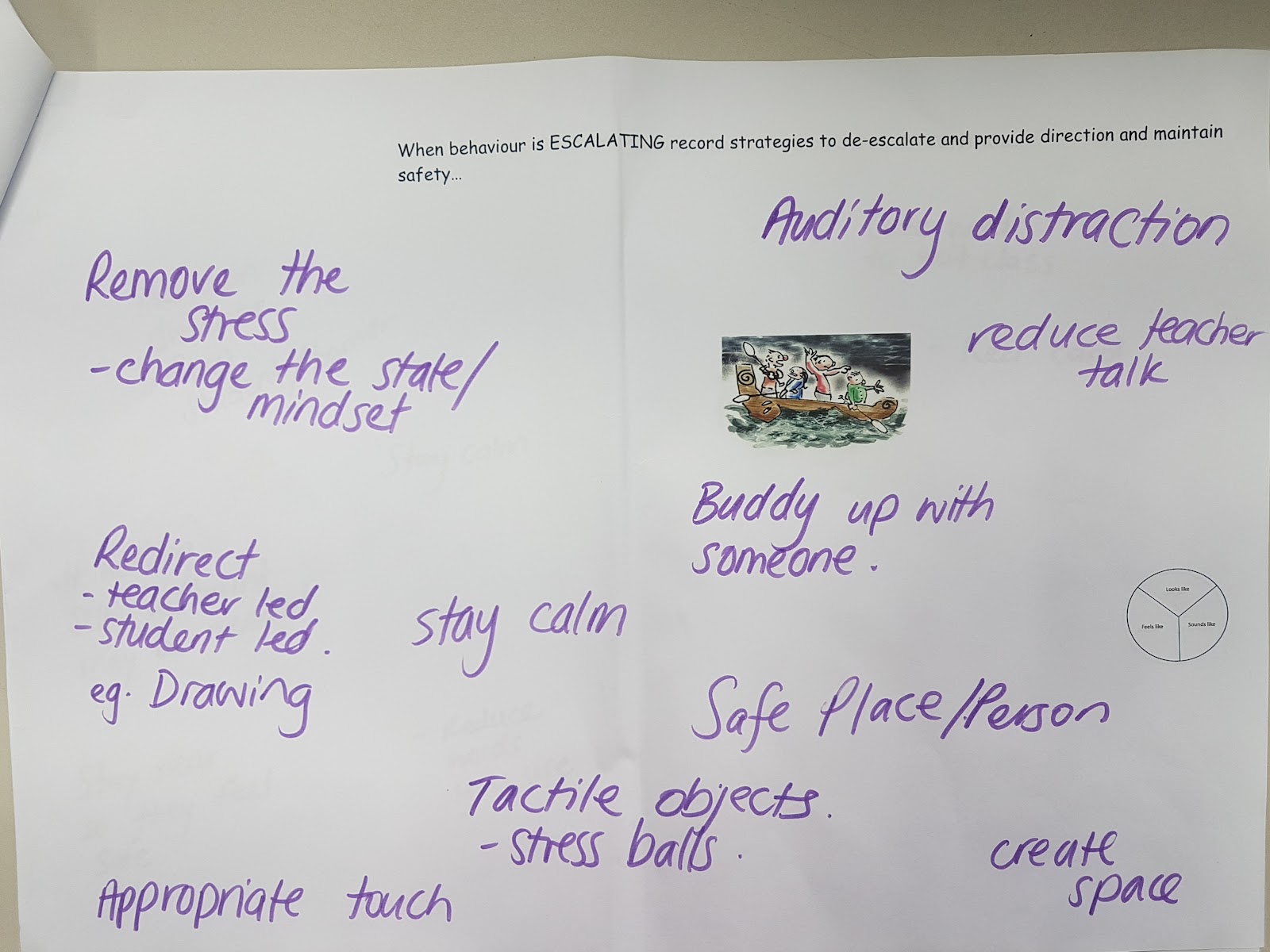
When behaviour is "Escalating' - Strategies to de-esclate and provide direction and maintain safety:

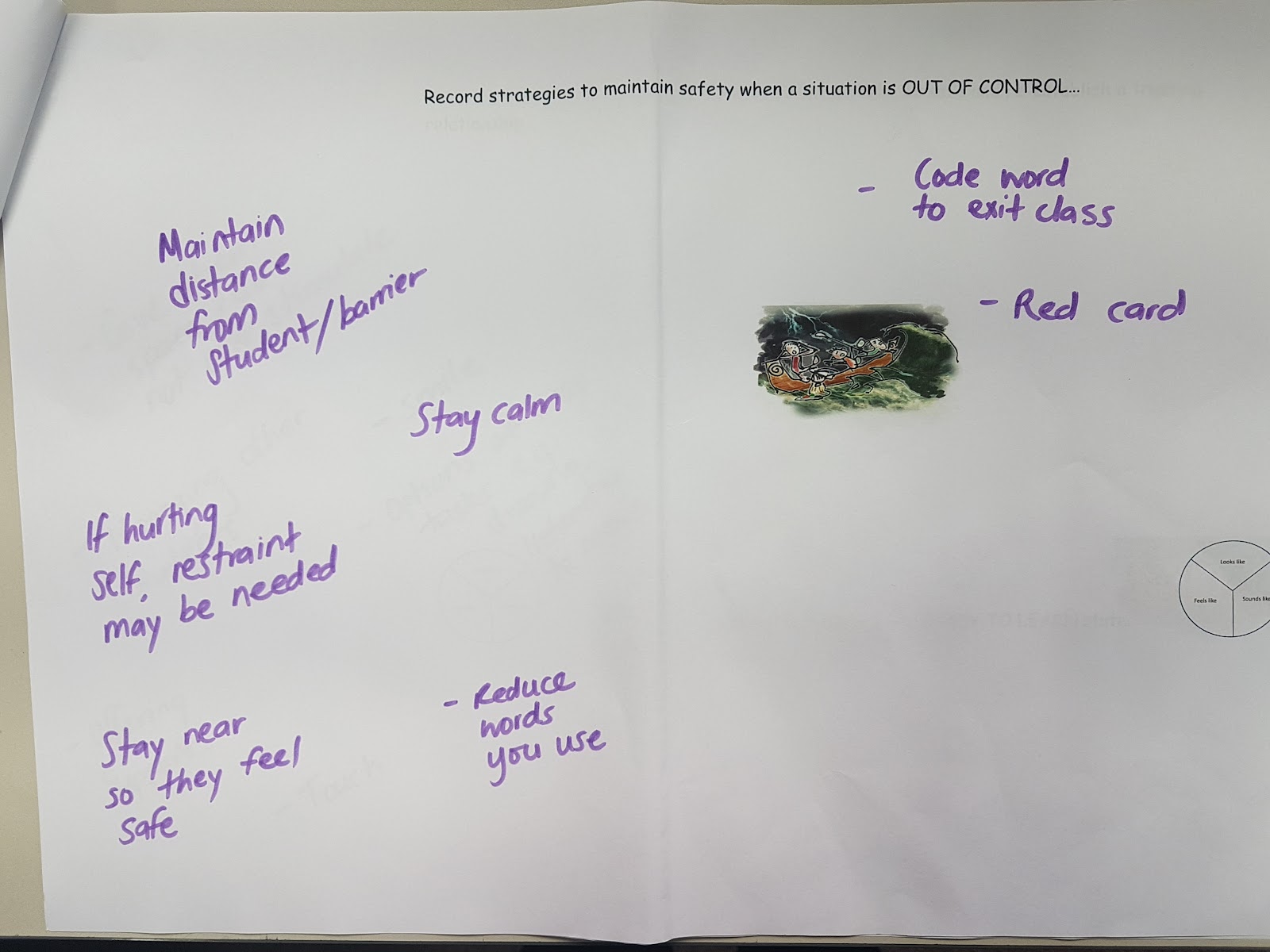
Strategies to maintain safety when a situation is 'Out of Control':

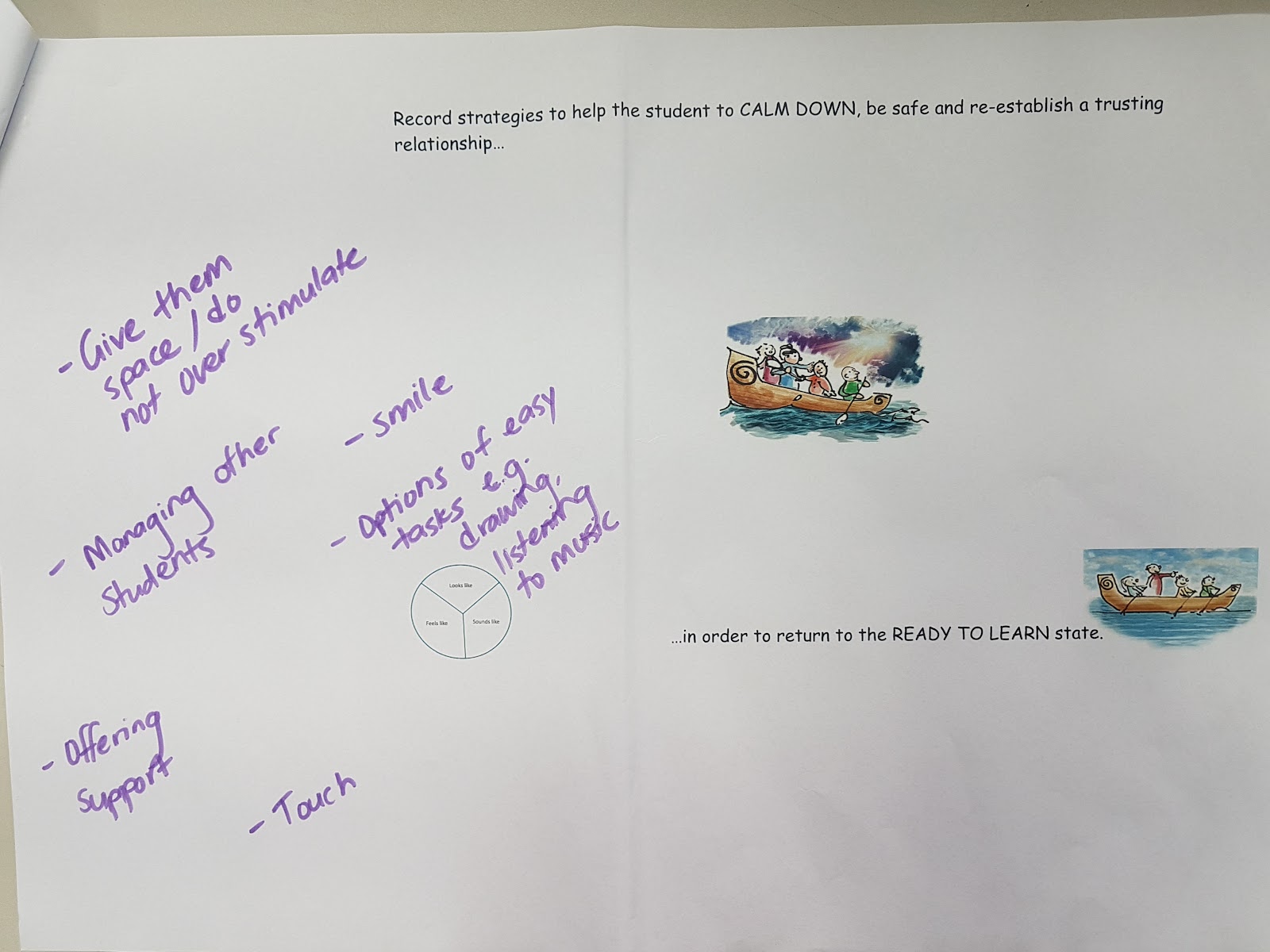
Strategies to help the student to 'Calm down', be safe and re-establish a trusting relationship:


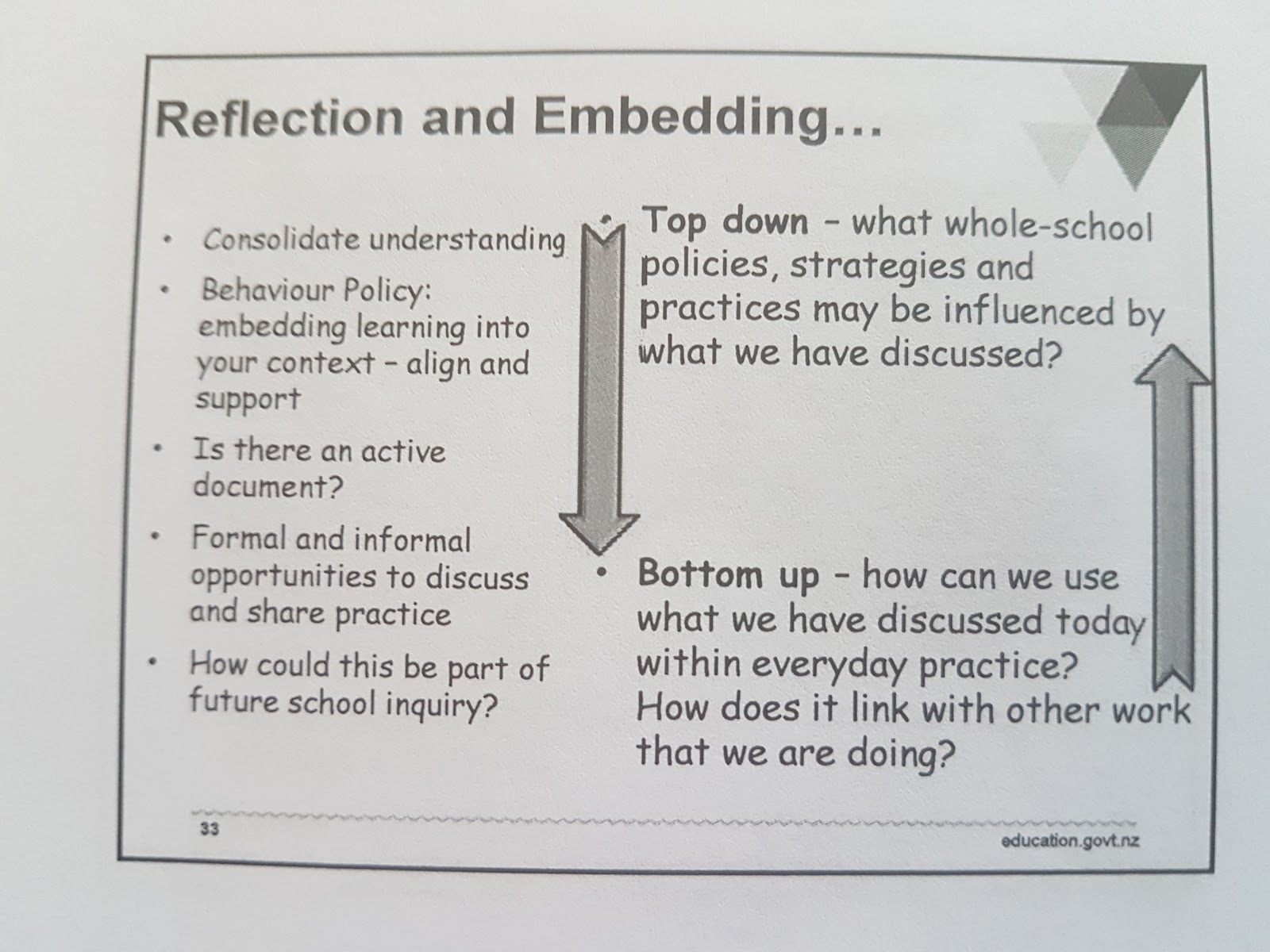
Module 4: Reflection and Embedding


Conclusion...
  • Maintain mana, walk away and determine next move
  • Ensure students know what will be happening, as some struggle with change


~ "Relying on one-on-one chat alone is rarely effective. It may take many of these conversations - this is a process to teach young people how to think about their behaviour. At a neurological level, we now understand that we are creating new neural pathways in young brains and there is not quick fix that does this!
(Thorsborne & Blood - 2013 pg. 42) ~

Friday, May 10, 2019

Learning NZSL - the best experience in a long time...

This week I started to learn New Zealand Sign Language, along with my students. We are lucky enough to have our office administrator who've done a course on NZSL, so I used her to teach us a few signs.

I was also very happy when I came across tweets with videos by Sulzy (@sasulz)! In one of her videos she showed how to sign "How are you?” & “I’m feeling _____.”

So, I practised and taught my students this the next day. 


This was the best experience for me in a long time! Students also had a lot of fun learning this new language during this year's New Zealand Sign Language week. The best part for me was when seeing students this week, some of them greeted me in sign language and signed how they were feeling!


I will definitely continue with learning and also show my students!

Wednesday, July 25, 2018

Oral Language across the curriculum

This workshop presented by Sheena Cameron and Louise Dempsey aimed "to support teachers to include more quality 'learning talk' in the classroom and to embed purposeful oral language opportunities across the curriculum." This was timely PD for my Teaching as Inquiry with my focus on developing Oral Language.

We started the session with the Talking strip - Introductions' by turning to a partner and by follow the steps on the strip.

We can use oral language strips to get children talking and using full sentences. Explicit teaching can include using pictures - lips closed, eyes open, ears listening etc.

The types of talk:
1. Exploratory talk (to help us understand and develop ideas)
2. Presentational talk (to share ideas and information and to entertain others)
3. Conversational talk (to build relationships)

Types of listening:
1. Informational listening (to obtain information and understand ideas)
2. Critical listening (to evaluate ideas and form opinions)
3. Appreciative listening (listen for enjoyment)
4. Responsive listening (listen to build relationships)

Establishing a 'think, pair, share' culture. Move away from the 'hands-up' approach as it is controlled by the teacher and severely limits student talk. This often results in a small group dominating the talk in a competitive manner.

Listening activity ideas:
1. Partner activity: call a friend - pretend to talk on the phone to a friend about something. Sit back to back and share.
2. Barrier games - making shapes, use a barrier to hide. Two students have the same bag of sticks. One student makes a shape, the other has to make the same shape through listening to the other's description. Another one is the Pizza barrier game where one has to explain to the other how to add pieces on the pizza.

Asking more open questions using:
1. Question strip
2. I wonder...?

Students should be talking in full sentences and elaborating on ideas...

Some elaboration questions / Prompts:
- Tell us more about...
- Why do you think that?
- Can you give us an example?
- What is your evidence?
- Can you justify your opinion?
- I have another example...
- I have a different idea...

Some alternatives to questions:
1. Students sit in a circle. Introduce a talk topic. Students use a microphone for taking turns to talk and to generate questions.
2. Shared Reading - predictions from cover. Do think-pair-share. Move away from hands up.
3. Make a suggestion - "My idea is ..." can help with getting students into a discussion

Talking groups:
Use different groupings to increase opportunities for student talk
1. Think, pair, share (partners)
Pausing in a lesson engage students in 'think,pair, share' and benefit both students and teacher as students shift from passive to active learning.
- Think:  allow students five seconds to think of what they will say
- Pair: students talk for a short time with a partner. Teacher can end talking time with simple countdown from five
- Share: a range of students can share back responses when appropriate and not necessary every time students talked to a partner.

2. Think, pair, square
Instead of sharing back as a class, partners can turn and face another pair and then share as four. Students can listen to ideas from one pair and summarise/add and new idea/ask a question.

3. Doughnut circle
Students sit or stand in two circles, outside one faces inward and inside one outward, so that all is facing a partner. Each student have a turn to speak. When it is time to change partners the teacher could call 'switch'. The inside circle then moves one partner to the left.

4. Jigsaw
Effective when planning an in-depth collaborative task. Each student in the group is given a number e.g. 1, 2, 3 or 4. Students with same number move to form a group. students then work together to learn about a topic and afterwards return to their home group and each team member shares his or her information.

5. Listening triads
Students work in groups of three taking on roles e.g. speaker, questioner, recorder [and/or] speaker, listener, questioner. The speaker talks about something specific and afterwards the other two students follow their roles by either asking questions (Questioner) and taking notes (Recorder) in order to feed back to the speaker, another group or whole class. Roles can be rotated.

6. Circle
This is a common grouping in the classroom. The idea is that everyone in the circle have a turn to say something. Students talk and listen to other's ideas and points of view. It is also good practice for speaking in full sentences.

7. Line up
Similar to the doughnut circle except students face their partner in two lines.

8. Horse shoe
Similar to the circle, but students are able to view the teaching area as well as each other.


~ "Children need writing to help them learn about reading, they need reading to help them learn about writing; and they need oral language to help them learn about both." - Anonymous ~

Monday, June 18, 2018

Anxiety, Learning and Behaviour

This was an interesting workshop that challenged thinking and perceptions.

Notes:
Each person comes to school with their own Thoughts, Emotions, Perspective from home. This is the case for both teachers and students...

Anxiety can start when having to deal with above

Anxiety – look at yourself first and how you cope with this, keep energy up. What can I do to fill my bucket at the end of the day. Know about mindfulness. If a teacher’s anxiety is going up, it will escalate the anxiety of the student. Look at the development of the brain – look at impact of trauma, neglect… they influenced development.

Brain development starts with:
Brainstem    -     Safety
Midbrain     -      Movement
Limbic         -     Emotions
Cortex          -     Learning

When students do not feel safe, they might make noise and be disruptive so they can be send out. They then they might feel safe as they are not subjected to the learning (which they might be scared of).

If a student is constantly anxious – it can be something specific...

Your anxiety can cause the student’s anxiety. Stay calm and talk in a calm voice.  When a student does not react, it might be their brain telling them "I am in danger" and that is why they might not react / respond. Unfortunately, a teacher / adult might perceive it as being defiant.

Acknowledge the feeling, but know how to cope with it. What strategy can be used to cope with feelings?
- Anti-anxiety activities: breathing exercises
- Get students to know to just breathe, will make them feel better
- Also, think how well you know this specific student.

Try and capture the right moment to help the student cope with strategies about what we do when not feeling well. Use the right vocabulary – don’t confuse angry with not happy.

Maybe do whole class teaching for coping strategies, step-by-step. Mentally visualizing working through the anxiety. Talk about what it might look like / feel like.

Know what emotions look like. Get students to act out – look up on internet.

Often an anxious student just needs time… but let them know you will be coming back to them. Difficult for anxious child to be put on the spot, speak up in class in front of everyone or even give an answer.

Often when a child is anxious, a parent will have it to. A dad might be aggressive because they are anxious. Women can cry. Get the parent to practice handling feeling and emotions with their child at home. Exercise help for unsureness- suggest they take a walk together each day. There will be more success when including the parent.

Diagnoses just gives us a bit more knowledge about the child, it is not the end of all.

Teach the ‘Worry Tree’ Problem solving technique...

The Helicopter view – teach kids to look at something with a 'bird’s eye view' and not ‘close up’. Look at something differently. What am I reacting to? What does this situation mean to, or say about, me? What's the worst thing about thinking that, or about the situation?


Resource:
Lots of ideas and metaphors on www.getselfhelp.co.uk


~ "Affirmations for Anxiety: This is only temporary; I am in control; I can take things one step at a time; Anxiety does not define me" - Anonymous ~

Saturday, May 5, 2018

Learning in a Digital World

I have been delighted to hear that I have been successful in my application for a grant after completing a 200 words impact statement for a Robotics Kit to enable a group of selected students of our school to participate in the 2018 FIRST LEGO League, which is a project-based, STEM education program. My aim with this is to engage our students and to get them excited about learning through robotics, whilst also immersing them in the world of technology. Our students will learn to participate in real-life, hands-on activities which has been designed to develop critical thinking, creative problem solving, collaboration and teamwork - all skills that are needed to be successful in the today's world.

One of our teachers, Matua Mel agreed to being the team coach / mentor. I will assist as 2nd coach / mentor as and when needed.
Matua Mel and I are excited to join our students on their learning journey!


~ "The most important principle for designing lively eLearning is to see eLearning design not as information design but as designing an experience". - Cathy Moore ~

Thursday, May 3, 2018

Nathan Wallis workshop on 'The Developing Brain'

Nathan explained to us how the brain works and how neuro- science can better inform our day to day interactions with children and young people. Advances in scanning technologies during the 1990's allowed us to understand the workings of the brain like never before.
What the research says:
- the first three years ARE the most important
- how intelligent you are isn’t your genes (previously the assumption was genes were for intelligence)
- the growth of the frontal cortex is experience dependent

What you experience for the first 1000 days of your life is probably what you will be experiencing for the rest of your life... (a child uses their first 1000 days to gather data to work out what sort of brain it needs to get through the rest of life). The more minutes a child sees his mum’s (or main carer’s) face in front of them, the brainier they will be. A first born child will always get most of this.

Humans have four brains. The human brain mediates our movements, our senses, our thinking, feeling and behaving.
Brain #1(Brainstem) is the most basic part of the brain and ensures survival (fight / flight / freeze). Survival is the most important. The brainstem controls heart rate, body temperature and other survival-related functions. It also stores anxiety or arousal states associated with a traumatic event. 
Brain #2 (Midbrain) is about movement. Together brains #1 & #2 is the reptilian brain. (that’s all a reptile has).
Brain #3 (Limbic) stores emotional information. Mammals have brains #1, #2 & #3 (it's about survival, movement and emotion).
Brain #4 (Cortical) controls abstract thought and cognitive memory; planning for the future, empathy and imagination. (The part of the brain that does all the “flash stuff.” - language, abstract, thought, imagination, consciousness. Only humans have brains #1, #2, #3 & #4. This is when you are doing something that a mammal can't do, for example ask: "Can the dog do it?" If the answer is yes, it’s not the front cortex). 
The brain is geared to react to negative feedback, because negative feedback links to survival. Positive feedback doesn’t threaten survival. We need to understand that the Brainstem (survival brain) is always in charge, not the Cortical (learning brain). The survival brain gives permission for learning - so one can learn, but the second your brain "flips" to survival you can’t learn. Survival always wins (fight / flight / freeze). Therefore, to really be using your cortex, your brain-stem needs to be calm...

Effects of Trauma, abuse and neglect on the developing brain...
An orphanage child will have an aroused Brainstem for three hours between feeds. When a child in a caring ["normal"] home cries, someone comes, they get food, a cuddle and in 2 minutes they relax. It is biologically impossible to over-spoil a child under 18 months. If they are comforted, looked at /after and cuddled, the more of a sensory system they will have for stress. This, as a result will set them up for dealing with stress later.  
 

Children have to play up to 7 years of age, otherwise you kill their creativity. Free play is thus not a waste of time. Unfortunately, teaching in the traditional sense interrupts free play. Teaching kids by taking them away from free play will dumb them down.


Other resources:
The First 1000 Days | Johan Morreau | TEDxTauranga: https://www.youtube.com/watch?v=K1slVo3BNtM

Brain Development and Learning by Nathan Mikaere- Wallis:
http://wikieducator.org/Professional_Inquiry/Nathan_Mikaere_Wallis

The crucial dyad relationship for infants | Nathan Wallis: https://www.youtube.com/watch?v=_UWbCnv1vno

Teenage brain under the microscope: https://www.youtube.com/watch?v=PaK48oxpSpM

We're not set by our genes | Nathan Wallis: https://www.youtube.com/watch?v=pTk0uZ3pZrI


~ "The six-year old that has "supposedly wasted all of their time playing, with no direct instruction at all from parents or teachers, will according to research be higher qualified, earn more money and be happier." - Nathan Wallis, The Developing Brain ~

Friday, March 23, 2018

Difference, Difficulty or Preference... The Power to Decide (SENCo Workshop)

As part of my SENCo role, I felt it is important for me to learn more about working with students with specific learning differences and how to be able to identify these students more accurately. 

Raising Achievement in at risk students and setting them up for success:

Although there are many success stories, 'good outcomes' does not always happen for kids with 'problems'. Unfortunately, teachers are not trained to look for learning difficulties. Traditional teaching is auditory which does not help, these kids need kinesthetic learning.

Assessment [for at risk students] shows the following:
- Adequate intelligence
- Literacy underachievement
- A range of undiagnosed learning difficulties / disabilities
- Unaddressed barriers to learning
- Learning styles are not readily catered for in our mainstream education system

In any given classroom there are different groups of learners...

1st Wave Learners: These are the students that learn easily and who hardly need a teacher. Our job is to put opportunities and resources in front of them and they are off.

2nd Wave Learners: The majority of our students lays here. The may be a bit above average, intelligent or they may be achieving even 6 - 18 months below their chronological age. Given all the good things we do in education, they will achieve quite nicely with the programmes, resources and teacher capability we have and they will reach their chronological age quite easily.

3rd Wave Learners: Students with things like dyslexia, dyspraxia, children who are on the autistic spectrum (Asperger's are part of the autistic spectrum) and ADHD. Not that ADHD is regarded as a learning disability, but often children with ADHD also have a learning difficulty and remediation for ADHD is similar to the other groups. The other ones to consider here are the auditory and visual processing disorders.
Underpinning Cognitive weaknesses (how brain process things - visual processing issues), Auditory (hearing fine, but how brain process) - hear things in the wrong order and write in the wrong order. Say words wrong. Phonological is the part what these kids struggle with.
Working memory important (kids who did not have this will have trouble in literacy and numeracy) - cognitive testing - processing in the head takes much longer.

4th Wave Learners: These are students with perhaps major auditory / visual type problems, major physical difficulties, intellectual difficulties and we also have our behavioural initiative in here. They are looked after Special Education teams, MOE and Special Education.  

Looking at the role of a SENCo:

Dyslexia:
Reading is a very difficult task for these students. We participated in a 'simulated' reading task... (note: put the two lines together and try to read it... you have to think if letters are p, b, d, etc). This is how a dyslexic student might see reading...

Currently the best means for identification of dyslexia type difficulties are tests of Phonological Processing. (Tunmer & Chapman 2005)

Something to think about:
50% of people with ADHD (Attention Deficit Hyperactivity Disorder) might also have dyslexia. There are 3 types of ADHD 
- inattentive type: getting distracted, having poor concentration and organizational skills
- hyperactive-impulsive type: never seeming to slow down, talking and fidgeting, difficulties staying on task; interrupting, taking risks
 - combination type (when student behave one day and another not - chemical imbalance)

Tips: 
- Print on pastel colours when making copies for dyslexic students - white page is not desirable. 
- See the ability, not the need... (show students photos of famous people with dyslexia)
                   
Dyslexia... Disability? Difficulty? Difference? or Preference? "STOP" before we label! Understand dyslexia as a learning preference.

Strengths of Dyslexic learners:
- Often imaginative, creative, lateral thinkers who develop original solutions to problems.
- Have an ability to think in pictures, sometimes with strong artistic talent and often with a strong visual preference for information acquisition and processing.
- Many are socially and verbally able and may enjoy drama and sport

Limitations / Difficulties of Dyslexic learners:
- Unexpected problems - literacy / numeracy (e.g. can't transfer skill from adding to subtraction)
- Require special ways of teaching to minimise problems and maximise potential
- Vulnerable as learners when reading and spelling is allowed to detract from information processing, core thinking skills and knowledge acquisition.
- Thinking ability is good or better than peers.
- Writing is the ptoblem

No dyslexic case is the same and there is no cure for it. Dyslexia can be improved by teaching students skills and strategies to use, when putting accommodations in place. Make students aware of what they get distracted with.
Accommodations can include:
- Create and model a supportive classroom environment that recognises and accepts difficulties
- Invite students to read, but allow them to pass in a group or class situation
- Set up paired reading activities (Buddy Reading / Tuakana-Teina)
- Use I.T.
- Give information auditorally as well and not just on paper

Developing Best Policy and Practise:
Recognising Dyslexia Type:
- Family history
- Early to walk, may not crawl
- Dressing skills
- Performance inconsistency
- Quick thinker, but not necessarily when given instructions
- Possible enhanced creativity
- Aptitude for construction / technical toys
- Appears bright, but is an enigma

Multisensory is important and we need to look at it from all perspectives: Kinesthetic (37%), Auditory (34%), Visual (29%). These have to be in place for 3rd Wave Learners. We know now that it is not true when people say "I learn better visually", as learning is not just 'in a box'.

Dyslexic students' - not brain compatible and some times need up to 49x repetition -> look at different learning styles. Should train T/A's to do the repetition, use computer programmes to back up what's been taught, using peers. Based on diagnostic evidence - important to know what the gaps are.


Reading Strategies:
- 1-1 tutor reading programmes
- Provide parent training and reading support at home
-  Give 1-1 reading opportunities as often as possible

Spelling and Writing Accommodations:
- Organise a scribe
- Set up shared writing
- Encourage mind maps, story boards, flow charts
- Mark for content and ideas

Metacognitive Strategies Writing:
- Scaffolding
- Moving from dependence to independence

Minimise fears of how to start:
- Give paragraph starters
- Offer to act as a scribe
- Give sentence starters and key words
- Accept work in different form

My Next Steps:
- Learn more / Upskill myself
- Give more opportunities to work with strengths. Set them up for success and focus on what they are doing right.
- Get T/A's trained to help raise achievement
- Look at integrated reading, writing and spelling programme 'Alpha to Omega' (can be used up to age 15 years). This a a programme that can be used in a class with all children. It fits all the criteria for 3rd Wave programmes. At the beginning of the book is an assessment where you can assess where children are with spelling and phonemic awareness and identifying any learning gaps there might be, which will give you a starting place to work from. This is a fantastic resource to use as it teaches you step by step as many teachers have not been trained in specifically development stages of learning or even knowing which areas comes first.
- Setting students up for success - look in to HPP programme and JOST

Remember:
- It is important to keep in mind that it is not just 'mainstream' students we are working with... some students have underpinning cognitive weaknesses that need addressing before academic learning can take place.
4D New Zealand model: "Get it right for dyslexia and we get it right for all"


~ "Learning is NOT the product of teaching. Learning is the product of the activity of learners." - John Holt ~