Showing posts with label RTC 12 - Teaching as Inquiry. Show all posts

Friday, December 16, 2016

What have I learnt this year?

Teaching as Inquiry and Appraisal is a process to help improve teaching practice and to prove that you are meeting the obligations and requirements of being a professional. Our school’s appraisal process integrates the two of these into a process that is based upon evidence, mutual trust and respect.
“...effective pedagogy requires that teachers inquire into the impact of their
teaching on their students.” NZ Curriculum, p35

This year I 'connected' this with our eLearning Plan and focused on Digital Citizenship (to make students aware of the ‘dangers’ and to increase knowledge of how to keep themselves safe online) and Digital Competency - Literacy (enable students to create digital content and adding media).

Baseline date compiled, showed a “current state” where my Year 1 students lack confidence in Digital Competency - Literacy. Although only a limited number of students were interviewed, my inquiry had a whole class focus and was not limited to specific students.

My Focus Questions were:
How can I  use eLearning tools (digital resources/ iPads /ePortfolios to support the class) to:
- Teach students about digital literacy and citizenship
- Support students to be engaged with what they are doing to improve learning outcomes
- Use eLearning to enable students to become thinkers and risk takers and reduce          dependence on teacher

eLearning tools and learning opportunities I trialed [with success] were:
- Easy blogger Jr
- Explain Everything
- Write About This NZ
- Quiver (Augmented Reality)
- KidsedchatNZ

I made sure that eLearning tools served a purpose when digital content was created to enhance learning as I strongly believe that the tool should be used to support learning.

We worked hard together to achieve the desired 'outcome' and getting positive feedback along the way sure helped and served as motivation.


Through consistent reflection it became evident when I had to revisit or changed what (and how) I do and where I needed to change direction and start again.

What have I learnt?
- I had to learn to ‘let go’ to enable students to become thinkers and risk takers to reduce dependence on teacher
- Things don’t always pan out in the best way possible and I had to consider theories about why something might be happening, which helped in my critiquing.

Reflection / Next Steps:
I feel that in many cases, the 'task' set contributed to students' critical thinking as they had to think what's needed to focus on for the learning outcome. I'd also hoped that students would 'integrate' / use technology naturally to explain their work. However, many times I still had to ask [them] if they would like to share their work on their blogs, using one of the apps. I don't think they see / understand the possibility of an iPad as tool to create / explain learning yet. Therefore, something I will need to work on next year is to make them aware of the potential this holds for learning.


Resources:


~ “To be digitally literate is to have access to a broad range of practices and cultural resources that you are able to apply to digital tools. It is the ability to make and share meaning in different modes and formats; to create, collaborate and communicate effectively and to understand how and when digital technologies can best be used to support these processes.” - (Hague & Payton, 2010) ~

Sunday, September 18, 2016

Augmented Reality in an Educational Environment

An article I have written for New Zealand Interface magazine (Issue 74, September 2016) on using Augmented Reality (AR) with 5 year old students:

Inspiring and engaging my students to make their learning real is important to me and I know that technology has the power to enhance learning. I see it as essential to bring it into my classroom to focus the learning onto the students’ future.

One opportunity that it brings to learning is 'Augmented Reality'. I have been aware of using AR for a while, but it was when I was reintroduced during my postgraduate study (The Mind Lab by Unitec) that contextualised it for me.

Here are two ways in which I have used this in students’ learning through the AR app Quiver.

Cluster Summer Sports
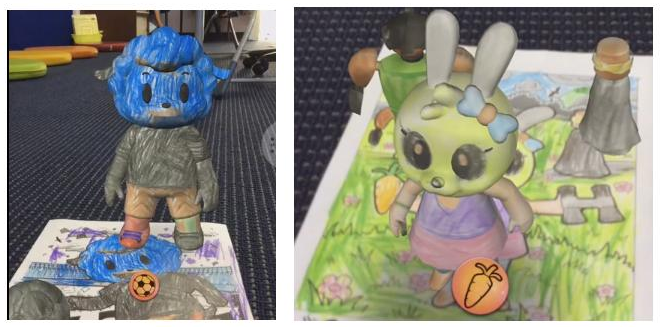
Firstly, they had fun reflecting and talking about their participation in a Cluster Summer Sports Day in which they were involved. Without the students even knowing, in this activity they were also touching on the Speaking and Listening component in the NZ Curriculum.

After choosing one of the two pictures provided (one for their ball kicking activity and the other for the game ‘rats and rabbits’), students coloured their choice using their favourite colours and then watched as their picture came to life just the way they'd made it.

Students took a screenshot and published their reflections verbally on their ePortfolios. (http://goals-r-us.blogspot.co.nz/2016/04/augmented-reality-using-quiver.html).

Erupting Volcanoes
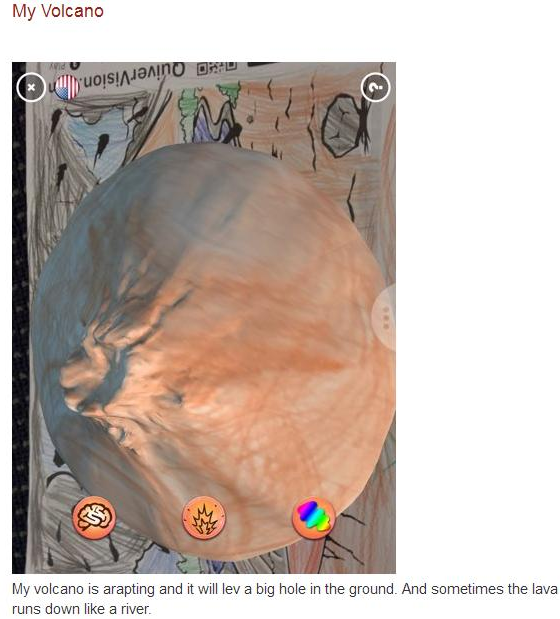
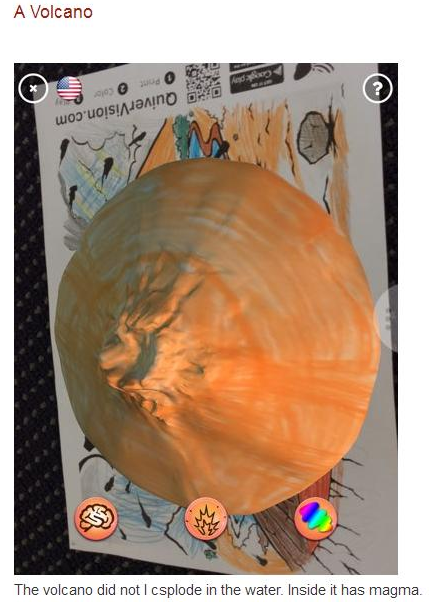
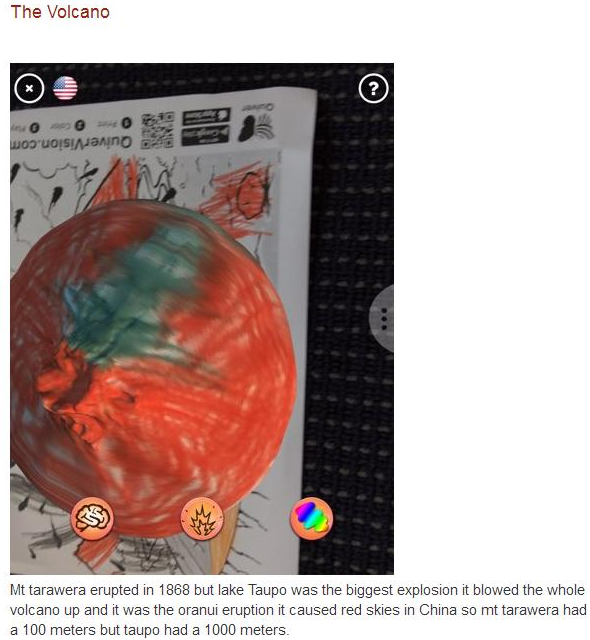
A second example was when students were learning and inquiring about volcanoes. I printed the volcano picture from the Quiver website.  Students took a screenshot and wrote a story about it.  They had the opportunity to choose how they would like to present what they knew and learnt about volcanoes. This has not only engaged them, but also enabled me to see what they have learnt. Writing has also becoming more fun, especially for the boys.

Some stories were published on our class blog


Excitement and engagement
To experience students’ excitement and engagement in their learning, is priceless and shows me that engagement is critical to their learning. The use of these digital tools gives them the opportunity to deepen their skills in engagement, communication, collaboration, critical thinking, as well as creation. It also allows students with various learning styles alternate modes to interpret ideas and understand challenging concepts, enhance their engagement & success.

As I see the difference in the learning of my engaged students, it becomes easier to find ways to incorporate technology into their learning. And, in my experience I have found that AR can be used in all learning areas of the NZ Curriculum. Making a difference and engaging students is not about what I teach, rather, it is about how I teach. This experience has been life-changing for me. It really gave me an opportunity to make a lasting difference in the lives of my young students.


Screenshots from Interface:


~ "Reality is merely an illusion, albeit a very persistent one." - Albert Einstein  ~

Thursday, May 12, 2016

Defining my Practice (Week 25)


Applied Practice in Context (APC) - Defining my Practice

Activity 1: 'My community of practice'

Wenger defines community of practices as 'groups of people who share a concern or a passion or about a topic, and who deepen their knowledge and expertise in this area by interaction on an ongoing basis'. He goes further and states 'The members of a community of practice are bound by three distinct elements: the domain, the practice and the community' (Wenger, McDermott & Snyder, 2002, p.4).

In their study on 'School cultures as contexts for informal teacher learning', Elena Jurasaite-Harbisona & Lesley A. Rex states 'A community of practice differs from other group types in terms of learning and knowledge and practice sharing rather than management objectives. In the school context, this occurs through informal learning via daily conversations, lesson reflections and other exchanges' (Jurasaite-Harbison & Rex, 2010).

Finlay mention that '...reflective practice invites professionals to engage in both personal reflection and broader social critique'. (Finlay, L., 2009, p.5).


My take on a Community of Practice is as follows:
A Community of Practice is a network of individuals with common problems or interests who get together to explore ways of working, identify common solutions, and share good practice and ideas. This group of people will share a concern or a passion for something they do and learn how to do it better as they interact regularly.

My specific learning communities (communities of practice) are:
1. My colleagues at the school I am currently at
2. Schools in the wider context as part of my role as Learning Facilitator with Ngā Pūmanawa e Waru (NPeW)

What is the purpose and function of my practice in these communities and in what ways do I contribute to them?
1. School: As Assistant Principal and ICT Lead, my purpose is to support colleagues with change and new digital technologies as well as making them aware of PL&D opportunities that will allow them to grow and improve their practice. Through discussions in our senior management team meetings it is evident that our shared goal is to ensure that colleagues and students have the opportunity to reach personal excellence. Throughout I am constantly reflecting on how I can lead effectively. Therefore I am grateful that I had the opportunity to grow myself professionally and personally through my involved in the [year long] Academy for Collaborative Futures' emerging leadership programme.
2. NPeW: My role is one of a Learning Facilitator and as a Junior School Teacher, after gauging interest from around the district, a Community of Practice for Junior Teachers have been started where we are able to discuss current issues and share best practice.

Although these are my two main communities, I am also part of these specific learning communities in which I aim to meet the goals and aims of my specific areas of my practice:
Online:
1. Twitter (share and partake in the many online "chats")
2. Virtual Learning Network (NZ) (and all the sub-groups that I belong to within)
3. New Entrant & Year 1 Modern Learning Pedagogy & Environment
4. Google+
5. TeachMeetNZ
Face to Face:
1. Whānau / Students / Local community
2. Connected Rotorua (Organiser and presenting at times)
3. Educamp NZ
4. uLearn

My final thoughts on a CoP:
Why having a Community of Practice?
It is not about bringing knowledge into the organisation but about helping to grow the knowledge that is needed internally within our organisations.

Benefits of a Community of Practice
1. Members share a repertoire of resources: experiences, stories, tools, ways of addressing recurring problems—in short a shared practice.
2. Various resources such as tools, documents, routines, vocabulary and symbols that in some way carry the accumulated knowledge of the community are being developed.
3. It involves ways of doing and approaching things that are shared to some significant extent among members.
4. Allows for sharing of experiences and learning from others.
5. Allows to collaborate and achieve common outcomes.
6. Provides the opportunity to innovate and create new ideas.

What are the key theories that underpins my practice?
1. Constructivism (Piaget, J., 1983 & Vygotsky, L., 1987)
This theory was formalised by Piaget who claimed that people construct new knowledge from prior experiences. He also believed children undergo stages of cognitive development that allows them to grow and develop as individuals, whilst Vygotsky claimed that learning is dependent on socio-cultural influences.

2. Pragmatism (John Dewey, 1916)
Within this theory it is believed that reality must be experienced. From Dewey's educational point of view, this means that students must interact with their environment in order to adapt and learn.

Evaluation of my practice with regard to these theories.
1. Constructivism: Vygotsky stated that peer work and cooperation lies at the heart of learning. However, the way that people become more knowledgeable is through increased actions and interactions with the environment, as Piaget suggested, but it is essential that pupils interact with their peers to gain a true experience of what they are learning. Therefore I do make use of Learning Buddies, Co-operative learning groups and Tuakana/Teina.
Drawing clearly from Constructivist ideas, it is claimed that pupils should be able to use speech and communication to make connections between what they already know and any new experiences and ideas they may encounter. Therefore, our learning environment is one in which students feel encouraged and secure enough to be able to express and explore their thoughts, feelings and emotions. 

2. Pragmatism: Dewey believed that human beings learn through a 'hands on' approach. I have change my practice significantly this year by giving students the opportunity to learn in this way. It became evident that learners were actively engaged in hands on activities as learning was rewarded immediately. Students also have a better grasp about the new concepts they are learning and realise that their learning goals are achievable.

What is the impact?
Reflection is crucial. I really like Rolfe et al's (2001) reflective model which is based on three questions only:
What?
So what?
Now what?
My opinion: Although this model is based on three simple questions, it should not indicate that reflections should lack depth, but it should rather be as comprehensive as possible. 
Finlay also states 'Other authors argue for the concept of critical reflection, which is seen as offering a more thorough-going form of reflection through the use of critical theory (Brookfield, 1995)'. 

A more comprehensive [and formal] way to reflect on my practice is to use our very own 'Teaching as Inquiry' model as “...effective pedagogy requires that teachers inquire into the impact of their teaching on their students.” (NZ Curriculum, p35)


References:

Finlayson,A.(2015). Reflective practice: has it really changed over time?. Reflective Practice: International and Multidisciplinary Perspectives, 16 (6), 717-730.

Jurasaite-Harbison, E., & Rex, L. (2010). School Cultures as Contexts for Informal Teacher Learning. Teaching and Teacher Education,26(2), 267-277.

Ministry of Education (2009) Teaching as Inquiry. Retrieved from http://nzcurriculum.tki.org.nz/Curriculum-stories/Case-studies/Teachers-as-learners-Inquiry/Teaching-as-inquiry

Wenger, E., McDermott, R., & Snyder, W. (2002). Cultivating Communities of Practice: A Guide to Managing Knowledge. Cambridge, MA: Harvard Business School Press,


~ "Without reflection, we go blindly on our way, creating more unintended consequences, and failing to achieve anything useful." - Margaret J. Wheatley ~

Tuesday, May 3, 2016

Ethics and Research (Week 24)


Researched and Community Informed Practice (R&C) - Ethics and Research

This week explores the key ethical principles in educational research and several examples of how people or institutions are rethinking the relationship between research and practice in education.

Learning Objectives:
  • Understand the key ethical principles in educational research.
  • Engage with literature on different initiatives and approaches to the relationship between research and practice in education.
  • Recognise some of the opportunities available to you going forward if you are interested in becoming more engaged with research.
'All social research (whether using surveys, documents, interviews, observation, or computer-mediated communication) gives rise to a range of ethical issues around privacy, informed consent, anonymity, secrecy, being truthful and the desirability of the research’ (Blaxter, L., Hughes, C., Tight, M. 2001, How to Research (2nd edn.), Oxford, UK: OUP.)

While as a teacher-researcher (undertaking research in your own classroom or school) one are not required to go through any formal ethics process, it is still critical to think about the ethical implications of your research.

The key principles of research ethics are:
  • Voluntary informed consent. That is participants have the right to opt in and opt out of the research and may not be forced or coerced into participating. Issues of consent are particularly important when working with children and generally require more rigorous consent procedures (often including a parent or guardian giving consent on behalf of the child).
  • Avoid deception. The aims and nature of the research must be clearly and accurately articulated to those involved.
  • The right to withdraw. All participants must have the right to withdraw from a study at any stage. If a participant withdraws, none of the data previously collected on them can be included.
  • Avoid detriment to participants.
  • Respect Privacy. This often includes ensuring anonymity for participants.
  • Consider disclosure.
  • Aim to debrief participants.

Ethics in your own work:

Miles and Huberman (1994) suggest that to mitigate ethical issues it is not only necessary to follow the ethical guidelines of your particular institution but also to consider why the study is worth doing and how it will contribute in some significant way to the broader domain. Tracy (2010) further advocates ensuring the worthiness of the topic of study and considering the significance of the contribution it will make to the research field or to practice.

Therefore, when planning any inquiry projects in your own practice it is helpful to think carefully about the purpose of your inquiry. Think about what your research might be able to contribute and to whom, and also how you will disseminate and share the findings of your research.


~ “While it might be argued that there are few scandals in educational research (or scandals that become public) it is difficult for researchers to deny that ethical, moral and political questions do not surround their day to day experience of education and educational research.” 
- Burgess, R. (Ed.) (1989). The Ethics of Educational Research. Lewes, UK: The Falmer Press. ~


Thursday, April 28, 2016

Interpreting and Using Evidence (Week 23)


Researched and Community Informed Practice (R&C) - Interpreting and Using Evidence

This week we are examining how we can interpret the data or evidence  collected during the inquiry project and use it to inform, direct and improve our practice.

Some Learning Outcomes are:

  • Recognise different techniques for interpreting evidence and understand how these can be employed in your practice.
  • Understand how you can use the evidence you collect to inform, direct and improve your practice.

Jonathan Gray wrote a very useful piece for The Guardian newspaper on the limits of data. It is well worth a read and is available from: http://www.theguardian.com/news/datablog/2012/may/31/data-journalism-focused-critical

Gray offers the following pieces of advice about data:

  • Data is not a force unto itself. It is what individuals (or groups) do with data that brings meaning and power.
  • Data is not a perfect reflection of the world. The choices we make about data, including what we choose to collect, how we collect it, how we analyse it and how we interpret our analysis all influence the findings and conclusions we can make.
  • Data does not speak for itself. It requires interpretation and analysis (hopefully by knowledgeable individuals). In education especially, it needs to be understood within its particular context. This might be in relation to a particular class, school, community etc.
  • Interpreting data is not easy. Really understanding what the data is telling us can be very tricky.


Supporting Resources:


Some interesting reads and advice as I continue to work on my Teaching as Inquiry project plan.


~ “Evidence-based education means integrating individual teaching and learning expertise with the best available external evidence from systematic research. Indeed, a central feature of evidence-based education must be the two-way process of broadening the basis of individuals’ experience and judgement by locating it within the available evidence, and generating research studies and evidence which explore and test the professional experience of teachers, students and other constituents of learning communities.”
- Davies, P. (1999). What is Evidence-based Education? British Journal of Educational Studies, 47(2), 108-121. ~


Thursday, April 21, 2016

Collecting Evidence or Data (Week 22)


Researched and Community Informed Practice (R&C) - Collecting Evidence or Data

This week we have to focus on the different methods that can be used to collect evidence (or data) during an inquiry project.
The Learning Objectives are:

  • Understand the importance of collecting evidence during an inquiry project
  • Become familiar with the different types of evidence you could collect
  • Decide on the types of evidence / collection methods you will use in your inquiry project

It is noted that the success of an inquiry project relies on the ability to collect evidence or data in order to determine the impact or influence the project is having. Data and evidence can take many forms, however, one of the defining features of collecting evidence in an inquiry project is that data collection is planned and systematic. Earl and Timperley (2014) suggest that evidence must be ‘fit-for-purpose, of sufficient quality to form an accurate representation of the situation being evaluated and be available when decisions are being made’ (p. 17).


Some helpful online resources:


Now to think about the methods that will best enable me to collect the evidence needed for my inquiry project...


~ “Imagine that Newton’s third law worked well in both the northern and southern hemispheres - except of course in Italy or New Zealand - and that the explanatory basis for that law was different in the two hemispheres. Such complexity would drive a physicist crazy, but it is a part of the day-to-day world of the educational researcher.”
- Berliner, D.C. (2002). Educational Research:The Hardest Science of All. Educational Researcher, 31(8), 18–20. ~


Wednesday, April 13, 2016

Planning my Teaching as Inquiry Project (Week 21)


Researched and Community Informed Practice (R&C) - Planning your Teaching as Inquiry Project
As part of Assessment 2 we have to think about how the Teaching as Inquiry project we design will engage various communities in your school (i.e. students, teachers, whānau etc) as well as how it relates to Kaupapa Maori research...

I have started to think about my own inquiry project and community engagement plan that results from the literature review I am compiling. It will focus primarily on the design of my project, but will gradually move into actually implementing the plan in my school context and in my practice.

This inquiry will be relevant when looking at our latest ERO report with our area for development "... community partnerships need to be reviewed in order to sustain school development and improvement."

I will therefore base my inquiry on "How can we use communication/digital technologies to engage parents, as schools are not leveraging communication/digital technologies to improve collaborative learning for all stakeholders."

The following video is quite appropriate for my inquiry as it not only covers the variety of meaningful uses for technology, but also the misconceptions about the role of technology in education.


“I alone cannot change the world, but I can cast a stone across the waters to create many ripples.” - Mother Teresa ~


Friday, April 8, 2016

Teaching and Research in the NZ Context: Teaching as Inquiry (Week 20)


Researched and Community Informed Practice (R&C) - Teaching and Research in the NZ Context: Teaching as Inquiry
As a teacher you are constantly evaluating and reflecting on your teaching practice, making judgements on what to do next. Adopting the stance of teacher researcher formalises these evaluative and reflective processes. 
As Wilson (2013) explains: Researching our practice presents the opportunity to problem-solve more intelligently, through drawing on existing research findings and by using rigorous methods to collect evidence which helps clarify our thinking. Experiences of participating in an informed way, and acting freshly, offer the teacher for whom teaching has become a routine a sense of freedom, of meaning, of worthiness and consequently increased self- esteem. (Wilson, 2013, 5)

Schon (1983) developed the concept of the reflective practitioner, invests teachers with an active role in the procurement and development of the specialised knowledge that they require to become expert teachers. Schon believes that teachers’ personal, practical knowledge is developed only when teachers reflect on their actions: 
He [the teacher] reflects on the phenomenon before him, and on the prior understandings which have been implicit in his behaviour. He carriers out an experiment which serves to generate both a new understanding of the phenomenon and a change in the situation. (Schon, 1983, 68).

Two main themes why teacher research is important
The first relates to the importance of teacher-created knowledge for improvement in teaching and learning, and in particular student outcomes. The second centres on notions of teacher professionalism. Some quotes that represent various reasonings behind the importance of teacher-research or teacher-inquiry.

It is a community of teachers that is needed to work together to ask the questions, evaluate their impact and decide on the optimal next steps … Such passion for evaluating impact is the single most critical lever for instructional excellence – accompanied by understanding this impact, and doing something in light of the evidence and understanding (Hattie, 2012). 

Teacher research has the potential to act as an important source of teacher and academic professional renewal and development because learning standards at the core of this renewal through the production and circulation of new knowledge about practice (Sachs, 2003).

Teaching as Inquiry goes beyond the reflective practices teachers regularly employ to develop a more systematic approach for investigating and evaluating practice.

Notes:
Graeme Aitken’s background paper 'The inquiring teacher'
TKI has some useful readings and inks on Teaching as Inquiry
Graeme Aitken’s a video on Teaching as Inquiry

This video shows an expert opinion on enhancing children’s curiosity with technologies.


“My role, as teacher, is to evaluate the effect I have on my students.” 
- John Hattie ~

Wednesday, March 30, 2016

Writing a Literature Review (Week 19)


Researched and Community Informed Practice (R&C) - Writing a Literature Review


A handy tip is to search for resources in Google Scholar.

The journey of seeking out research articles and to critically interpret and evaluate research reports and findings is a lengthy process. Sorting them into appropriate 'categories/themes' is time consuming, but critical evaluation is important.

Once satisfied with the number [and range] of resources and ensuring that the materials are relevant to all the aspects of the research question(s) I will be able to analyse and evaluate them. Then... time to start writing...


~ "Writing is easy. All you have to do is cross out the wrong words." - Mark Twain ~


Thursday, March 24, 2016

Using Research as a Practitioner (Week 18)


Researched and Community Informed Practice (R&C) - Using Research as a Practitioner
This is the week to focus on my understanding how to search for and locate education research and how to critically interpret and evaluate research reports and findings. Then to choose and define a research area inquiry topic that is investigated in literature.

Learning Objectives for this week from the portal:
  • Understand the different types and formats of education research
  • Know how to search for and locate education research
  • Develop skills to interpret and critically evaluate research

1. Undertake some general background reading on the topic, familiarizing yourself with the topic and some of the key ideas and issues.
2. Create research questions and key words
3. Identify possible sources (also consider 'grey literature' - which is academic material that has not been formally published)
4. Organize and keep track of resources

How to interpret and critically assess literature?

It is important when you read research literature that you are critically engaging with it. Critical reading requires you to:
Interpret: understand the significance of the data or findings
Analyse: examine the text in detail to determine its meaning
Question: interrogate the assertions and assumptions presented in the text
Reason: develop your own point of view on the text
Evaluate: judge the credibility or strength of the text based on its reliability, validity and generalisability

My chosen area for a literature review is to focus on the 'Community' (Parents and Whānau)
I am choosing this topic to demonstrate the benefits of digital learning opportunities
The purpose is to make parents/whānau realise the benefits to students when they engage in digital learning opportunities

Now to think about the research question(s)...


~"If we knew what it was we were doing, it would not be called research, would it?" - Albert Einstein ~


Friday, March 18, 2016

Introduction to research in education (Week 17)


Researched and Community Informed Practice (R&C) - Introduction to research in education
And with this the first week of the formal (8 weeks) online course starts... through readings I am reminded that research plays an important role in education.  

Learning Objectives for this week from the portal:
  • Understand what education research is
  • Recognise the various roles that research plays in education
  • Understand what is meant by research-informed/evidence-based practice and what this means for your practice.
  • Understand the principles of Kaupapa Māori how they relate to research

The three key areas education is divided into are: research, policy and practice. Unfortunately research and practice are not always connected. This diagram shows how research, policy and practice can informed each other in an ideal world.
What is research?
  • Research is systematic, critical and self-critical enquiry which aims to contribute towards the advancement of knowledge and wisdom. … Discipline research in education aims critically to inform understandings of phenomena pertinent to the discipline in educational settings. … Critical enquiry [is] aimed at informing educational judgements and decisions in order to improve educational action. This is the kind of value-laden research that should have immediate relevance to teachers and policy makers, and is itself educational because of its stated intention to ‘inform’. It is the kind of research in education that is carried out by educationists. (Bassey, 1999, 38-39) 
  • Educational research is not just a way to come up with new ideas about teaching and learning, but most often it is a way to convince us that the ideas we already have are worth exploring—that they are worth buying into (Morrell and Carroll, 2010, 2).


There are 3 steps to follow in research:
1. Pose a question.
2. Collect data to answer the question.
3. Present an answer to the question.
(Creswell, 2011, 3)

For more information look at the first chapter of Creswell's Educational ResearchMain things from this reading:
  • What research is and the roles that it can play
  • The basic steps in the research process
  • The nature of quantitative and qualitative research
  • Different types of research design in education


Reflecting on the principles of Kaupapa Māori with the following questions:

1. How can Kaupapa Māori inform research?
The Treaty of Waitangi is interwoven into our New Zealand Education system, through the NZC and PTC. “A seminal study in this area is Huygens’ (2007) research into how collective Pākehā consciousness can change in response to learning about the Treaty of Waitangi.” Engage with the community and involve them in the research to bring change in the educational experience for Māori. Consider tikanga that underpins the ethics and nurture culture and needs by relating to the principles of kaupapa. The researcher should look that what they intend to research benefits Maori and will be making a positive difference. It also creates a sense of accountability for the researcher within the context of end goals. (Alex Barnes, 2013. Pg 12 & 23).
All this includes a wide range of research methods.

2. How can the principles of Kaupapa Māori relate to my own practice?
It helps me to think about what I want to do within another cultural context and to have active relationships with stakeholders. Teaching and learning is one with Māori and does not stand alone. Here I remember what an e hoa once said to me: "If it works for Māori, it will work for others."


The aim for the following 8 weeks will be to become a critical consumer of research relevant to practice/field and following a deep understanding. It will be about formulating key research questions in a field of study relevant to the community.


~ "Research is formalized curiosity. It is poking and prying with a purpose." 
- Zora Neale Hurston


Friday, December 18, 2015

Teaching Inquiry (Writing) Reflection

The main question in our 'Teaching as Inquiry (Writing)' was: "How can we accelerate the progress of our group of students to where they should be in relation to the National standards?"  Using some initial data and knowledge of our students, we were able to establish a baseline and direction.

Reflection:
  • What impact has the teaching had on students? -> Students were aware of what they know and about their next steps in their learning process. They became aware of the purpose for learning to write.
  • How do we know, what is the evidence? -> Students enjoyed writing and were using their skills to write for a purpose, such as 'persuasive letters' requesting a class pet, their 'writing journey' and some of their 'last stories'.
  • What do we need to do next? -> Explore other ways of introducing a writing topic. Keep students 'on track' with ongoing reflection and discussion.

Taking everything in consideration (as well as positive feedback from classroom observations), we feel confident that this inquiry was completed successfully.


Wednesday, September 2, 2015

Workshop on Student Voice


When students express their understanding of their learning process, we use the term 'student voice'. This term can also describes how students give their input to what happens within their learning environment and school.

We brainstormed ideas around 'quality' teacher, students and environment and looked at the benefits for students, for teachers and school:


Factors that influence student engagement:
  1. Relationships with teachers and peers
  2. Relational learning
  3. Dispositions to be a learner
  4. Motivation and interest
  5. Personal agency
  6. Self-efficacy
  7. Goal orientation
  8. Academic self-regulated learning

So what should we do?
  • Listen to students
  • Build a culture of inclusion
  • Encourage student to student and student to teacher conversations
  • Expect students to engage in dialogue
  • Use IT to assist in the gathering of of voice
  • Be open to change


Further resources:


    ~ "Student voice is the road to change" - Unknown ~

    Saturday, June 20, 2015

    Revisiting transformation & teaching practice

    As Term 2 is about to conclude, I feel that I should reflect once more on my teaching practice.

    I have made my students the focus, placed them in the centre and built on prior knowledge. I made a huge effort to individualize (but not personalize) the learning for each student.

    Last year, during eFellow Master class sessions, we had numerous discussions about transformation. Therefore, I have revisited my reading on the 'Keys to transformation', a blog post by Derek.

    Reflection time:
    Have I used 'the three keys to unlock transformation potential'?

    Firstly - My students were provided with choices and they had the ability to act on those choices. However, I feel that I should guide my students [even] more when making good and appropriate choices and assist them to act on them in their learning.

    Secondly - In using my class wiki for several years now, I believe I found a way of embracing the wide range of contexts in which learning occurs. I acknowledge that learning is not confined to the classroom's four walls and students have an individual learning plan which they can access anytime, anywhere.

    Thirdly - I feel that knowledge building is supported through the SOLO Inquiry model and Learning Buddy (Tuakana/Teina) system I use in class. My students also have the opportunity to interact and make connections with other students and classes through the weekly KidsedChatNZ twitter chat.

    Next steps:
    - Personalize the learning experience for all students (using progressions in 'kid-speak')
    - To recognise my students as active participants at all levels of their learning.


    ~ "Learning and innovation go hand in hand. The arrogance of success is to think that what you did yesterday will be sufficient for tomorrow." - William Pollard ~


    Saturday, April 11, 2015

    TeachMeetNZ - Celebration

    I have been involved in #TeachMeetNZ since 2013, either by presenting or as part of the support team... and I am still in awe of the host, Sonya.  Her ability to bring this all together with fabulous educators to share their learning by way of this PL&D platform is just mind blowing.  I feel so honoured to be part of it.  Thank you Sonya! 

    The best part [for me] is that there is always something new to learn at each and everyone one of these sessions!

    Today I've learnt about itunesU, through Nick's presentation. This is something I would really like to explore. James talked about student voice in the wider world. With his presentation he confirmed my view on the importance of blogging with students, to make learning visible and connect beyond the classroom. Then the wonderful 'App smashing' by Steve , which I have used with my Year 1 students before.
    Thanks Caroline for sharing with us about the effectiveness of Daily 5. It reminded me that I really need to get this up and running in my class environment again, now that the 5 year old's are more settled at school! Ben, it was great to hear how you are still as passionate about 3D printing as during our #eFellows14 master classes! I still wear my eFellow14 charm (you made for all of us, using the 3D printer) with pride. I really enjoyed listening to Ritu sharing her personal learning journey over the bridge for boys engagement and achievement. I agree that we have to have high expectations for our boys, but so do [I think] we need to have for ourselves and all of our learners. There was also a strong message about independent learning coming through from Ritu, which I really liked.

    By just listening to all the presenters, I realize that there is so much more for me to accomplish... and there are many more ways to assist my students to reflect on and think critically about their learning! I can and have to select other technologies and resources that will be effective and address the needs of individual students. My journey is ongoing...

    What a privilege to have been part of today's #TeachMeetNZ - who is [by the way] approximately two years old! It was great catching up with Kathy and Monika again too!

    The presentation of the stunning line up of educators:


    My Storify:


    A little memento from Sonya:


    ~ "The only impossible journey is the one you never begin." - Anthony Robbins ~


    Saturday, February 28, 2015

    Teaching Inquiry (Writing)

    This teaching inquiry will see me working collaboratively with another teacher.

    The main question for us is: "How can we accelerate the progress of our group of students to where they should be in relation to the National standards?"  Using some initial data and knowledge of our students, we were able to establish a baseline and direction.

    Focusing Inquiry questions:
    • What assessment information do we have?
    • What are our students' strengths?
    • What are our students' learning needs?
    Our Inquiry: "How can we support students to learn/know alphabet names and sounds, which leads them to build words and ultimately putting words into sentences?"

    Teaching Inquiry questions:
    • What instructional strategies will we use to help students achieve?
    • What resources will we need?
    • How will we differentiate to meet student needs?
    • How will we encourage student ownership of their learning?
    • What personal learning do we need to undertake? (Research/Readings/Support from others/Professional Development/Observations/videos)
    Actions:
    • Encourage student recording: Whiteboard, Student books, iPad - voice/ video, Student blogs, Shared Writing book
    • Relevant problems
    • Using materials: Flashcards, Class Wiki (ILP), Practice letter names & sounds
    • Providing challenge: Students relate writing to a picture
    • Learning buddy work: Share their writing/ story with a buddy
    • Questioning: provide thinking time

    Our Learning Inquiry will look at:
    • What impact has our teaching had on our students?
    • How do we know, what is the evidence? (Assessment/Student feedback - feed forward/Observations)
    • What do we need to do next?
    • What changes could we implement?

    Reflection: (To be elaborated on in due course)
    See outcome in Teaching Inquiry (Writing) Reflection


    "Success doesn't happen overnight. Keep you eyes on the prize and don't look back." 
    - Erin Andrews ~

    Friday, February 13, 2015

    'RTC Ready'

    Connected Rotorua had a great start to the year with Shaun sharing his knowledge on how to manage evidence for the Registered Teacher Criteria.

    He shared these Registered Teacher Criteria (RTC) Reference Sites

    Shaun has been using Google Slides to collect evidence for his RTC. I've used his Google Slides since 2012 and personally find this to be a valuable tool [to use] to collect my evidence. It is also easy to hyperlink particular posts from my blog, which I tag (label) with the RTC.
    Two other examples of how blog posts are tagged (labelled) with RTC are from Shaun & Annemarie.

    There is also a template in Google Sites, created by Leigh Hynes to use. Watch this video on how to find this template.

    More RTC Templates

    And then last, but not least using SOLO Rubrics by Pam Hook to self assess RTC.


    ~ "If you have a candle, the light won't glow any dimmer if I light yours off of mine."
    - Steven Tyler ~


    Saturday, December 20, 2014

    End of year reflection (2014)

    One of my goals this year: 'Educating Life-long Learners'

    Reflecting on My opinion:
    I was able to build good relationships with my learners and had build their confidence and skills to ensure their learning is successful, enjoyable, meaningful and lifelong.

    Reflecting on: My aim this year?
    Learners were motivated to be active, engaged and connected learners for life, whilst getting them to use and apply the NZC Key Competencies and any other resources available to them through KidsedchatNZQuadblogging Aotearoa and 'Pass the Blog'.

    Reflecting on: How will I do this?
    1.  Learners were educated on how to make choices, how to think and learn
    3.  Each learner were valued for what they do well (using weekly assembly awards)
    4.  Learners knew they matter

    With my 'Teaching as Inquiry (Maths)' my main question was: "How can I accelerate the progress of my focus group of students to where they should be in relation to the National standards?" and My Inquiry became about: "How can I support these students to show and explain their thinking?"

    Reflection:
    • What impact has my teaching had on my students? -> After introducing a concept, I encouraged student recording. Outcome:  Students were happily engaged in maths activities and considered it to be "their favourite time of the day".
    • How do I know, what is the evidence? (Assessment/Student feedback - feed forward/Observations) -> Outcome:  Evidence about it here
    • What do I need to do next? -> I provided students with the opportunity to [independently] explore and experiment further. -> Outcome:  Students created their own problems. See some examples here
    Taking everything in consideration (as well as positive feedback from classroom observations), I feel confident that this inquiry was completed successfully.


    I have also completed reflections on my eFellow14 inquiry, Reading Recovery training, uLearn14 experience and TeachMeetNZ presentation.


    ~ "Working hard becomes a habit, a serious kind of fun. You get self-satisfaction from pushing yourself to the limit, knowing that all the effort is going to pay off." - Mary Lou Retton ~


    Tuesday, December 2, 2014

    Reading Recovery - a year in reflection

    I have always been keen to try out new things to enhance my learning and improve my teaching, but when I learned that I will be involved in training as a Reading Recovery Teacher this year, I was almost struck with fear. However, that fear was quickly laid to rest when I experienced the specialist guidance, incredible support and positive feedback from our tutor, Wendy.  As a group, we fitted in well with each other and we were able to discuss many aspects of our teaching and training together. 

    My thoughts, reflections and general comments on this year:
    • The training course give me insight into how children read and write and I realised that many children who have managed to learn almost all letters and sounds and to read and write several words still cannot read the simplest text.  To successfully read texts children must divide their attention between meaning and other sources of information and make decisions in the same way that mature readers do, but within their limited repertoire of knowledge.
    • I became aware that I've changed my teaching to focus on strategies to enable children to use efficient strategies to get meaning from texts as they read for meaning as this increased their ability to use print as cues and phonological cues to generate, confirm or alter their responses.

    What aspect of the course did I find most challenging?
    • What? Making sure I use & complete the right forms at the right time (Observation Survey excluded). Why? Everything was new and there are multiple forms to be completed for different aspects in the programme.

    My biggest highlight and lowlight:
    • Highlight: The problem-solving that the children did as they pursue meaning through the reading and writing of whole texts that built the store of words and word-parts that they can identify and recall.  To experience how proud the children are of their progress and how their self-confidence has grown.

    Feeling grateful to have received this positive feedback from a parent:


    Lowlight:  Slow progress/acceleration and limited support from home for some children.


    Thank you Wendy (our Tutor), Gayle, Angela, Karen, Robyn, Haylee, Sharon and Heather for a wonderful year of learning and laughs!  We have worked hard and although we felt unsure at times, it was great to experience how we've started to believe in ourselves and how we have grown in confidence. Yay, we've made it!

    Our Celebration lunch and last get together as a group....


    ~ "The capacity to learn is a gift; The ability to learn is a skill; The willingness to learn is a choice" - Brian Herbert ~