Showing posts with label Our Standard 3 - Professional Relationships. Show all posts

Thursday, January 27, 2022

This Way... That Way

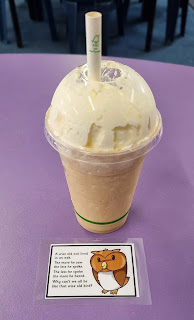
A lovely way to start the new school year... with a coffee shout by the Principal on our TOD! 

I'm very excited with our revised Curriculum and the launch of it today! Information is set out in a logical and easy to use way. Our Curriculum is the stepping stones of what we do at our school.

With the current 'situation' world wide, it is clear that a normal school day and how we know it, is gone. We have to maximise impact for our students every day. Our teaching is now adaptable, to enable us to reach all students. The main thing is that we still enjoy teaching and forge [even stronger] professional relationships with our students, whilst allowing them to have fun with their learning experiences. On top of that, we need to look after ourselves and find something that makes us smile every day.

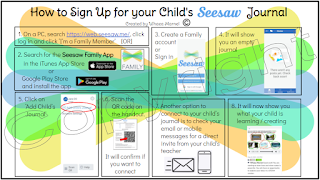
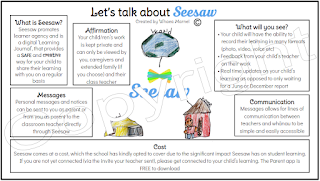
We will also be utilising Seesaw fully this year, to strengthen our school-home relationships. As I have the key role of ICT/Digital Technology Curriculum Manager, I have already ran one PD session towards the end of last year (2021) and also on our TOD to support with implementing this. Sessions to support will continue throughout and as needed.

Here are and example of two posters I created that has been shared with our school community. 


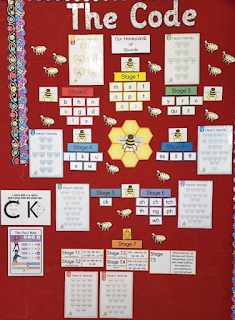
This year will also see me implementing 'Structured Literacy' in class. A new concept for me (therefore, this will be the focus of my Professional Growth Cycle), but I am very excited about the elements of such instruction. Here's my class display...


~ "Our focus is not dwelling on the past, but focusing on the future. The influence you will have looking forward, stepping stones to success for our tamariki." - Our school 'slogan' for 2022 ~


Tuesday, April 28, 2020

Distance Learning - T.O.D. Week 3 (Term 2, 2020)

Lockdown: Alert Level 3 - Day 1

We had our T.O.D. this morning through Zoom. We also reflected on the last two weeks' online learning and looked at [some] next steps.

Our school is very fortunate to have no students attending on-site classes from Wednesday 29 April to Monday 11 May 2020.

We will therefore continue to drive online learning for our students over the next two weeks. 


~ "Teachers are the guardians of spaces that allow students to breathe and be curious and explore the world and be who they are without suffocation." - Brené Brown ~

Wednesday, August 14, 2019

Collaborative Practice & Team function

Members from our AP|DP Association listened to a presentation on 'Leaders and Learning' (Empowering Leaders, Empowering Learning).

Some 'takeaways'...
  • What a leader believes in his/her core about every teacher's capacity to learn and improve impacts on his/her effectiveness in leading a team
  • The 'Pygmalion Effect' v 'Golem Effect'
  • From the #InnovatorsMindset who quoted Author and human behaviour researcher Tom Rath who notes in his book, 'Strengths Finder 2.)', that, "people who do have the opportunity to focus on their strengths every day are six times as likely to report having an excellent quality of life in general. Clearly we need to make sure our educators and students have ample opportunity to explore and practice in areas which they thrive."
  • Consider the way we function as a team/leadership. The way we function impacts the learning of teachers/students
          The ultimate place for a team's collaboration to fall is in Quadrant I: High functioning, 
          High impact
  • Five fundamental values/beliefs which supports effective leadership:
  1. Collaboration
  2. Shared leadership
  3. Goal setting & attainment (SMA - H(Heart) - RT)
  4. Rigorous discourse
  5. Continuous discourse

We listened to a short extract on 'Disciplined Collaboration'


  • The most powerful professional learning occurs when professionals collaborate, enquire, reflect and co-construct together. In short, inter-dependent learning.
          BUT
  • Simply working together does not guarantee any change or improvement in leadership, professional practice or pedagogy. For this to occur, the condition for collaborative learning and the evaluation of impact need to be firmly in place.

  • Professional collaboration SHOULD have impact, have a purpose, have a hard edge, challenge
  • Feedback are based on our observations and experiences (Appreciative... Coaching... Evaluation...). Key player in feedback is the receiver 


  • Observation and reflective analysis- to empower practice:
  1. Prior to an observation - time to meet and talk to establish clear observation purpose, process, goal - linked to teacher's inquiry goal
  2. Co-construct the effective practice criteria, that the observer will observe
  3. Reflective analysis and dialogue of the lesson - centered around the pre-established criteria and the impact on learner outcomes - how are learners responding and learning? (Responsive & Adaptive Expertise)
  4. Co-construct new/improved practice based on analysis dialogue - set time for follow-up analysis


Question to ponder:
  • How important is mindset in leadership? - What challenges do I see in MY leadership around mindset?


Connecting the learning... Where to next?

  • Leadership styles - self-awareness, strengths, next steps
  • Leading a team - tools and strategies - the HOW?
  • Collaboration with purpose
  • Collective efficacy and Culture building
  • Professional Learning Communities - what/why/HOW?
  • Effective feedback
  • Leadership Inquiry / Learning Inquiry
  • Distributed Leadership
  • Practise observation and reflective analysis
  • Adaptive and responsive expertise
  • Building relational trust
  • Effective communication / Difficult conversations
  • Leading with Emotional Intelligence
  • Innovative Leadership


~ "A leader who helps develop FOCUSED COLLABORATIVE CAPACITY will make the greatest contribution to student learning - Fullan & Quinn, 2016 ~

Monday, May 20, 2019

UBRS Workshops (Modules 1 - 4)

A blog summary of my notes...

First Session:

Aim:
  • Preventing behaviours that challenge and if necessary de-escalating the situation
  • How to stop behaviours from happening 
  • How to support child without putting more demand on them

Intro: 
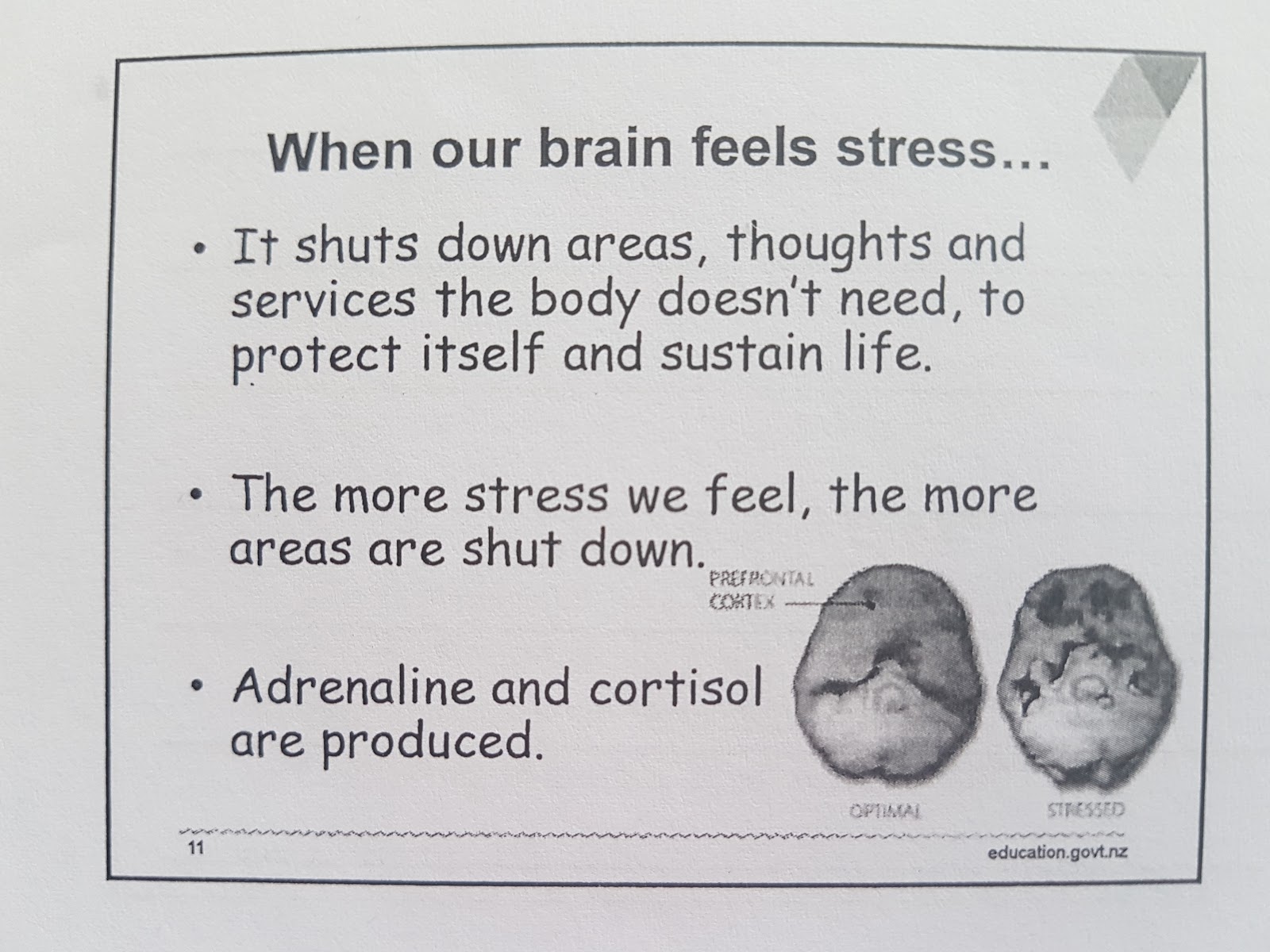
  • Understand what is happening in the brain when it’s under stress…
  • When seeing difficult behaviours, think what might be happening in the brain


Summary:
  • When the brain is under stress Adrenaline and Cortisol are produced
  • These shut down the layers of brain activity starting with logic and self-control
  • Calm the situation - don’t inflame by punitive approaches
  • BUILD behaviours by ignoring, figuring out what the driver is, replacing with positive behaviours, praise and encouragement, frequent positive restatement, reminders and redirection


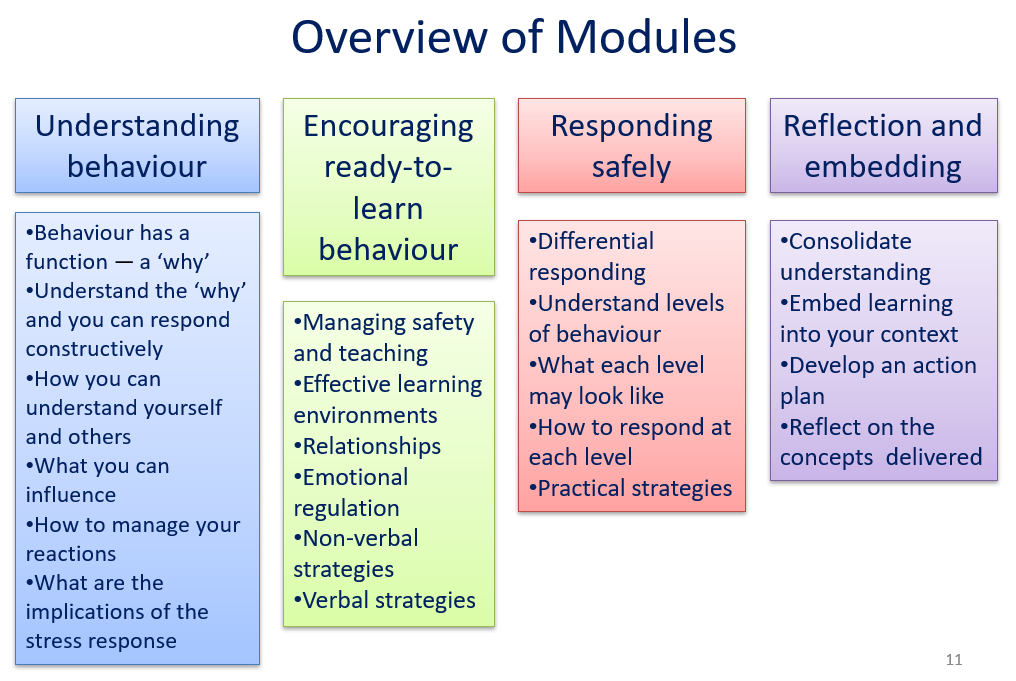
Module 1: Understanding behaviour - Why? How? What?

Remember the can of coke ‘analogy’ - shake it and it explode...
  • Being mindful of the factors that occur in a child's life that is baggage when they come to school
  • If you want to be supportive, shift your perspective by not judging and instead offer support to build that relationship

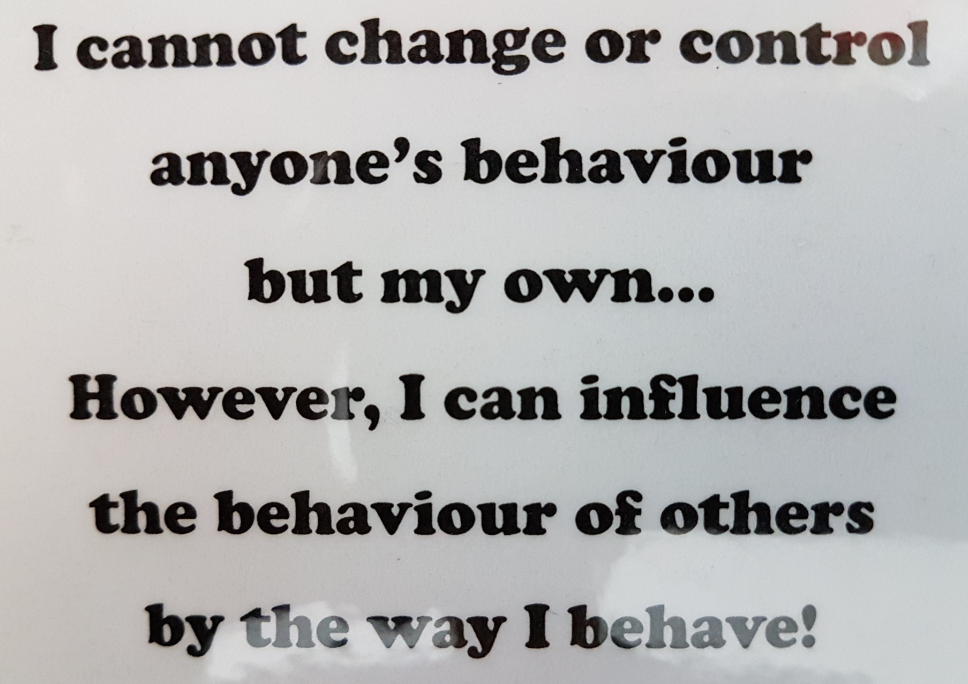
What can YOU influence?:
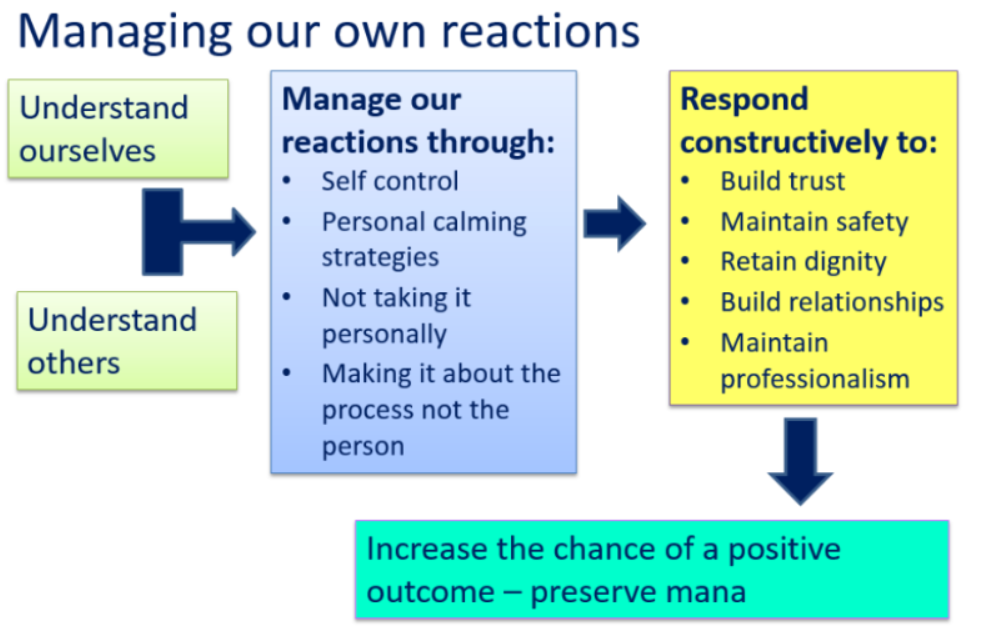
  • The only thing we can control is what we do, think and believe…
  • … and what we do, think and believe can influence the outcome to increase the likelihood of de-escalation


Understand, then manage your actions:


Stress Response: Psychological effects…


Module 2: Encouraging ready-to-learn behaviour

Establishing a learning focused culture by exploring strategies that prevent and de-escalate challenging situation through:
  • Creating supportive learning environments
  • Teaching for positive behaviour - revisiting the brain and stress
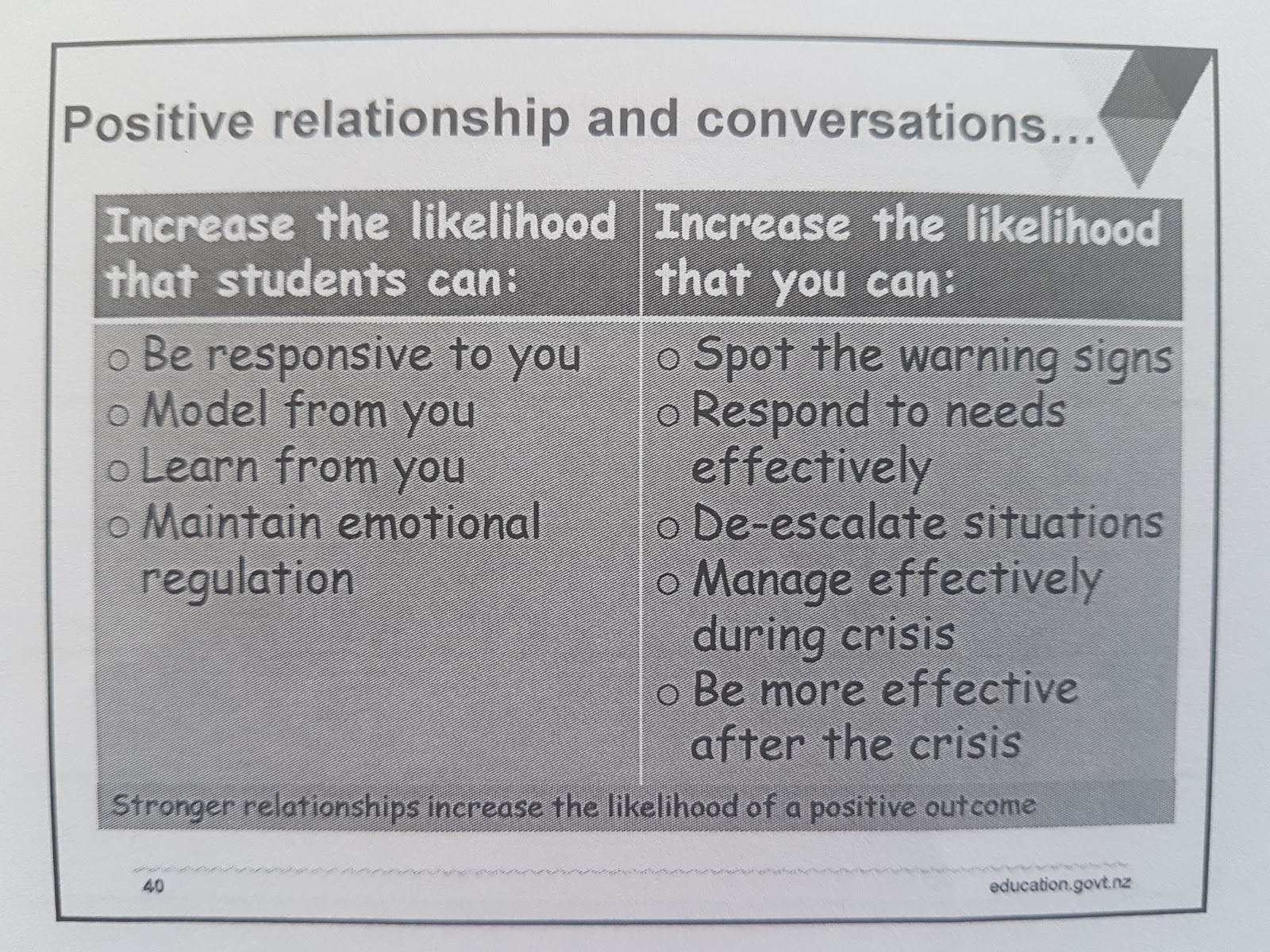
  • Strengthening positive relationships
  • Exploring strategies that support emotional regulation
  • Exploring communication - what we say and how we say it
  • Exploring strategies that prevent and de-escalate challenging situations


Exploring communications - what we say and how we say it:
  • Create win-win scenarios with two winners
  • Talk to students with compassion and respect
  • Address private or sensitive issues in private
  • Take the student seriously and address issues
  • Give focused attention
  • Avoid humour like sarcasm, inappropriate remarks or mocking - be polite

Summary:
  • De-escalation refers to a set of verbal and non-verbal responses which, if used selectively and appropriately, reduces the level of a student’s anxiety or anger to prevent loss of control
  • Research tells us that knowing the student, building trusting relationships and using effective de-escalation techniques can all minimise the likelihood of restraint


Module 3: Responding Safely

Intro:
  • Often behaviour is done for an audience
  • How do your actions escalate or de-escalate the situation?
  • Whatever goes bad, it will pass and things will get better


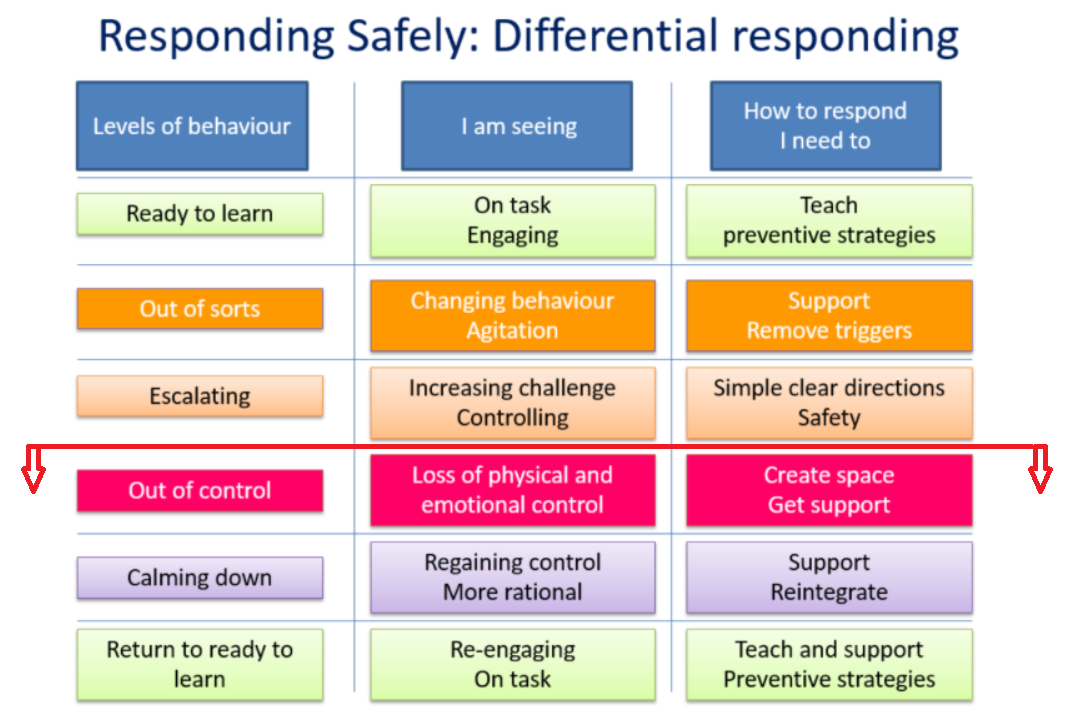
Responding Safely - Differential Responding:

(Note: when students are below ‘red line’, you will have trouble with bringing them back. A student that often go below this line would normally have a ‘safety plan’ - through SENCo / RTLB) 


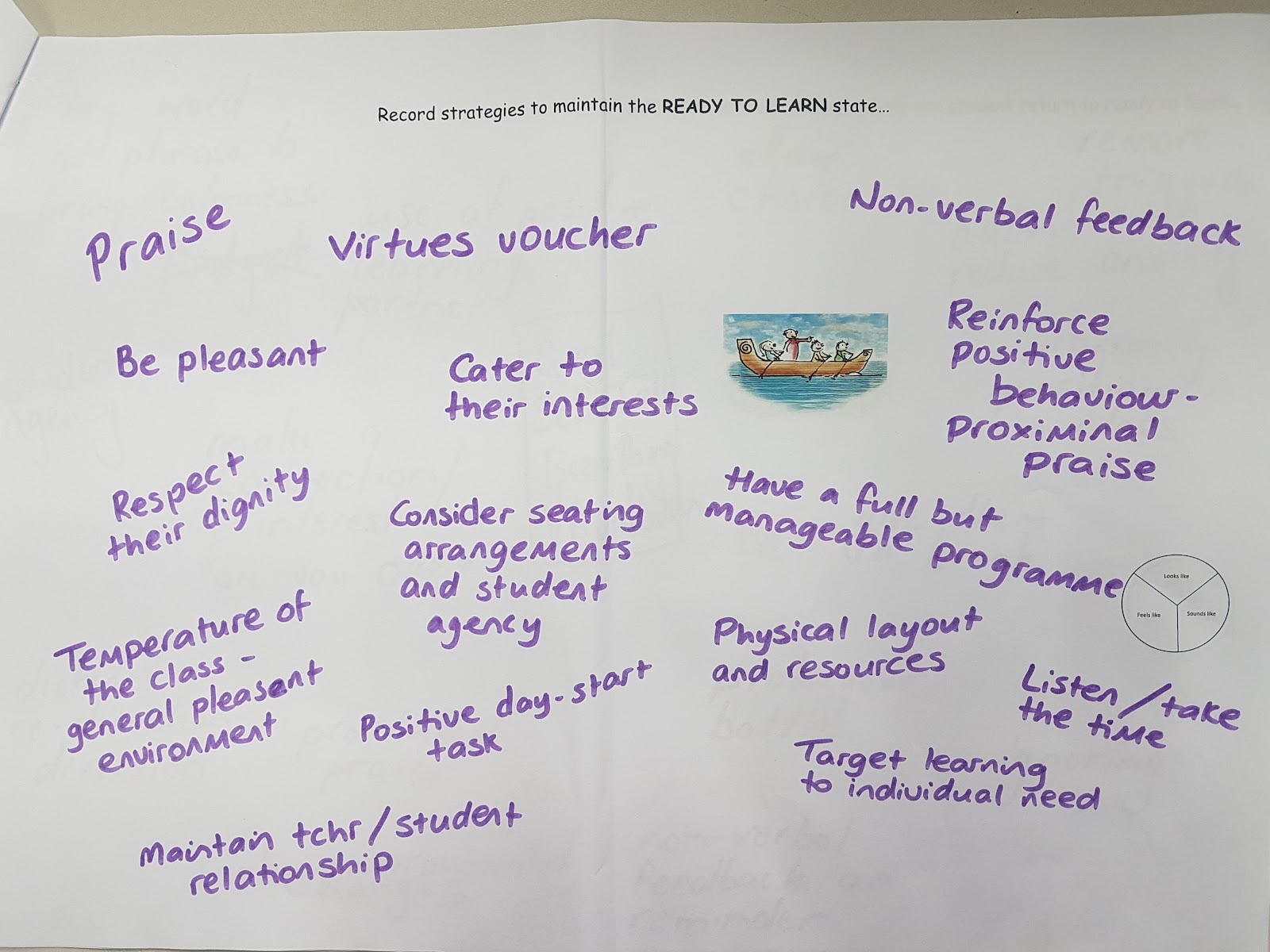
Strategies to maintain the 'Ready to Learn' state:

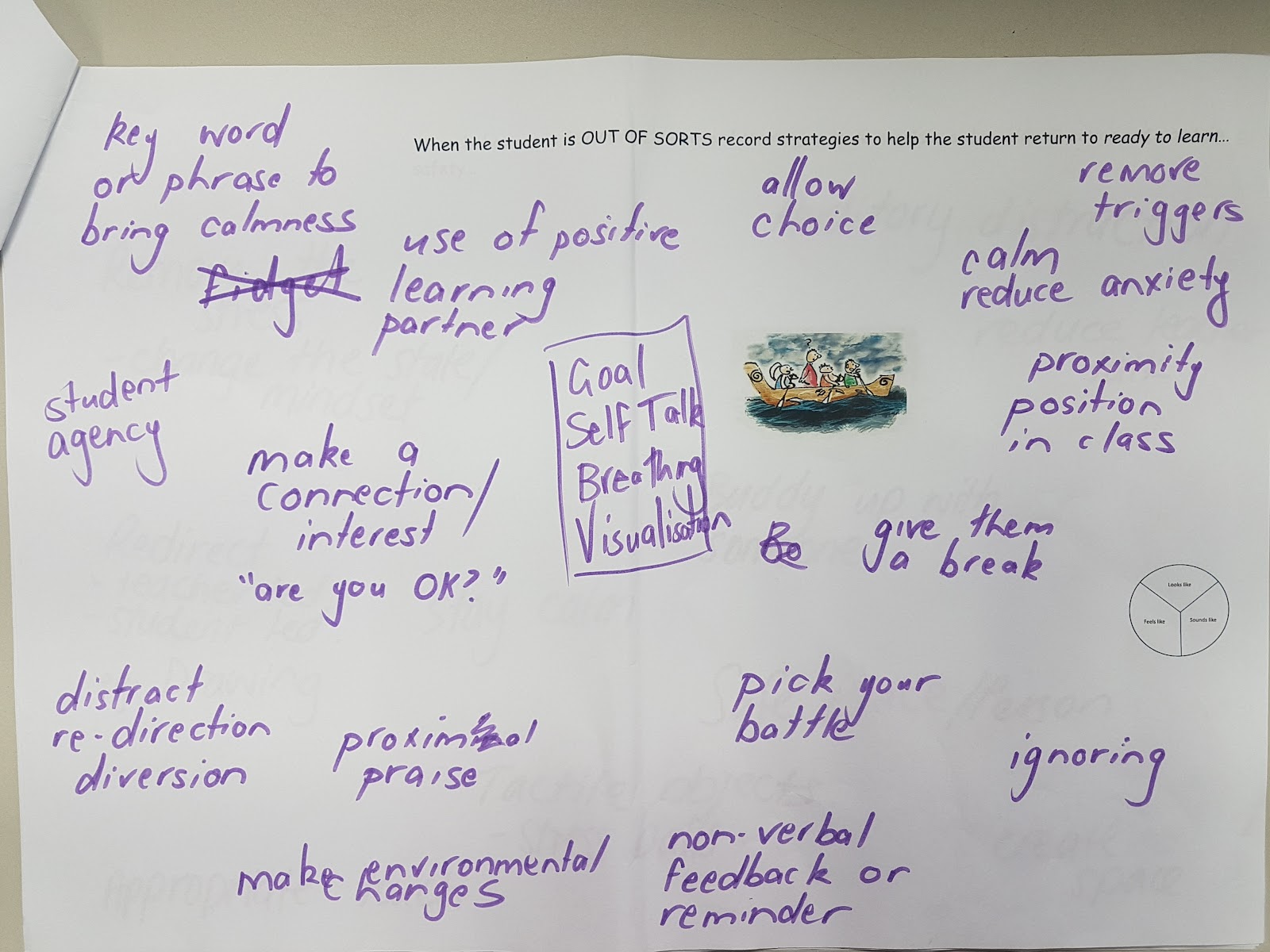
When the student is 'Out of Sorts' - Strategies to help the student return to Ready to Learn:

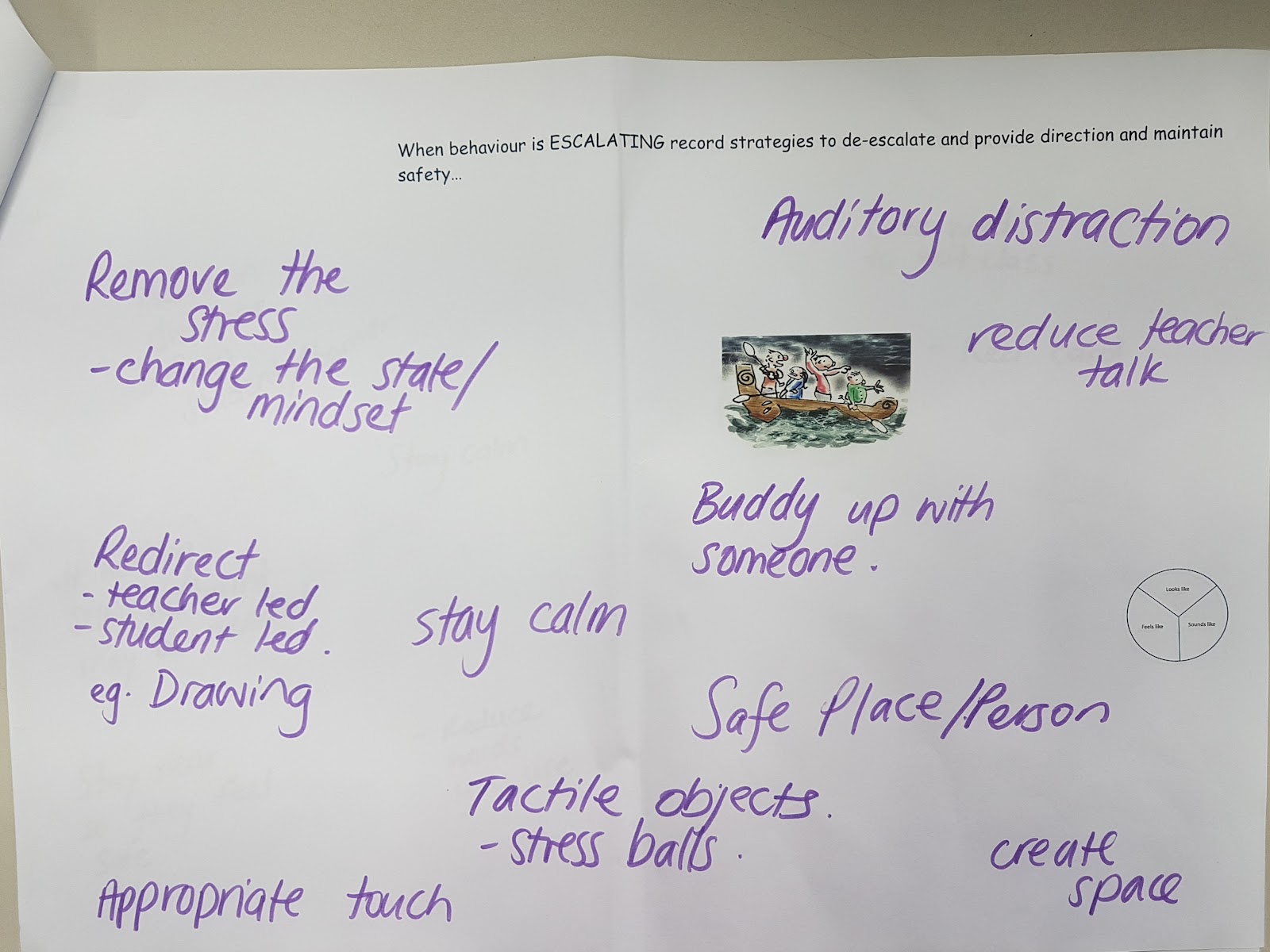
When behaviour is "Escalating' - Strategies to de-esclate and provide direction and maintain safety:

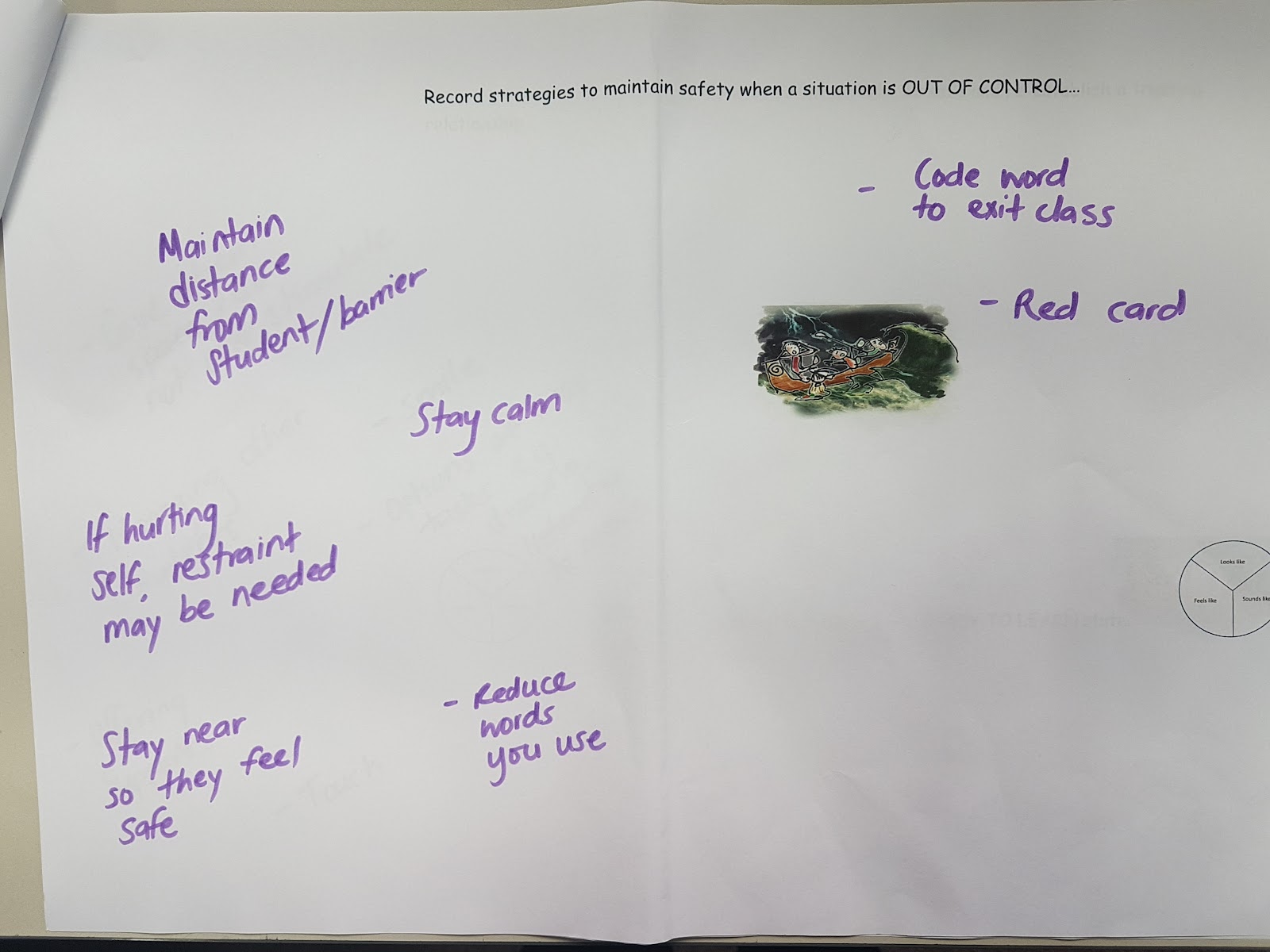
Strategies to maintain safety when a situation is 'Out of Control':

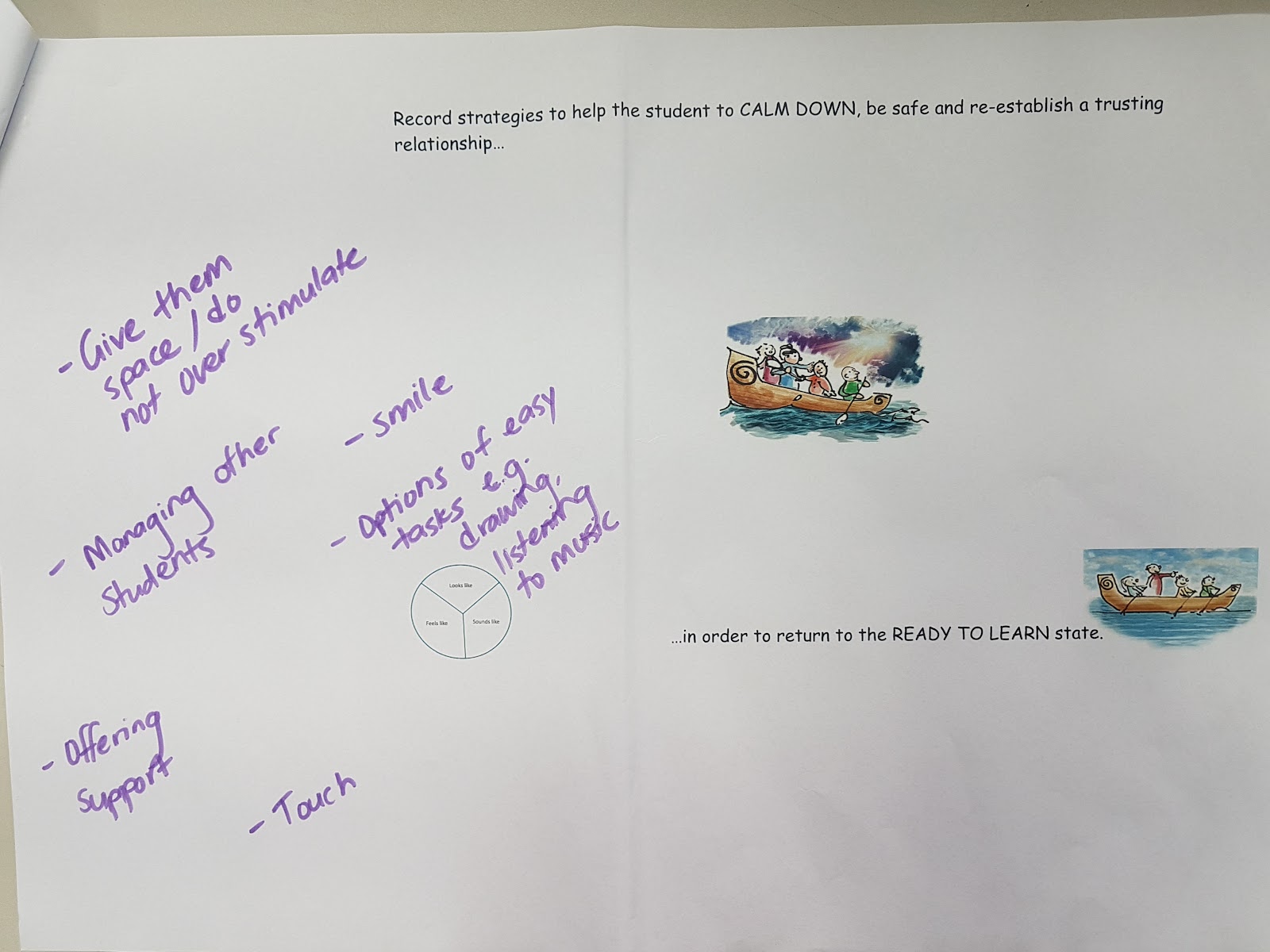
Strategies to help the student to 'Calm down', be safe and re-establish a trusting relationship:


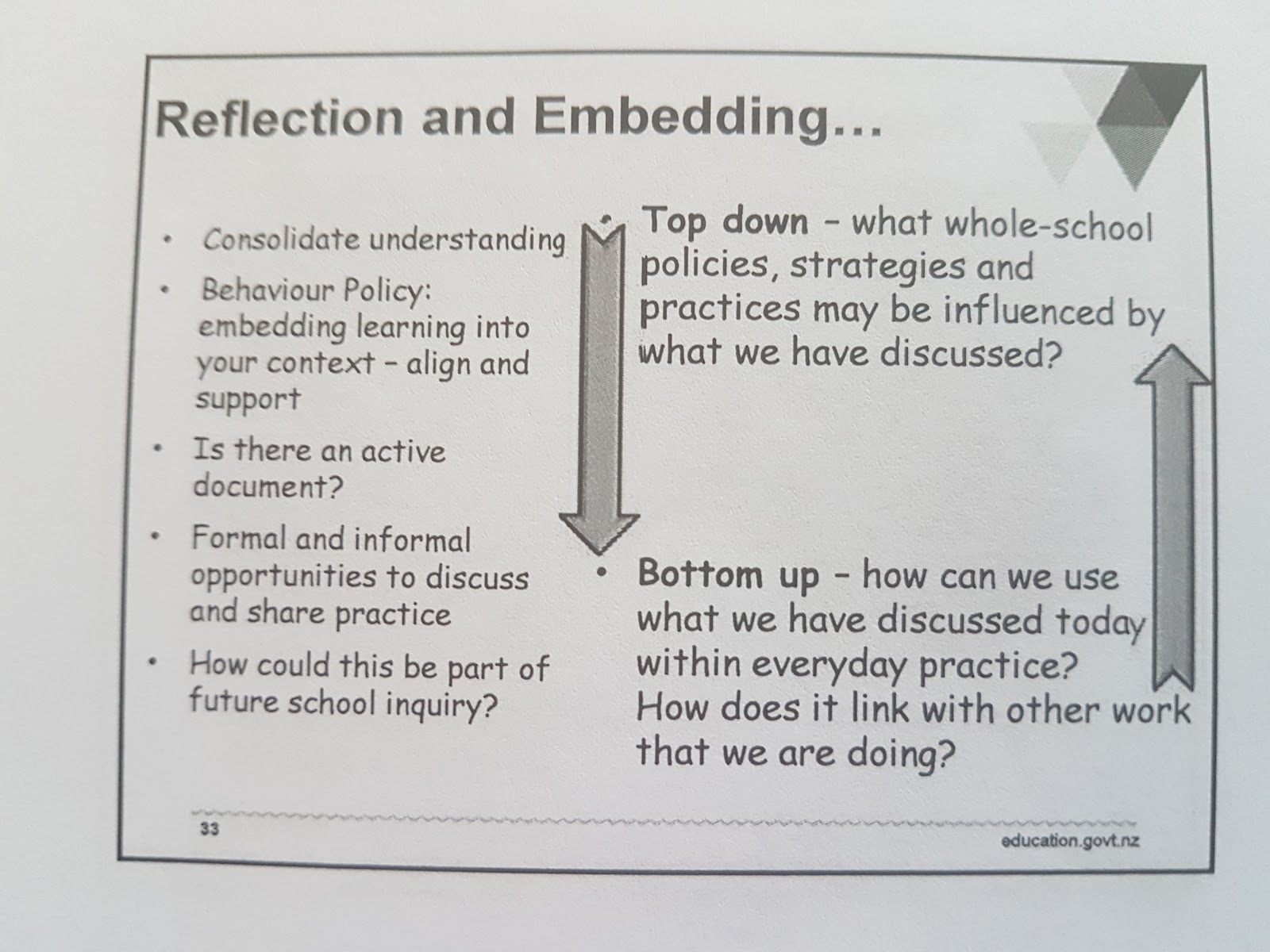
Module 4: Reflection and Embedding


Conclusion...
  • Maintain mana, walk away and determine next move
  • Ensure students know what will be happening, as some struggle with change


~ "Relying on one-on-one chat alone is rarely effective. It may take many of these conversations - this is a process to teach young people how to think about their behaviour. At a neurological level, we now understand that we are creating new neural pathways in young brains and there is not quick fix that does this!
(Thorsborne & Blood - 2013 pg. 42) ~

Friday, May 10, 2019

Learning NZSL - the best experience in a long time...

This week I started to learn New Zealand Sign Language, along with my students. We are lucky enough to have our office administrator who've done a course on NZSL, so I used her to teach us a few signs.

I was also very happy when I came across tweets with videos by Sulzy (@sasulz)! In one of her videos she showed how to sign "How are you?” & “I’m feeling _____.”

So, I practised and taught my students this the next day. 


This was the best experience for me in a long time! Students also had a lot of fun learning this new language during this year's New Zealand Sign Language week. The best part for me was when seeing students this week, some of them greeted me in sign language and signed how they were feeling!


I will definitely continue with learning and also show my students!

Tuesday, January 29, 2019

I see it..., I want it..., I dream it...


With the above as my word for 2019, I will be open to seeing the possibilities, the problems, the solutions and the milestones that can be reached every day.

Focusing more on the “why”, not just the “what” and “how” when stepping back from the day-to-day planning and details of my work, will allow me to not only see the big picture, but also the immediate achievements and needs.

I would like to see that the link between our school, parents, whānau and community where our school's educational goals are concerned are understood and supported. This will enable us to further create and nurture relationships of trust.

My job will be done if I could see the simple question “What’s best for ________?” being asked and acted upon. After all, staff well-being is crucial, and it is also our responsibility to ensure that students are excited about learning and to inspire a deep love for learning.

I know that the insanely long hours I work, is not contributing to recuperating and focusing on myself. My goal is to seeing myself take time out at least once a week, to 'de-stress' and to improve my work-life balance to avoid burnout.

Here goes to focusing on the doable... one step at a time, when seeing my 'dream' for those I am meant to inspire, serve and support.


~ "I'm sure, that this year, you will find me somewhere in between inspiring others, working on myself, dodging negativity and slaying my goals." ~

Saturday, October 27, 2018

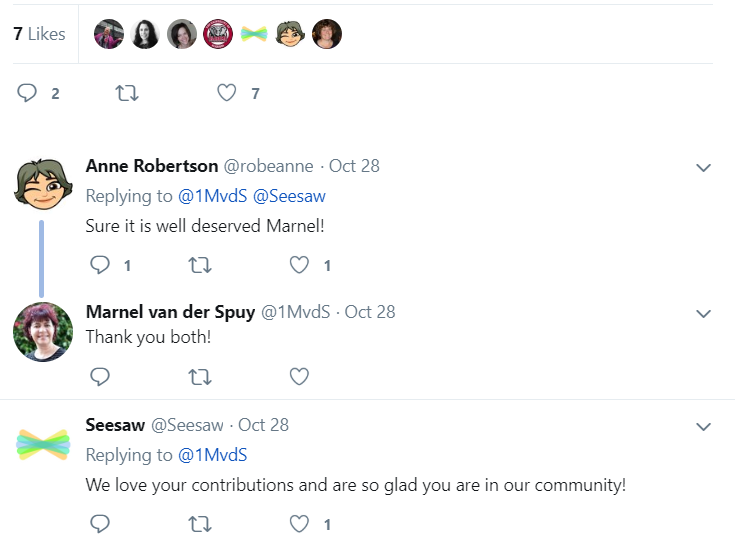
Seesaw Featured Contributing Author

Thank you for the the lovely email ! 🤗 Feeling privileged to be part of the Seesaw community and for being able to share activities!


Friday, October 12, 2018

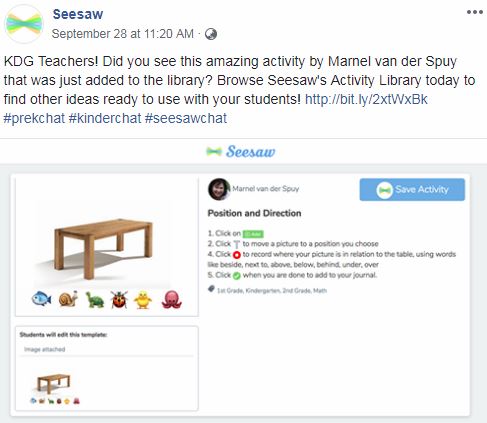
Seesaw Activity recognition


Been notified by someone that they saw this posted on Seesaw's FB. Thank you for the mention !
 

Wednesday, July 25, 2018

Oral Language across the curriculum

This workshop presented by Sheena Cameron and Louise Dempsey aimed "to support teachers to include more quality 'learning talk' in the classroom and to embed purposeful oral language opportunities across the curriculum." This was timely PD for my Teaching as Inquiry with my focus on developing Oral Language.

We started the session with the Talking strip - Introductions' by turning to a partner and by follow the steps on the strip.

We can use oral language strips to get children talking and using full sentences. Explicit teaching can include using pictures - lips closed, eyes open, ears listening etc.

The types of talk:
1. Exploratory talk (to help us understand and develop ideas)
2. Presentational talk (to share ideas and information and to entertain others)
3. Conversational talk (to build relationships)

Types of listening:
1. Informational listening (to obtain information and understand ideas)
2. Critical listening (to evaluate ideas and form opinions)
3. Appreciative listening (listen for enjoyment)
4. Responsive listening (listen to build relationships)

Establishing a 'think, pair, share' culture. Move away from the 'hands-up' approach as it is controlled by the teacher and severely limits student talk. This often results in a small group dominating the talk in a competitive manner.

Listening activity ideas:
1. Partner activity: call a friend - pretend to talk on the phone to a friend about something. Sit back to back and share.
2. Barrier games - making shapes, use a barrier to hide. Two students have the same bag of sticks. One student makes a shape, the other has to make the same shape through listening to the other's description. Another one is the Pizza barrier game where one has to explain to the other how to add pieces on the pizza.

Asking more open questions using:
1. Question strip
2. I wonder...?

Students should be talking in full sentences and elaborating on ideas...

Some elaboration questions / Prompts:
- Tell us more about...
- Why do you think that?
- Can you give us an example?
- What is your evidence?
- Can you justify your opinion?
- I have another example...
- I have a different idea...

Some alternatives to questions:
1. Students sit in a circle. Introduce a talk topic. Students use a microphone for taking turns to talk and to generate questions.
2. Shared Reading - predictions from cover. Do think-pair-share. Move away from hands up.
3. Make a suggestion - "My idea is ..." can help with getting students into a discussion

Talking groups:
Use different groupings to increase opportunities for student talk
1. Think, pair, share (partners)
Pausing in a lesson engage students in 'think,pair, share' and benefit both students and teacher as students shift from passive to active learning.
- Think:  allow students five seconds to think of what they will say
- Pair: students talk for a short time with a partner. Teacher can end talking time with simple countdown from five
- Share: a range of students can share back responses when appropriate and not necessary every time students talked to a partner.

2. Think, pair, square
Instead of sharing back as a class, partners can turn and face another pair and then share as four. Students can listen to ideas from one pair and summarise/add and new idea/ask a question.

3. Doughnut circle
Students sit or stand in two circles, outside one faces inward and inside one outward, so that all is facing a partner. Each student have a turn to speak. When it is time to change partners the teacher could call 'switch'. The inside circle then moves one partner to the left.

4. Jigsaw
Effective when planning an in-depth collaborative task. Each student in the group is given a number e.g. 1, 2, 3 or 4. Students with same number move to form a group. students then work together to learn about a topic and afterwards return to their home group and each team member shares his or her information.

5. Listening triads
Students work in groups of three taking on roles e.g. speaker, questioner, recorder [and/or] speaker, listener, questioner. The speaker talks about something specific and afterwards the other two students follow their roles by either asking questions (Questioner) and taking notes (Recorder) in order to feed back to the speaker, another group or whole class. Roles can be rotated.

6. Circle
This is a common grouping in the classroom. The idea is that everyone in the circle have a turn to say something. Students talk and listen to other's ideas and points of view. It is also good practice for speaking in full sentences.

7. Line up
Similar to the doughnut circle except students face their partner in two lines.

8. Horse shoe
Similar to the circle, but students are able to view the teaching area as well as each other.


~ "Children need writing to help them learn about reading, they need reading to help them learn about writing; and they need oral language to help them learn about both." - Anonymous ~

Monday, June 18, 2018

Anxiety, Learning and Behaviour

This was an interesting workshop that challenged thinking and perceptions.

Notes:
Each person comes to school with their own Thoughts, Emotions, Perspective from home. This is the case for both teachers and students...

Anxiety can start when having to deal with above

Anxiety – look at yourself first and how you cope with this, keep energy up. What can I do to fill my bucket at the end of the day. Know about mindfulness. If a teacher’s anxiety is going up, it will escalate the anxiety of the student. Look at the development of the brain – look at impact of trauma, neglect… they influenced development.

Brain development starts with:
Brainstem    -     Safety
Midbrain     -      Movement
Limbic         -     Emotions
Cortex          -     Learning

When students do not feel safe, they might make noise and be disruptive so they can be send out. They then they might feel safe as they are not subjected to the learning (which they might be scared of).

If a student is constantly anxious – it can be something specific...

Your anxiety can cause the student’s anxiety. Stay calm and talk in a calm voice.  When a student does not react, it might be their brain telling them "I am in danger" and that is why they might not react / respond. Unfortunately, a teacher / adult might perceive it as being defiant.

Acknowledge the feeling, but know how to cope with it. What strategy can be used to cope with feelings?
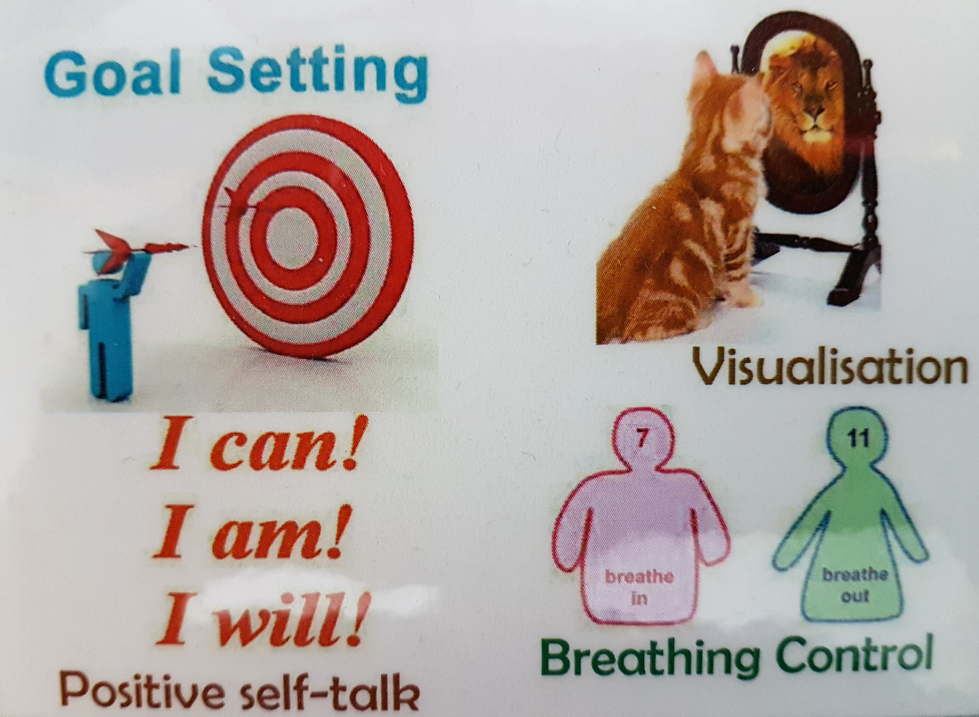
- Anti-anxiety activities: breathing exercises
- Get students to know to just breathe, will make them feel better
- Also, think how well you know this specific student.

Try and capture the right moment to help the student cope with strategies about what we do when not feeling well. Use the right vocabulary – don’t confuse angry with not happy.

Maybe do whole class teaching for coping strategies, step-by-step. Mentally visualizing working through the anxiety. Talk about what it might look like / feel like.

Know what emotions look like. Get students to act out – look up on internet.

Often an anxious student just needs time… but let them know you will be coming back to them. Difficult for anxious child to be put on the spot, speak up in class in front of everyone or even give an answer.

Often when a child is anxious, a parent will have it to. A dad might be aggressive because they are anxious. Women can cry. Get the parent to practice handling feeling and emotions with their child at home. Exercise help for unsureness- suggest they take a walk together each day. There will be more success when including the parent.

Diagnoses just gives us a bit more knowledge about the child, it is not the end of all.

Teach the ‘Worry Tree’ Problem solving technique...

The Helicopter view – teach kids to look at something with a 'bird’s eye view' and not ‘close up’. Look at something differently. What am I reacting to? What does this situation mean to, or say about, me? What's the worst thing about thinking that, or about the situation?


Resource:
Lots of ideas and metaphors on www.getselfhelp.co.uk


~ "Affirmations for Anxiety: This is only temporary; I am in control; I can take things one step at a time; Anxiety does not define me" - Anonymous ~

Monday, May 14, 2018

Digital Citizenship & Cyber Safety

Leading today's staff meeting around Digital Citizenship and Cyber Safety, I talked about what we will be looking at achieving...

1. To become more informed and vigilant
  • Only identify students by first name on ePortfolios and if it can be helped at all, don’t have a name by a photo, rather have more than one student in the photo.
  • Teacher to moderate posts
  • Search yourself online and see what comes up...

2. Teachers to focus on guiding and supporting students with having a safe, positive and creative online behaviour / Teachers should MODEL
  • No passwords printed out to be displayed / laying around
  • Teachers and student user agreements (log out of emails / accounts)
  • Check out the Finesse with ICT site that I’ve compiled and shared in the Team Drive for lots of things around ICT
3. Deliberate teaching of Digital Citizenship / CyberSafety

4. Photos / Pictures and Copyright
  • A lot of times, students and teachers use pictures / photos from Google images. They all state ‘images may be subject to copyright’. Teach students not to use this. 

How do you know if you can use an image from Google Images?
  • Find images, text, and videos you can reuse
  • Go to Advanced Image Search for images or Advanced Search for anything else. However, often they are still ‘maybe subjects to copyright’
  • In the "all these words" box, type what you want to search.
  • In the "Usage rights" section, use the drop-down to choose what kind of license you want the content to have.
  • Select Advanced Search.
A place to access safe images that are available to be used in the classroom and for educational purposes is http://photosforclass.com/ and citations are watermarked onto downloaded images.


~ "It's imperative for us to model digital citizenship to even our youngest learners." 
- Beth Holland ~