Showing posts with label RTC 11 - Assessment. Show all posts

Friday, August 11, 2017

Learner Engagement... 'Me and My School'

I was privileged to attend a NZCER 'Me and My School' Learner Engagement Survey Workshop.

"Me and My School is a unique, research-based student engagement survey designed for New Zealand students Years 4 to 10. It offers a snapshot of the learning culture in your school, standardised data to track progress over time and a nationally referenced gender, ethnicity, and year level comparison." - NZCER

Why 'Me and My School'? (Theory of Action)
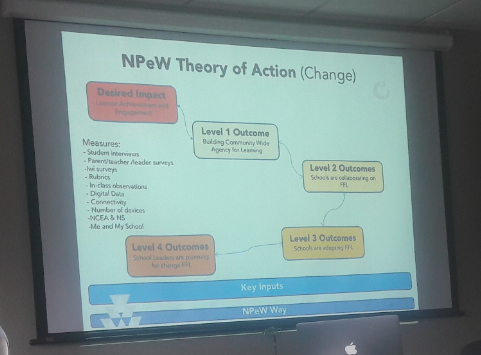
Outcomes of using 'Me and My school':
- Impact of NPeW
- Potential link to other data
- Useful assessment at multiple level (schools, CoLs, District)
- Input into school strategic plans for 2018

What does the survey measures? 3 main aspects: - Behavioural - Effective / emotional - Cognitive (willing to try new things??) Links to the Key Competencies

Getting staff ready for online survey:

- Use demo sites to introduce staff - Teachers need to talk students through 'instructions' & 'about me' parts - When students start with survey, advised that teacher should not be walking around, due to anonymous nature

Results: - With online reports you can view interim reports - Making sense of the reports - lots of different ways that data can be looked at / intrepid. Tips: Think about protocols on how to administer - maybe get students to all do it together in class or think about how it works best for your students. If someone is away, get them to do it when they are back. Aim to get all students to partake.

Conclusion:
This assessment tool is designed to give a school robust and systematic information about student engagement.


~ "Measure what you value instead of valuing only what you can measure" - Andy Hargreaves ~

Sunday, September 18, 2016

Augmented Reality in an Educational Environment

An article I have written for New Zealand Interface magazine (Issue 74, September 2016) on using Augmented Reality (AR) with 5 year old students:

Inspiring and engaging my students to make their learning real is important to me and I know that technology has the power to enhance learning. I see it as essential to bring it into my classroom to focus the learning onto the students’ future.

One opportunity that it brings to learning is 'Augmented Reality'. I have been aware of using AR for a while, but it was when I was reintroduced during my postgraduate study (The Mind Lab by Unitec) that contextualised it for me.

Here are two ways in which I have used this in students’ learning through the AR app Quiver.

Cluster Summer Sports
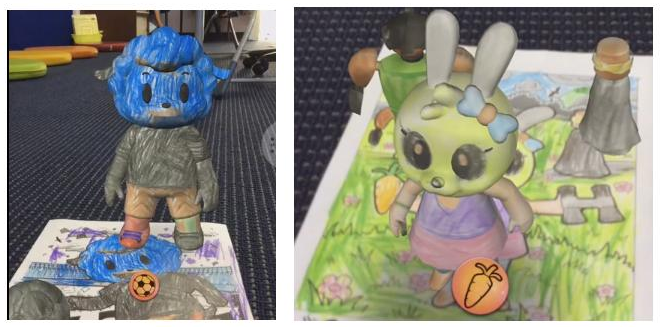
Firstly, they had fun reflecting and talking about their participation in a Cluster Summer Sports Day in which they were involved. Without the students even knowing, in this activity they were also touching on the Speaking and Listening component in the NZ Curriculum.

After choosing one of the two pictures provided (one for their ball kicking activity and the other for the game ‘rats and rabbits’), students coloured their choice using their favourite colours and then watched as their picture came to life just the way they'd made it.

Students took a screenshot and published their reflections verbally on their ePortfolios. (http://goals-r-us.blogspot.co.nz/2016/04/augmented-reality-using-quiver.html).

Erupting Volcanoes
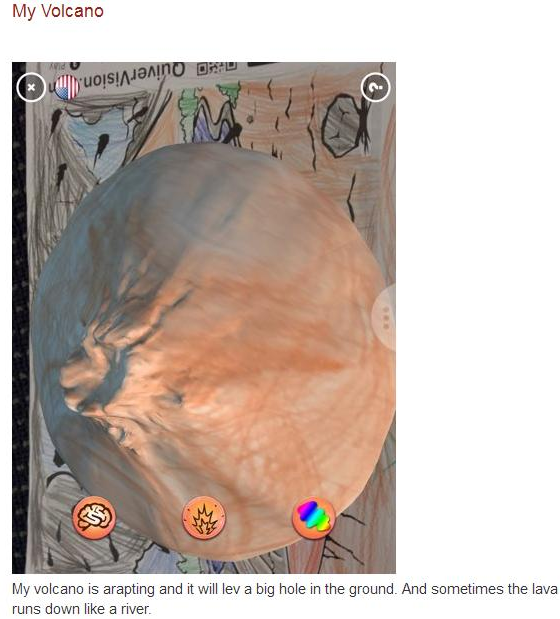
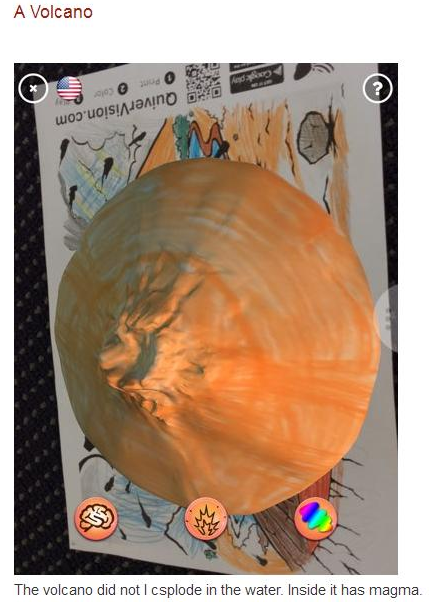
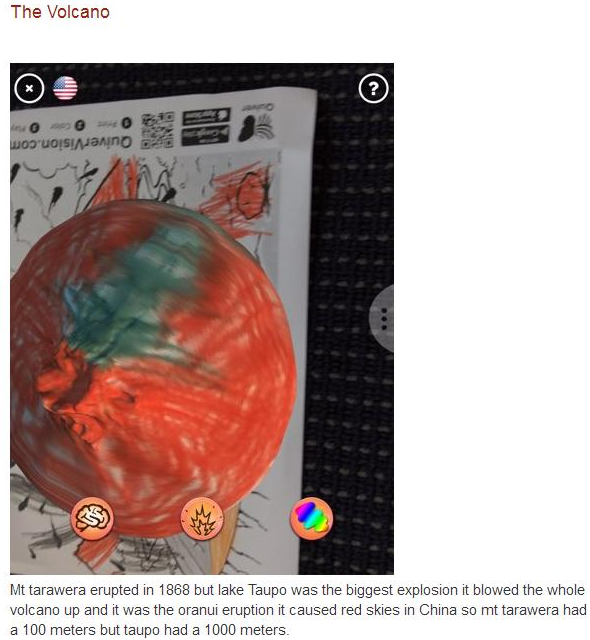
A second example was when students were learning and inquiring about volcanoes. I printed the volcano picture from the Quiver website.  Students took a screenshot and wrote a story about it.  They had the opportunity to choose how they would like to present what they knew and learnt about volcanoes. This has not only engaged them, but also enabled me to see what they have learnt. Writing has also becoming more fun, especially for the boys.

Some stories were published on our class blog


Excitement and engagement
To experience students’ excitement and engagement in their learning, is priceless and shows me that engagement is critical to their learning. The use of these digital tools gives them the opportunity to deepen their skills in engagement, communication, collaboration, critical thinking, as well as creation. It also allows students with various learning styles alternate modes to interpret ideas and understand challenging concepts, enhance their engagement & success.

As I see the difference in the learning of my engaged students, it becomes easier to find ways to incorporate technology into their learning. And, in my experience I have found that AR can be used in all learning areas of the NZ Curriculum. Making a difference and engaging students is not about what I teach, rather, it is about how I teach. This experience has been life-changing for me. It really gave me an opportunity to make a lasting difference in the lives of my young students.


Screenshots from Interface:


~ "Reality is merely an illusion, albeit a very persistent one." - Albert Einstein  ~

Saturday, February 28, 2015

Teaching Inquiry (Writing)

This teaching inquiry will see me working collaboratively with another teacher.

The main question for us is: "How can we accelerate the progress of our group of students to where they should be in relation to the National standards?"  Using some initial data and knowledge of our students, we were able to establish a baseline and direction.

Focusing Inquiry questions:
  • What assessment information do we have?
  • What are our students' strengths?
  • What are our students' learning needs?
Our Inquiry: "How can we support students to learn/know alphabet names and sounds, which leads them to build words and ultimately putting words into sentences?"

Teaching Inquiry questions:
  • What instructional strategies will we use to help students achieve?
  • What resources will we need?
  • How will we differentiate to meet student needs?
  • How will we encourage student ownership of their learning?
  • What personal learning do we need to undertake? (Research/Readings/Support from others/Professional Development/Observations/videos)
Actions:
  • Encourage student recording: Whiteboard, Student books, iPad - voice/ video, Student blogs, Shared Writing book
  • Relevant problems
  • Using materials: Flashcards, Class Wiki (ILP), Practice letter names & sounds
  • Providing challenge: Students relate writing to a picture
  • Learning buddy work: Share their writing/ story with a buddy
  • Questioning: provide thinking time

Our Learning Inquiry will look at:
  • What impact has our teaching had on our students?
  • How do we know, what is the evidence? (Assessment/Student feedback - feed forward/Observations)
  • What do we need to do next?
  • What changes could we implement?

Reflection: (To be elaborated on in due course)
See outcome in Teaching Inquiry (Writing) Reflection


"Success doesn't happen overnight. Keep you eyes on the prize and don't look back." 
- Erin Andrews ~

Friday, February 6, 2015

Connecting with students - First week reflection

Our new school year started on an optimistic note.  We welcomed two new staff members and there is a positive atmosphere in our wonderful school.

It was fabulous to see how some of our students came running to their classes after their arrival.  They were happy and chatty. Another highlight for me was the chance to talk to parents/ caregivers and whānau.

One of my priorities for the first week back (although only three days of school), was to make connections with all students in the learning environment.  Activities for the first week back was planned and selected with the aim to collect student voice, to look for patterns of behaviour at different times and in different situations and to determine each student's strengths.  I became aware of different verbal and non-verbal behaviours, which will enable me to plan and cater for individual needs.  

We established "our GUIDE for a Happy and Successful Environment" (just some 'fancy' words for our Class goals/rules) which we tied in with some of our school's Virtues.  

As a group we also practiced saying our karakia during appropriate times [of the day] and I enjoyed seeing my students' happy and excited faces when involved in these activities.

Next week will see us establishing our Learning Buddy system among many other learning opportunities. 


~ "One hundred years from now... it will not matter what job I had, or what kind of car I drove, or how much money was in my bank account, but that I made the difference in the life of a child" - Unknown ~

Saturday, December 20, 2014

End of year reflection (2014)

One of my goals this year: 'Educating Life-long Learners'

Reflecting on My opinion:
I was able to build good relationships with my learners and had build their confidence and skills to ensure their learning is successful, enjoyable, meaningful and lifelong.

Reflecting on: My aim this year?
Learners were motivated to be active, engaged and connected learners for life, whilst getting them to use and apply the NZC Key Competencies and any other resources available to them through KidsedchatNZ, Quadblogging Aotearoa and 'Pass the Blog'.

Reflecting on: How will I do this?
1.  Learners were educated on how to make choices, how to think and learn
3.  Each learner were valued for what they do well (using weekly assembly awards)
4.  Learners knew they matter

With my 'Teaching as Inquiry (Maths)' my main question was: "How can I accelerate the progress of my focus group of students to where they should be in relation to the National standards?" and My Inquiry became about: "How can I support these students to show and explain their thinking?"

Reflection:
  • What impact has my teaching had on my students? -> After introducing a concept, I encouraged student recording. Outcome:  Students were happily engaged in maths activities and considered it to be "their favourite time of the day".
  • How do I know, what is the evidence? (Assessment/Student feedback - feed forward/Observations) -> Outcome:  Evidence about it here
  • What do I need to do next? -> I provided students with the opportunity to [independently] explore and experiment further. -> Outcome:  Students created their own problems. See some examples here
Taking everything in consideration (as well as positive feedback from classroom observations), I feel confident that this inquiry was completed successfully.


I have also completed reflections on my eFellow14 inquiry, Reading Recovery training, uLearn14 experience and TeachMeetNZ presentation.


~ "Working hard becomes a habit, a serious kind of fun. You get self-satisfaction from pushing yourself to the limit, knowing that all the effort is going to pay off." - Mary Lou Retton ~


Tuesday, December 2, 2014

Reading Recovery - a year in reflection

I have always been keen to try out new things to enhance my learning and improve my teaching, but when I learned that I will be involved in training as a Reading Recovery Teacher this year, I was almost struck with fear. However, that fear was quickly laid to rest when I experienced the specialist guidance, incredible support and positive feedback from our tutor, Wendy.  As a group, we fitted in well with each other and we were able to discuss many aspects of our teaching and training together. 

My thoughts, reflections and general comments on this year:
  • The training course give me insight into how children read and write and I realised that many children who have managed to learn almost all letters and sounds and to read and write several words still cannot read the simplest text.  To successfully read texts children must divide their attention between meaning and other sources of information and make decisions in the same way that mature readers do, but within their limited repertoire of knowledge.
  • I became aware that I've changed my teaching to focus on strategies to enable children to use efficient strategies to get meaning from texts as they read for meaning as this increased their ability to use print as cues and phonological cues to generate, confirm or alter their responses.

What aspect of the course did I find most challenging?
  • What? Making sure I use & complete the right forms at the right time (Observation Survey excluded). Why? Everything was new and there are multiple forms to be completed for different aspects in the programme.

My biggest highlight and lowlight:
  • Highlight: The problem-solving that the children did as they pursue meaning through the reading and writing of whole texts that built the store of words and word-parts that they can identify and recall.  To experience how proud the children are of their progress and how their self-confidence has grown.

Feeling grateful to have received this positive feedback from a parent:


Lowlight:  Slow progress/acceleration and limited support from home for some children.


Thank you Wendy (our Tutor), Gayle, Angela, Karen, Robyn, Haylee, Sharon and Heather for a wonderful year of learning and laughs!  We have worked hard and although we felt unsure at times, it was great to experience how we've started to believe in ourselves and how we have grown in confidence. Yay, we've made it!

Our Celebration lunch and last get together as a group....


~ "The capacity to learn is a gift; The ability to learn is a skill; The willingness to learn is a choice" - Brian Herbert ~


Wednesday, November 5, 2014

My eFellow Inquiry presentation to the Cluster Principals

One thing that is being expected of you as an CORE Education eFellow is to share your learning, approaches, practices and inquiries with the wider teaching community.  

Thus, when asked by my Principal to present on my inquiry at the Cluster Principal meeting, I agreed (as I have had already presented my inquiry at uLearn14 and at #cenz14). 

Some of my presentation slides:


A short extract of my presentation:
  • Where and how do I start to facilitate personalised learning was just one of my questions. Through my networks and discussions with other teachers, I found that many were asking the same questions (especially in the junior school area)
  • I focused my inquiry on pedagogy and technologies (rather than the physical aspect of MLE) and although I was already using technology with great success in my classroom, I was driven by a desire to make learning even more rewarding and purposeful for my students
  • Questions arise about how I could support my students to carry out learning in purposeful and meaningful ways
  • I started working on supporting students to take more responsibility for their learning and how to make choices.  They have a choice of how they want to present their learning (iPads/Notebooks or via their Individual blogs).  When students know they have to share with peers, family or the teacher, it gives them accountability as well.  When they know they have to reflect on how that activity went, they have to have done it. With this I ensure no one is falling through the gaps under the guise of just "doing my own thing"
  • Is this working in our learning environment? Definitely! I will now walk into class after lunch and students will be engaged in a learning activity without me telling them what to do. Where as earlier they were just sitting on the mat, waiting for me to direct them

I left them with these questions:
  • What is your vision for your school, you learners?
  • What changes need to happen at your school / classroom level?
  • What would be the first thing you will be thinking of changing in your pedagogy?
  • Do you think Personalised Learning has potential in your school environment and what would be your first step to support teachers to implement this?

Conclusion:
In the end it all came down to Student Agency and the "power to act" as Derek explained in Trend 1 of CORE's Ten Trends for 2014.


~ "Tell me and I forget. Teach me and I remember. Involve me and I learn." - Benjamin Franklin ~

Saturday, March 1, 2014

Teaching as Inquiry (Maths)


Main question: "How can I accelerate the progress of my focus group of students to where they should be in relation to the National standards?"  Using some initial data and knowledge of my students, I was able to identify (target) students.

My Focusing Inquiry questions were:
  • What assessment information do I have?
  • What are my students' strengths?
  • What are my students' learning needs?
My Inquiry: "How can I support these students to show and explain their thinking?"

My Teaching Inquiry questions were:
  • What instructional strategies will I use to help students achieve?
  • What resources will I need?
  • How will I differentiate to meet student needs?
  • How will I encourage student ownership of their learning?
  • What personal learning do I need to undertake? (Research/Readings/Support from others/Professional Development/Observations/videos)
Actions:
  • Encourage student recording: Whiteboard, Student books, iPad - voice/ video, Student blogs
  • Relevant problems: student interest, addition and subtraction
  • Using materials
  • Providing challenge: students think of problems
  • Learning buddy work: explain what buddy said
  • Questioning: provide thinking time
My Learning Inquiry will look at:
  • What impact has my teaching had on my students?
  • How do I know, what is the evidence? (Assessment/Student feedback - feed forward/Observations)
  • What do I need to do next?
  • What changes could I implement?

Reflection: (To be elaborated on in due course)


~ "Teaching kids to count is fine, but teaching them what counts is best"
 - Bob Talbert  ~