Showing posts with label PL & D. Show all posts

Saturday, August 31, 2019

Convenient and Flexible Learning

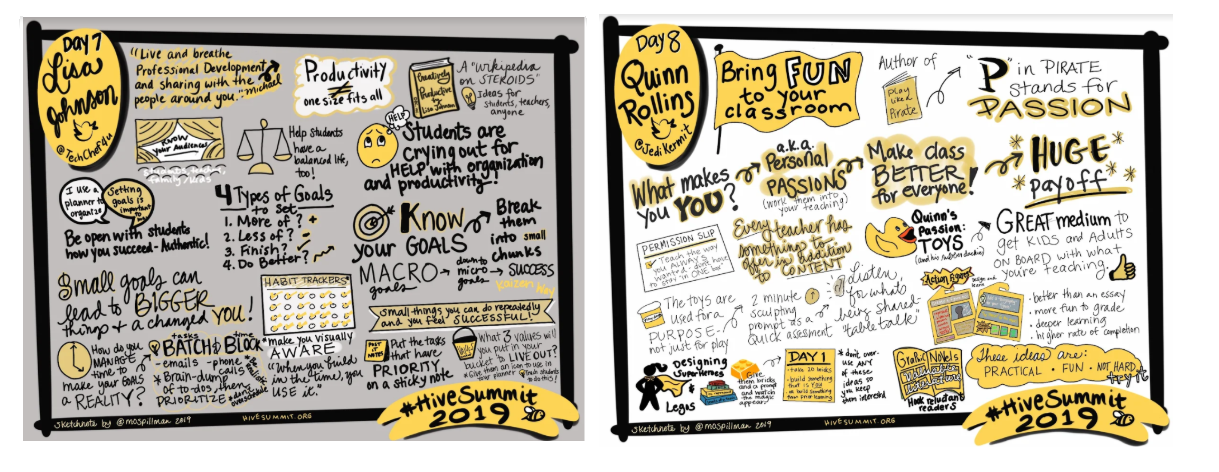
I have had the opportunity to be involved in some online Professional Development this month through the 'Hive Summit', organised and hosted by Michael Matera. 

The themes were:
Day 1: #YouMatter and Day 2: Engaging and Empowering
  • You cannot compete with someone who believes that their contribution is needed by the world” - Angela Maiers
  • We’re not talking about a trick or drop-in lesson. We’re talking about a refined engagement system; something that can be put in place time and time again” - Michael Matera


Day 3: Shaking up learning and Day 4: Relationships 
  • We can’t let our own limitations be limitations for our students” - Kasey Bell
  • Once you know someone’s story, everything changes” - CJ Reynolds


Day 5: Leadership and Day 6: Leadership and Engagement
  • Empathy leads to relationships, leads to advocacy, leads to success” - Ted Neitzke
  • If I’m not excited about teaching it, they can’t be excited about learning it” - Michelle Ferré


Day 7: Productivity and Day 8: Play
  • "There is no 'One Size Fits All' for Productivity" - Lisa Johnson
  • [Students] don’t always get to flex their creative muscles” - Quinn Rollins


Day 9: Self-care
  • We are entitled to self-care” - Dan Tricarico


"The Hive Summit is a conference built for all educators and offers opportunities to learn, grow, and connect." - https://www.hivesummit.org/

Saturday, December 9, 2017

Constant Improvement

Our school had been very fortunate to secure Anne from CORE Eduaction and CLA as facilitator for our PD this year. One focus was on parent engagement... This has been something that I have been talking about in one of my past Inquiries... How can we get parents ENGAGED in their child's learning? Many people think that attending sports events means that parents are engaged, however; parents are here only 'involved' in what is happening at a school... therefore the importance of getting them engaged... in students' learning, especially class and individual student blogs as an ePortfolio is crucial.

A good starting point for us as a staff was to look at the elements of a positive learning environment for us individually. This also help us to understand each other a bit better (I think)...

Anne lead a session with parents around the eLearning Planning Framework. Feedback from parents and teachers both were very valuable...

As teachers, we also brainstormed our ideas...

Closer to the end of our PD, we went back to a Padlet we started at the beginning of the year and revisited our ideas...

So where to next for us at this stage?

Exciting times ahead...


~ "Excellent schools don't believe in excellence - only in constant improvement and constant change." - Dan McCabe ~

Thursday, January 26, 2017

Brave, Resilient learners & Change

Our school was fortunate to secure Anne Robertson for one of our Teaching Only Days. After posing the Key Question for this session: "How do we challenge the way that professional learning has traditionally been structured and make it more consistent with modern learning practice, that is collaborative, creative, daring and challenging and meets the needs of all teachers in your school?" we introduced ourselves and discussed what motivates us to learn. One interesting thing that came to the front was that learning styles can change and develop. Therefore, Professional Learning has to be meaningful, relevant and focused on how it is going to support our learners.

The first rule of learning is that people learn what they need to learn, not what someone else thinks they should learn” Peter M Senge: The Fifth Discipline: The Art and Practice of the Learning Organisation

An exercise we had to complete was to think about three people on staff, think about their needs and put ourselves in their shoes when thinking about learning. It is vital that teachers should be considered in the same way we think about planning for our learners. We have to allow for different ways for teachers to engage in PL&D. One size does not fit all! Ownership and agency is essential if teachers are to engage positively.

Consider Knowles’ 6 principles of adult learning...
- Adults are internally motivated and self-directed
- Adults bring life experiences and knowledge to learning experiences
- Adults are goal oriented
- Adults are relevancy oriented
- Adults are practical
- Adult learners like to be respected

This can be easily applied to students as well, although not all of them might be motivated to learn, because they have to be in class / at school. What happens at home in the morning, might very well impact on how they learn...
Think UDL and cater for all learning needs in class, this however needs to be the same for teachers.

Image credit: Anne Robertson @robeanne 2016

Each of us had to think about our three teachers again while imagining one came across this small cave entrance with our three teachers... consider... What is my first instinct? What is their first instinct How would you feel if someone said to you - right we are all going to go into this cave now? Think about why your reaction is as is. What is it based on?
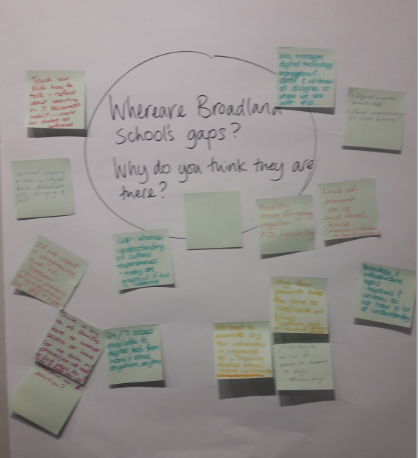
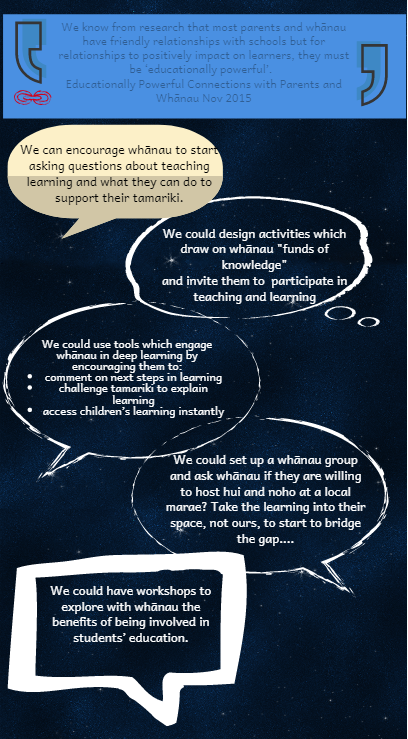
It might be hard for some to go in, having a fear of the unknown. This might be the same for people when having to learn new things. It might be easier to motivate kids, rather than motivate adults. Getting people out of their comfort zone. Tip for whānau engagement... think about cultural situations, think about that acting in a different culture could be quite scary.

We bring a whole lot of baggage with us when it comes to making decisions about what we do. Our Mental Model is shaped by the unspoken, unacknowledged, unrecognised assumptions we have just beneath the surface that guide our actions - positively and negatively.  Our prior experience plays a huge part as does our situation and context - age, gender, family situation, school setting. And mental models often resist change.
It is important to remember that we all see thing from different perspective, due to our experiences. This underpins our values/virtues and beliefs.

Enablers and Blockers challenge... 
What do we see as the ENABLERS to engagement in professional Learning at our school and what are the things that BLOCK people from engaging?


Sheryl Nussbaum talks about schools being “Future Ready” - there are 4 elements to being future ready. However, it is very important to consider as we develop Professional Learning programmes, that teachers are learners too.

An environment where the message is always ‘we are not good enough’ can be demoralising and counterproductive for all stakeholders. George Couros #Innovatorsmindset

ln the book “The Innovator’s Mindset” George Couros talks about the need for leaders to trust, to allow a positive space for people to grow and develop their skills, to focus on strengths not weaknesses. 
Something to ponder... Do we look at strengths of people or do we always look at the negative? Finding people's strengths is so important.

"When we build on our strengths and daily successes - instead of focusing on failures - we simply learn more” Tom Rath


Simon Sinek talks of how 'why' should be first, even before the 'how' and the 'what'. This seems a deceptively simple idea... But teachers also need a sort of personalised why… e.g. why should I adopt new practice. It has to be contextual to the way they teach and learn, to the students in their classes and the way that they are as teachers and learners themselves.
It is possible for the ‘why’ to evolve too and it doesn’t have to be static. However, you can’t just change the ‘why’ without a moral purpose or reflecting on it and considering why it might have changed.  Which is where Spirals of Inquiry come in…


Anne talked about an analogy that she heard of recently... consider a fire - what does it need to keep burning? (fuel and oxygen and space between the sticks for the fire to develop). If more sticks are being piled up on the fire, it collapses and has no space for the oxygen to keep fanning the flames so it suffocates and dies out. This is the same with teachers... they need to have space and time to keep motivated to learn and care should be taken not to overload them. 

One thing that came through strongly though was the idea of time for reflection and consolidation which is represented in the Poutama - the Maori representation of steps that symbolise levels of learning and that after each step there is an opportunity to consolidate, to take a breather (rekindle the fire) and assimilate skills learned before moving onward and upwards.

Key idea: We need to provide space for people to have inspiration. Don't keep on piling up... What can we take away... Allow teachers to take a step, and then have time to get an understanding and put learning into practice, before taking the next step.

Engagement in PL&D isn’t an option but leaders need to model good practice, be sensitive and respectful of the learners’ needs and be warm but demanding just as we are with the students in our classes…

Image Credit: https://mymindabout.files.wordpress.com/2013/03/infinite-staircase-olafur-eliasson1.jpg

Building on the Poutama steps of knowledge acquisition with time for assimilation and consolidation of skills discussed earlier - and the spiral of inquiry - this idea of a spiral staircase that can provide space for teachers to focus on their practice and the needs of their learners, that encourages constant, ongoing reflection, and further inquiry is very powerful. A never ending spiral staircase of learning...


~ "You are never too old to learn. At no time ever say, 'It's too late to learn,' not until the day you die." - Kimani Ng'ang'a ~

Monday, April 4, 2016

Auditory Processing Disorder

I was lucky enough to be part of a workshop presentation by Angela Alexander, Doctor of Audiology, from the Auditory Processing Network. She shared with us information on APD and some quick tips and tricks to enhance life and learning for students with an auditory processing disorder. Students with this condition can't process what they hear in the same way other kids do because their ears and brain don't fully coordinate.

There are two basic functions of hearing that are extremely important: sensitivity and processing. Sensitivity refers to the softest sound an ear can hear.

There are four levels of auditory skills:
  • Awareness to sound (hearing sensitivity/basic hearing function)
  • Discrimination of sound (being able to not only hear a sound, but be able to process it. Able to hear difference between 'n' and 'm' sound)
  • Identification of sound (the ability to hear the difference in one sound from another and to hear that sound in isolation. eg. know that we refer to the sound' 'm' with the letter 'm')
  • Comprehension (understanding a spoken message)
When the first three is not happening students can have a problem with comprehension as the brain might process sounds differently.


10 ideas to support a child with hearing problems
  • Memory: short term to long term and echoic (making it fun/ weird to remember)
  • The importance of repetition and consonant production
  • Simplify instructions
  • Breaks are important
  • Remove this sentence from your language ("I am just going to say it once")
  • Be positive
  • Decrease your distance & 'yacker tracker'
  • Allow preview/review at home
  • You are an amazing referral source
  • And most importantly... The greatest factor in success for a person with auditory processing disorder is the attitude and understanding of their teachers, caretakers and health professionals.


~ "Remember: everyone in the classroom has a story that leads to misbehavior or defiance. 9 times out of 10, the story behind the misbehavior won't make you angry. It will break your heart." - Annette Breaux ~


Friday, March 11, 2016

Future Focussed Learners and GAFE at Connected Rotorua

In the first Connected Rotorua meeting for 2016 the following topics have been discussed:
1. Engaging future focussed learners in an Authentic Rotorua context
2. GAFE (keeping the learner at the center)

We were fortunate to have had Hancine and Helen leading the discussions and it was a privilege to be MC on behalf of the Ngā Pūmanawa e Waru Learning Team.


      ~ When dealing with children there is greater need for observing than of probing” 
                                                      - Maria Montessori ~


Saturday, July 18, 2015

"It's not about the bean bag!"

I attended a great professional learning day run by Daniel Birch, Lisa Squire and Sharyn Afu from Hobsonville Point Primary School during the recent school holiday. We learnt about 'why' MLE and MLP is important and 'how' to make this happen in a class.


There was also time for discussions.... 


Reflection:
Much was around inquiring into our own practice and thinking about what learning should be like. The school vision and values and how we unpack them is equally important.
It was good to hear that some of the '19th Century' stuff is still important, but that the context needs to be different.

My conclusion:
Transformation is so important and change happens when we strive to improve what we are doing. By considering new ideas and different ways of 'doing' things, we would be able to provide our students with the very best we can.


My Storify:


~ "First comes thought; then organization of that thought, into ideas and plans; then transformation of those plans into reality. The beginning, as you will observe, is in your imagination." - Napoleon Hill ~


Saturday, March 14, 2015

Leadership Coaching

This workshop was my third PD session for this year and I would regard it to be a very positive and enjoyable experience.  

I have been introduced to the eight skills of coaching and became aware of the true meaning of coaching and how to use the GROWTH coaching framework.

We all know that goal setting is really important as it gives a directive, energising function and effect commitment. Therefore, one has to make sure that iSMART goals [inspiring, Specific, Measurable, Achievable, Relevant, Time-bound] are being set, instead of SLOTH goals [Somewhat vague, Lack commitment, Open-ended, Timid, Hard to achieve], as they will be more likely be achieved.

What I also liked was that the group were able to see the impact of a coaching conversation and that we were given time to practice coaching someone.

Summing up:
  • Coaching is about transforming good intentions into great results, it is a significant conversation
  • It is a significant conversation to unlock a person's potential to maximise their performance
  • When a leader coaches a colleague, you encouraged them to be self-directed.  
  • Good coaching leads to Actions, Clarity and Energy


~ "Vision without action is but a dream. Action without vision is a waste of energy. But a vision with action can move mountains" - Lao- Tze


Saturday, February 21, 2015

"Kick-starting Learning in Term 1"

Annemarie confirmed the venue for our annual EducampRotovegas and I've had the e-Learning Smackdown slides and Sign-up form sorted long before schools started back for 2015.  We were ready and was looking forward to welcome educators to Rotorua.

Then we received this tweet from Network for Learning


and a blog entry by Andy Schick
http://www.n4l.co.nz/educamprotovegas-participants-thank-you/

Thank you N4L for recognizing teachers in this way!


We had a great turnout, the room was packed and it was wonderful to see so many newbies present.  The Smackdown did not disappoint, with a huge range of ideas and resources being shared.  


My Storify tells the story of the day, as it happened in the Twitter feed.


A warm thank you to all of the attendees! 


~ "To the world you may be 'just' a teacher, but to your students you are a HERO" 
- Unknown ~


Friday, February 13, 2015

'RTC Ready'

Connected Rotorua had a great start to the year with Shaun sharing his knowledge on how to manage evidence for the Registered Teacher Criteria.

He shared these Registered Teacher Criteria (RTC) Reference Sites

Shaun has been using Google Slides to collect evidence for his RTC. I've used his Google Slides since 2012 and personally find this to be a valuable tool [to use] to collect my evidence. It is also easy to hyperlink particular posts from my blog, which I tag (label) with the RTC.
Two other examples of how blog posts are tagged (labelled) with RTC are from Shaun & Annemarie.

There is also a template in Google Sites, created by Leigh Hynes to use. Watch this video on how to find this template.

More RTC Templates

And then last, but not least using SOLO Rubrics by Pam Hook to self assess RTC.


~ "If you have a candle, the light won't glow any dimmer if I light yours off of mine."
- Steven Tyler ~


Friday, January 30, 2015

And we're off!

We kicked our 2015 year off with two very meaningful and productive professional learning and development (PL&D) days which I thoroughly enjoyed! 


PD #1: 'Appraisal Workshop'
Prior to our session we had to complete a reflection page about a best memory/experience, the worst memory/ experience from a past teacher appraisal and the most effective aspect of appraisal that improved practice.

These were read out aloud during the session and I find it to be an 'eye opener' to hear about everyone's experiences...

During the session we looked at:
- Teacher improvement cycle/Performance Management
- Links to RTC's / Professional Standards
- Links to Portfolio's / 'Body of Evidence'

Some valuable discussions emerged from this session.  


Next Step(s): 
The management team will now establish a framework of how the appraisal process may look for our school, which we would then discuss and share with staff.


PD #2: 'Swim Safe'
Through the Kiwi Swim Safe professional development workshop, we receive practical theory around swimming instruction.   I also learnt that students need to understand the elements of learning to swim and water safety to enable them to participate safely in 'water environments.' 

I left with some new knowledge and confidence to deliver swimming and water safety lessons in the pool.

Next Step(s):
Utilizing the 'Swimstart' Resource to deliver an effective and successful Level 1 swimming programme to my students. 


~ "Who dares to teach must never cease to learn" - Anonymous ~

Monday, January 12, 2015

Tips & Tricks - #aussieED

It has been a while since I've participated in an aussieED chat, mainly due to the difference in time zones. The chat was [again] inspiring, with many passionate educators taking part and sharing ideas.  

It was great to discuss and share with one another what one of our greatest achievements in 2014 was. Yes, even teachers need to celebrate our accomplishments. 

Time to think about something we hope to learn this year...
Stemming from my eFellow research, I plan to inquire and learn how to plan for personalised learning using SOLO Taxonomy. I am also adamant to learn more about the theory and practice of UDL (Universal Design for Learning).  I left this chat with some great resources (thanks to Simon Townley - who I've never met!) around UDL just by participating and interacting.  Twitter is the main source where teachers go to get inspiration from.  This is the place where you can interact with like minded, passionate colleagues - no matter where they are in the world!

Isn't this what PL & D should be like, I wonder.  Teachers able to drive their own learning about topics that interest them. To [ultimately] achieve a learning outcome that can be used to benefit our students.

We discussed how cloud computing can be used in our classrooms in 2015 and even what new things we might see in the classrooms of 2020...

As an educator, I personally feel that one should never stop learning and growing. It is important to let students know they matter and that they are the reason we are here.  And then, most importantly, to have a work-life balance.

What I like about edchats? 
People are always willing to share links to further readings and you learn from each other.

What am I going to try out?
I am going to incorporate what I have learned during my eFellow14 research into my practice and will definitely be looking at having a better work-life balance this year.


~ "Surround yourself with people who make you a better person" - Anonymous ~


Monday, November 3, 2014

EOTC and the Classroom - #primedchatnz with William Pike

After a couple of technical issues, the #primedchatnz Google Hangout went Live where the organiser James Hopkins as well as Kate from Learning Network NZ discussed EOTC with William Pike.

Reid and I worked behind the scenes as moderators, with me putting up questions on Twitter and Reid answering other tweeters, while we both engaged successfully with people who made time to join us and tweeted some of William's views on EOTC and the classroom.

The participation of other educators on Twitter was once again incredible. A warm thank you to everyone who has contributed to the discussion. I have learned so much and feel privileged to have been part [once again] of #primedchatnz.


Here is my Storify of the discussion that was happening on Twitter:


~ "Must we always teach our children with books? Let them look at the mountains and the stars up above. Let them look at the beauty of the waters and the trees and flowers on earth. They will then begin to think, and to think is the beginning of a real education." - Davi Polis ~


Friday, October 31, 2014

Connected Educator Month - #cenz14


Connected Educator Month in NZ-Aotearoa kicked off with a bang!  I joined the celebration and listen to some amazing presentations.  We were in for an amazing 31 days of Connected, Professional Learning.


The following are links to some Workshop recordings.

Day 1: (1st October)
  1. CEM Launch - Kick off session with Sheryl Nussbaum-Beach, Sandy Philips, Derek Wenmoth, Wharehoka Wano, Phoebe Davies, Anthony Faitaua, Karen Melhuish Spencer
  2. Introduction to the Starter Kete 
  3. CEM NZ Showcase - Carolyn Stuart, Sonya Van Schaijik, Te Mihinga Komene, Anthony Faitaua, Allanah Kind, Tessa Gray
  4. Stories of Connected PLD from NZ - Aotearoa   (Connected Professional Learning - Shared notes) - Hoeard Baldwin, Trevor Storr, Phillipa Antipas, Alana Madgwick, Tamara Bell

Day 2: (2nd October)
  1. Modern Learning Practices and the connected world (Shared Google Doc) - Stephen Heppell, Derek Wenmoth, Janelle Riki, Mark Osborne
  2. Change Leadership: Connecting Maori and Pasifika (Shared Google Doc) - Dr. Sarah-Jane Tiakiwai, Keriana Tawhiwhirangi, Maria Lemalie, Togi Lemanu, Phoebe Davies, Tahy Paki
  3. Connected Voices, Whatunga Korero project - with the link to the project
  4. A powerful blend: ULearn14 and Connected Educator Month: What's in store
  5. #blogsync launch: Chris Waugh, Karen Meluish Spencer

Day 3: (3rd October)
  1. Connected learning: Plotting pathways, navigating mazes - Silvia Rosenthal Tolisano, Tom Barrett, Togi Lemanu, Karen Melhuish Spencer
  2. Book Group kick-off: NZCER's Key Competencies for the Future - Rachel Bolstad, Sue McDowall, Sally Boyd

I made the decision not to link to all the Workshops I watched after Day 3, as I was getting ready to prepare for uLearn14 and soon after that it was back to school again.  However, the calendar for all events can be found here


Other events that I committed myself to throughout October was:


~ "We are all strangers CONNECTED by what we REVEAL, what we SHARE, and what we TAKE AWAY.... OUR STORIES" - Libba Bray ~


Saturday, October 25, 2014

My fabulous #TeachMeetNZ experience

Today, I have had the opportunity to present [a second time] for #TeachMeetNZ. This was a special session, as we worked collaboratively with #TMSydney for Connected Educator Month.

Sonya [as usually] was an amazing host, which helped to make this experience even more enjoyable. Thank you for being my inspiration, Sonya!

When asked to base my presentation around a 'Connected Educator' I happily obliged, as I am a connected educator.  I have build a Personal Learning Network with incredible educators, locally and globally.  We are able to develop our shared visions and common goals and can discuss the needs for future focus learning.

We know the world is changing at an incredible pace for our students and if we want to prepare them for their future, it is important that we, as connected educators also become the connected learners.

Being a connected educator provides me with ongoing inspiration and support.  It is my wish that more educators would see the value of being connected.

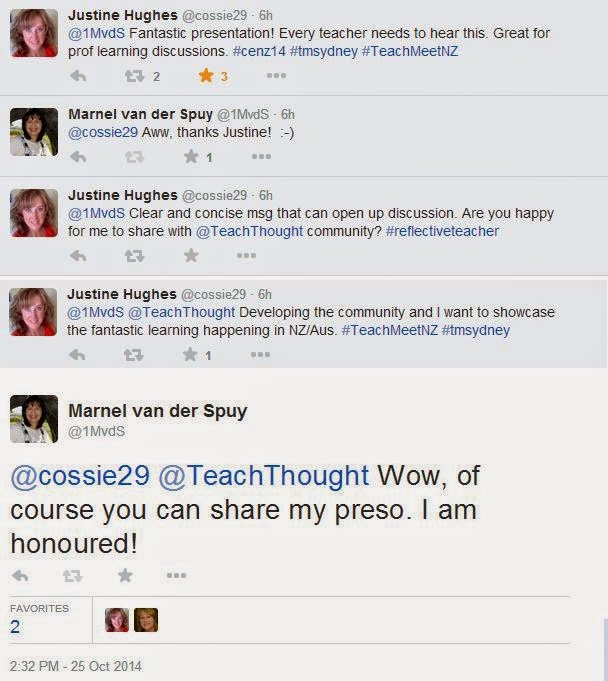
I was blown away when Justine asked if she can share my presentation.


I felt humbled when reading the kind words of Kimberley. I am privileged to have had the opportunity to be in a #TeachMeetNZ session with you, Kimberley.  I think you are doing amazing things with your students and  I do hope we can have a proper chat in the near future!


Reflection:
Having the opportunity to grow my own practice, to question, to experiment and to make mistakes is invaluable.
I acknowledge that I have grown immensely [personally and professionally] since becoming a connected educator.  However, this is just the beginning... I know that there is still a lot more to learn and experience.

So where to next?
I am going to utilize the Google Hangout tool to get in touch with educators around topics that would make learning even more rewarding and purposeful for my students. 

A Storify:


~ The purpose of learning is growth, and our minds, unlike our bodies, can continue growing as we continue to live. - Mortimer J. Adler ~


Wednesday, October 8, 2014

#primedchatnz - Future Focused Learning with Tony Ryan

This was this year's second #primedchatnz and my first where I've been asked to moderate for #primedchatnz with James and Kate during the Live Google Hangout with Tony Ryan.

I was also responsible for pledging this event to Connected Educator Month.

I knew I would have to multi-task, as this was also one of the days [in the week leading up to uLearn14] where our #eFellows14 came together for our last sessions with what John and Louise had planned for us!

While the other eFellows were busy in a session, I was busy tweeting questions on twitter, while listening to the live conversation with Tony.  What an inspiring, thought provoking and inspiring session to have been part of.
Thankfully, I was able to [also] record the eFellow session and discussion for listening to afterwards.  I really can't imagine my life without technology!


My Storify of the discussion on Twitter:


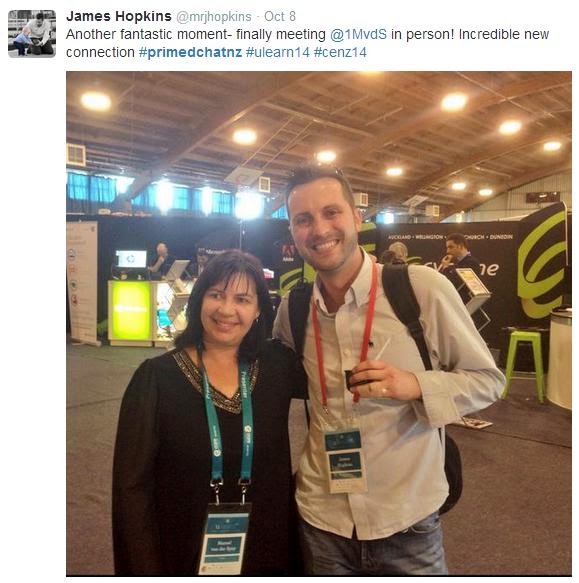
And then... after working online together, the amazing moment when meeting #primedchatnz organizer James face to face...


as well as Kate from Learning Network NZ!


~ " Life is not measured by the number of breaths we take, but by the moments that take our breath away" - Anonymous"


Thursday, October 2, 2014

Connected Educator Month - #Blogsync

We all have something to say...

I love that I can use my blog to share my views and to reflect on many things.  My blog is a wonderful tool that I use to look back on my posts.  It enables me to reflect constantly on my past and current thinking.  It shows how my thinking has changed and what I have learned [or not!] 

On day #2 of Connected Educator month, I watch the launch video for #blogsync and as a blogger, I found this session and tips on blogging to be very useful.

Chris Waugh mentioned that he's noticed that people who write blogs are sometimes a little bit afraid of the process, and I can't agree with him more.  I sometimes find it quite frightening to lay bear my thoughts.  But then he also mentioned that if you have a blog and you decide to write on a topic, it is completely yours, you curate it and decide on the tone and content. Yay!

With blogsync you just have the opportunity of more people taking notice, in particular people who might be thinking of the same things than you are.

We were invited to join http://blogsync.edutronic.net/ and connect to a blogging community. Yes! That would be my next step.

Thoughts from Karen Melhuish Spencer and Chris Waugh:

- Use the 'connectedness' of the internet to make what we do in the classroom real and authentic to the students.  It is also for us [as educators] to connect with the wider world as most of us work in schools settings where we're isolated from our colleagues most of the time.
- Cracking open of what's happening within the four walls in your school is incredibly powerful  - that making visible. Especially if you're teaching in a quite traditional model school where it is you and your classroom and your learners and people rarely see what you are doing. Blogging can then sometimes be the only window that you offer on your practice and that shared, collaborative conversation can come through something like blogsync. It helps make our profession visible through the stories of the practitioners


What is blog sync?
- Blogsync is for educators who is looking for something deeper and more critical in terms of reflective writing and connecting to each other around that reflective writing.
- Some of the benefits are, you can expand your thinking and the reading of and responding to each other's blogs leads to a depth in discussion.
- This is also a way for people to express their personal view, but also to do it in a form that allows for wider discussion

Topics for this month:

Week One: 1 October - 10 October:
'What it means to be a connected educator' - my learning life online, and how being connected has affected my work in education.

Week Two: 13 October - 17 October:
'Diversity and inclusive practice' - What does this look like for us as Educators? For us as learners?

Week Three: 20 October - 31 October:
'Leadership in schools' - Modern leadership? Leading change? Leading with moral imperative?

Week Four: 27 October - 31 October:
'Student agency and voice' - Making students' contribution meaningful, giving it agency


Tips for writers?
- One of the most powerful things a blogger can do is write from personal experience. Yes Chris, I agree,  it does take a little bit to get comfortable with!
Bloggers who write from their own, experience in the classroom or experience as learners themselves, are often the ones who attracts the most interest.
- Be confident that your own personal experience is interesting to people and that you're personal take on something is valuable.
- You don't have to regard yourself as an expert on to the topics chosen.
- Be confident and comfortable with your own view
- Don't write too much at a time.
- Tell your story in a medium that works for you (Use just words or use them in combination with pictures)


~ To Blog is To Share, To connect, To create, To inspire - Anonymous ~

Connected Educator Month - Modern Learning Practices in a Connected World

Day #2 of Connected Educator Month started with a Workshop on 'Modern Learning Practices in a Connected World' with a supporting Google Doc.

I was really looking forward to it, as this topic tied in with my eFellowship inquiry. I will also have the opportunity to share my findings at ULearn14.

With presenters like Derek Wenmoth, Stephen Heppell and Mark Osborne, this  workshop was all about what 'connected education' might look like for future-focused organisations. I really enjoyed listening to Janelle Riki story about how they started and their first steps into Modern Learning Practices in a Modern Learning Environment. 

My Storify sums up this session:


~ There is no such thing as as an unmotivated student.  There are, however, students in unmotivated states - Eric Jensen ~


Friday, August 1, 2014

Tweeting & Blogging at Connected Rotorua meeting

The theme for our fifth Connected Rotorua meeting was Tweeting & Blogging.  

The evening started with Alex, sharing her "The Twittersphere - How do I get involved" presentation. She explained what twitter is and why you should use twitter as an educator.  To help people get started on twitter, she also shared a list of her favourite NZ and International Tweachers.

Annemarie then discussed the protocol and security of blogging.  We were reminded that our school owns intellectual property - even the student blogs.

The evening concluded with me, talking about using Kidblog with NE & Year 1 students as an ePortfolio.  I ensure we tag posts, which makes it easy to monitor progress over time and also to use as additional information for OTJ's.


I also talked briefly about my students' participation in KidsedchatNZ, a twitter chat for NZ schools .  I am not letting the fact that some of my students are still learning to read and write hold us back to participate. To overcome this 'barrier', I organise parent help for our participation.  Tweets are projected on the SmartBoard, which we read out loud, students respond to questions and a parent types it for them.


My last 'tip' for the evening was that if you have a personal blog, tag your posts with the appropriate RTC 1-12 as evidence that you meet the criteria to be a Fully Registered Teacher in NZ.


~ "Most great learning happens in groups. Collaboration is the stuff of growth" 
- Sir Ken Robinson ~

Wednesday, July 30, 2014

The first GEG NZ hangout

Thanks to an invite from Amy McCauley to the GEG NZ: Let's get started event, I had the opportunity to learn from a number of experts.  My PD & L was brought to me, in the comfort of my own home! 

During this Hangout On Air, Amy McCauley, Fiona Grant, Tim Gander, Matt Ives, Rob Clarke and Nick Major discussed:
- What the GEG NZ is all about
- Using the community
- Where to for our community
- How to use and control your G+ content
- Smackdown (Quick fire hints and tips)
- Q & A time

There were so many fantastic tips and handy information to take away, that I find it really hard to choose only one favourite. Needless to say that I am already looking forward to the next GEGNZ event.

Watch the GHO video to see what you might find worthwhile.


#GEGNZ Storify by Fiona Grant.


Additional information on the event


~ "The only person who is educated is the one who has learned how to learn and change." 
- Carl Rogers ~


Sunday, July 27, 2014

EduCamp Auckland

I have always wanted to attend an Educamp in Auckland, but it just never happened.  This year however, I took the plunge, registered and was brave enough to add slides to the 'Smackdown', after receiving this tweet from Fiona.


I was looking forward to my participation with much anticipation (however, not so much to the early rise).
Annemarie and Alex were [as usual] great company while driving. The discussions happening on our way to and from an educamp are interesting and many times thought provoking.

On arrival, I enjoyed meeting all the people I have already had many meaningful interactions with on Twitter, face to face.  It was also lovely to meet Reid, one of my fellow KidsedchatNZ co-coordinators in person. And it was great to catch up with people I already know!

The Smackdown got underway, which I found to be very interesting and worthwhile.  I consider myself lucky when receiving a wee gift for contributing to the 'Smackdown.'

Sonya gathered all the TeachMeetNZ participants [present] together for a photo opportunity.


Afterwards, I wandered over to the wall to explore the options of what my next learning will involve.  I was however stopped by some teachers who wanted to learn more about blogging and using apps with students (after listening to me presenting my slides). So, I've ran a session with some teachers and received some positive feedback.

Amazingly, the sharing did not stop at the end of the session.  I also got involved in a twitter discussion with Sam afterwards as well as replying to a request from Alex

I've also supported Reid when he ran a session on KidsedchatNZ

At the end of the day...


Here is my Storify of this wonderful day (which you can also view at EduCampAKL).


~ "We should not only use the brains we have, but all that we can borrow." 
- Woodrow Wilson ~