Sunday, October 12, 2014

uLearn14 - "The ultimate modern learning & teaching conference"


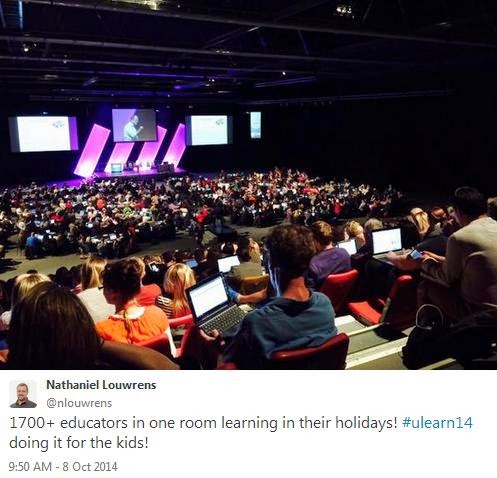
One of my highlights this year was the uLearn14 Conference.


Not only was this my first year attending, but the one in which I presented on my eFellow14 inquiry.


uLearn14 also gave me the chance to meet some of the wonderful people I have been interacting with on Twitter [and to catch up with the ones I've already met].


However, it was not all about 'socializing'...

The CORE Website stated: "The uLearn14 programme was structured around three key strands that focus on aspects of modern learning and leading:
- Modern learning practices
- Modern learning environments
- Modern learning technologies"

Therefore, I've chosen my breakouts carefully to as far as my eFellow schedule allowed, as uLearn was after all really about learning how I could enhance my practice.

Day1:
  • Breakout One:  Making the Most of the Early Years: Learning to Learn & Inquire at 5 with Bridget Casse
This workshop covered the SOLO Taxonomy, Inquiry & Pedagogy in the Early Years and we looked at how a learning environment can contribute to the education of young learners.


"Our youngest children are natural wonderers; from birth, every moment is a new experience. Our youngest children could well be the MOST experienced at creating new learning! What if we made more of a conscious effort to talk with them about how and why they think they are learning? What positive outcomes could result if we expect and encourage our youngest to explore the learning process while they explore the world around them?

We frequently converse with children about what they are seeing, doing, exploring and finding. How often are we talking with them about how this learning is being constructed?  What if we use the common language of learning to deconstruct their learning with them? Is ‘kidspeak’ really necessary? Are we making the most of the early years when our children are so creative and open to learning by empowering them and teaching them learning to learn strategies and skills?"
"We explored how the use of SOLO Taxonomy and modeling of an open to learning disposition can help overcome young learners’ fears of making mistakes. Together we realise ‘not knowing’ is the first step towards understanding! Even better, we know exactly how to meet our goal! Meeting our very next step is attainable. Ownership and pride in creating new understanding is contagious and intrinsic motivation is naturally triumphant."
  • Breakout Two:  iPads - a day in a junior classroom with Marion Kirby & Alison Willis
"Integrating technology, embedding technology, blended classrooms - all phrases for how we use modern technology in our classroom programmes."

In this workshop Marion & Alison shared their journey of how they use iPads throughout our day to enhance children’s learning.  From oral language to writing, reading, maths and more. We learned about the apps (Book Creator, Explain Everything, Dropbox, Camera app, Doodle Buddy) they're using - the how, why and when, activities


Day 2:
  • Breakout Four: It's bigger than Inquiry with Lane Clark
"What does it mean to learn?
Is there a difference between knowing and learning?
What is authentic learning?
What is integrated learning?
Is there a difference between theme and authentic integration?
What does real learning look like?
What are the similarities and differences between ‘real life’ learning and ‘in school learning’?"

According to Lane "If it‘s our goal to see an increase in student levels of engagement; an increase in levels of high school retention; an improvement in student performance standards; and learners skilled and ready to contribute to their world, we need to re-think what we are doing, and how we are doing what we are doing, in schools.  We need to teach our kids how to think and how to learn through a comprehensive learning process that mirrors the way in which learning occurs in the outside world.  We need to ensure that intellectual rigor, depth of knowledge and understanding, authentic, relevant and purposeful curriculum, our priorities   We need to change the way learning is planned, designed, implemented, assessed and evaluated."


And then time for the Gala Dinner...


Day 3:
  • Breakout Six: Developing a vision for school leaders with Rob Clarke
"This session shared an example of a facilitation approach for developing a shared vision. This approach ensures that everyone has a voice and an equal input into developing a consensus for the ideas generated." 
We've heard that the quality of questions we ask, will have a strong influence on the quality of dialogue. Also that a vision should not be static, but fluid.


Keynote Speakers:

Keynote 1: Prof Yoram Harpaz - The Ideologies of Education : In search of the pedagogical sentiment

Keynote 2: Adam Lefstein - Teacher Professional Discourse and Learning

Keynote 3: Dr Katie Novak - Universal Design for Learning

Keynote 4: Quinn Norton - MacGuffins, hackerkids and the troublesome 21st century
Note: I was unable to attend Keynote 4, as it was time for our last lunch as eFellows14 together... 


Two of my favourite Blog posts about uLearn14:
ULearn... I thank you - James Hopkins
Embracing the Tigger in Us - Reflections on #Ulearn14 - Annemarie Hyde

As part of Connected Educator Month some uLearn14 events were also Live Streamed.


~ "Man's mind once stretched by a new idea, never regains its original dimensions" - Oliver Wendell Holmes Sr. ~


Friday, October 10, 2014

"Normalization and Stereotyping" - Master Class #4 (#eFellows14)

When I woke up at the start of this week, I realised that this would be our last time together as eFellows14... I was in awe that our time had passed this quickly.

When everyone was settled in yet another beautiful location for our time together, Louise started with using the Russian nesting dolls to demonstrate how there is a tendency to try and know people. We put them in boxes and categorize them...

The complexity of human nature is huge, therefore categorizing people is one thing, or putting them in a box or even thinking you know them, could be really problematic. As soon as you peel back all those layers, you realise that those are just some of the descriptives that are attached to us.

This was a great session, discussing normalization & stereotyping. Yes, we need to look through the layers at the real person, don't make judgements.

We were also reminded that if we do transformative work without exploring identity, categorization etc. then we are not really doing transformational work.


After this, we had a session with Deanne Thomas on Cultural Responsive practice. It is about knowing the learner, making connections and involving everyone (not just priority learners). 


Manu Faaea-Semeatu talked to us about what the term Pasifika means to us and how to realise student potential.


eFellow Anniversary Dinner (8 October 2014):


We enjoyed a great evening, celebrating 10 years of the eFellowship.


In his speech, John congratulated us for what we had achieved and Louise talked about how the purpose of our times together was twofold. One to build our research skills and the other to develop our critical thinking skills.

During our sessions we learned how to bring a transformative lens to our research. Thank you John and Louise! You were awesome mentors!

We were also presented with our own Year Book.


eFellows14 and some past eFellows at the dinner


Our [last] Adventures as eFellows14:


uLearn 2014 - Memories:


~ "Don't cry because it's over, smile because it happened." - Dr Seuss ~


Thursday, October 9, 2014

uLearn14 Presentation

Today was indeed D-day for the CORE Education eFellows of 2014...

After embarking on our year long journey of inquiry and searching for answers, as well as trialing what we've learned, it was finally time to give feedback on our questions, answers and findings.


Presentation:


Feedback:


A warm Thank You to everyone who've had attended my session.  I really appreciated the time given to come and listen to what I had to share with you.


~ "We never know which lives we influence, or when or why" - Stephen King ~


Wednesday, October 8, 2014

#primedchatnz - Future Focused Learning with Tony Ryan

This was this year's second #primedchatnz and my first where I've been asked to moderate for #primedchatnz with James and Kate during the Live Google Hangout with Tony Ryan.

I was also responsible for pledging this event to Connected Educator Month.

I knew I would have to multi-task, as this was also one of the days [in the week leading up to uLearn14] where our #eFellows14 came together for our last sessions with what John and Louise had planned for us!

While the other eFellows were busy in a session, I was busy tweeting questions on twitter, while listening to the live conversation with Tony.  What an inspiring, thought provoking and inspiring session to have been part of.
Thankfully, I was able to [also] record the eFellow session and discussion for listening to afterwards.  I really can't imagine my life without technology!


My Storify of the discussion on Twitter:


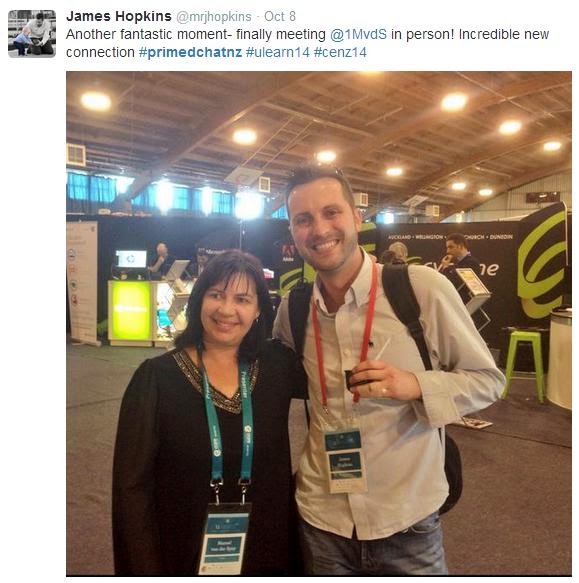
And then... after working online together, the amazing moment when meeting #primedchatnz organizer James face to face...


as well as Kate from Learning Network NZ!


~ " Life is not measured by the number of breaths we take, but by the moments that take our breath away" - Anonymous"


Thursday, October 2, 2014

Connected Educator Month - #Blogsync

We all have something to say...

I love that I can use my blog to share my views and to reflect on many things.  My blog is a wonderful tool that I use to look back on my posts.  It enables me to reflect constantly on my past and current thinking.  It shows how my thinking has changed and what I have learned [or not!] 

On day #2 of Connected Educator month, I watch the launch video for #blogsync and as a blogger, I found this session and tips on blogging to be very useful.

Chris Waugh mentioned that he's noticed that people who write blogs are sometimes a little bit afraid of the process, and I can't agree with him more.  I sometimes find it quite frightening to lay bear my thoughts.  But then he also mentioned that if you have a blog and you decide to write on a topic, it is completely yours, you curate it and decide on the tone and content. Yay!

With blogsync you just have the opportunity of more people taking notice, in particular people who might be thinking of the same things than you are.

We were invited to join http://blogsync.edutronic.net/ and connect to a blogging community. Yes! That would be my next step.

Thoughts from Karen Melhuish Spencer and Chris Waugh:

- Use the 'connectedness' of the internet to make what we do in the classroom real and authentic to the students.  It is also for us [as educators] to connect with the wider world as most of us work in schools settings where we're isolated from our colleagues most of the time.
- Cracking open of what's happening within the four walls in your school is incredibly powerful  - that making visible. Especially if you're teaching in a quite traditional model school where it is you and your classroom and your learners and people rarely see what you are doing. Blogging can then sometimes be the only window that you offer on your practice and that shared, collaborative conversation can come through something like blogsync. It helps make our profession visible through the stories of the practitioners


What is blog sync?
- Blogsync is for educators who is looking for something deeper and more critical in terms of reflective writing and connecting to each other around that reflective writing.
- Some of the benefits are, you can expand your thinking and the reading of and responding to each other's blogs leads to a depth in discussion.
- This is also a way for people to express their personal view, but also to do it in a form that allows for wider discussion

Topics for this month:

Week One: 1 October - 10 October:
'What it means to be a connected educator' - my learning life online, and how being connected has affected my work in education.

Week Two: 13 October - 17 October:
'Diversity and inclusive practice' - What does this look like for us as Educators? For us as learners?

Week Three: 20 October - 31 October:
'Leadership in schools' - Modern leadership? Leading change? Leading with moral imperative?

Week Four: 27 October - 31 October:
'Student agency and voice' - Making students' contribution meaningful, giving it agency


Tips for writers?
- One of the most powerful things a blogger can do is write from personal experience. Yes Chris, I agree,  it does take a little bit to get comfortable with!
Bloggers who write from their own, experience in the classroom or experience as learners themselves, are often the ones who attracts the most interest.
- Be confident that your own personal experience is interesting to people and that you're personal take on something is valuable.
- You don't have to regard yourself as an expert on to the topics chosen.
- Be confident and comfortable with your own view
- Don't write too much at a time.
- Tell your story in a medium that works for you (Use just words or use them in combination with pictures)


~ To Blog is To Share, To connect, To create, To inspire - Anonymous ~


Connected Educator Month - Modern Learning Practices in a Connected World

Day #2 of Connected Educator Month started with a Workshop on 'Modern Learning Practices in a Connected World' with a supporting Google Doc.

I was really looking forward to it, as this topic tied in with my eFellowship inquiry. I will also have the opportunity to share my findings at ULearn14.

With presenters like Derek Wenmoth, Stephen Heppell and Mark Osborne, this  workshop was all about what 'connected education' might look like for future-focused organisations. I really enjoyed listening to Janelle Riki story about how they started and their first steps into Modern Learning Practices in a Modern Learning Environment. 

My Storify sums up this session:


~ There is no such thing as as an unmotivated student.  There are, however, students in unmotivated states - Eric Jensen ~


Friday, September 26, 2014

Innovation in Schools - a live conversation with Grant Lichtman

During the last week of Term 3, #edchatNZ hosted a live conversation with Grant Lichtman on Innovation in Schools.

Danielle stated: "How might you think differently about innovation in schools if you had the chance to visit, interview and observe sixty-four schools? Grant Lichtman did just that. He interviewed 600 teachers, administrators, students and parents and talked to them about innovation." 

It was an hour well spent, listening to his stories and another great professional learning event! 


My Storify:


~ "Innovation is change that unlocks new value" - Jamie Notter ~