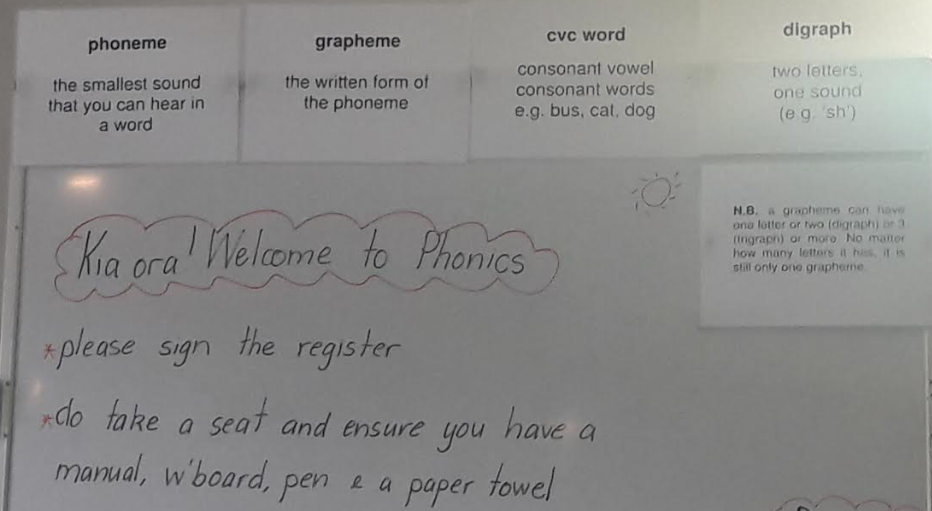
I've always incorporated Phonics into my literacy programme, but as I am constantly reflecting on my teaching and how it can be improved, I jumped when the opportunity to attend the 'Yolanda Soryl workshop' arose.
Yolanda confirmed the view I have that students need a range of basic phonics strategies so they can easily work out new words in reading and spelling.
Teaching tips and pointers:
Allow only lower case letters to be written in phonics
Only have a reason for a capital letter like writing your name. When they write a capital letter in writing ask what the reason was for writing letter in capital - if no reason, rub out.
Only teach capital after lower case is secure
Summary:
Blending important for reading: d, d-o, d-o-g = dog
Break up word to write- segmentation
Some students know their sound, but don’t know how to break it up
Teach kids how to hear
The aim is to look at work and recognize it instantly
Read name before school - this is recognition of graphic knowledge
Teach high frequency words fast
Phonics is for low reading learners
Grammar - does it sound right. Get them to read their sentences back
Ingrain a sense of a sentence - repetitive reading
Teach students to re-read their writing, to check if it sounds right.
3 levels that students use to connect (sounds, words, sentences). Students that struggle don’t connect these three
Important to decode to enable them to comprehend
Book introduction important - look and introduce unfamiliar words
Teach fluency at word level - then you have chance to read page
Dyslexic kids tend to use both sides of the brain
Hear low level reader read out loud every day to improve reading outcome
Phonics is about using sounds, not only knowing sounds
I am also looking forward to the release of the Phonics App which can be used to learn/revise the alphabet sounds. It also follows a Phonics 'Hear, Read, Write' lesson plan and can stand alone or be used to revise a lesson. The App features a New Zealand accent which is so important for helping students learn the short vowel sounds.
~ "It shouldn't matter how slowly a child learns, as long as we are encouraging them not to stop" - Robert John Meehan ~
When helping to set up for the MindLab session, I was approached by Mary about my work at Ngā Pūmanawa e Waru. I explained to her what I am capable of helping with… She mentioned that she would like help with setting up a blog for their library and we arranged for a time to meet and to get the ball rolling.
This morning, we created a blog, added pages, added important links and information on to it. I also showed her how she could create posts. Mary was very excited and happy with the outcome and asked that I checked in regularly when helping at MindLab to see that see is going well.
Feedback from librarian via email:
“RHGS Library Blog
Professional Development:
To invite the expert – Marnel van der Spuy –Ngā Pūmanawa e Waru to deliver professional development to show me how to make a blog.
This session is the first of ongoing assistance of how to make a blog. It was amazing to have such expert assistance that Marnel was able to provide. The assistance was professional, encouraging, and reassuring. It seemed to take her no time at all to establish the basic blog site we needed i.e. links, photos, advice, examples of blogs; as a real novice in terms of ICT literacy it was a pleasure to have someone who made your lack confidence seem OK with her calm, cheerful manner.
Hopefully Marnel is able to provide ongoing help when she comes in as part of her Mindlab visits or I can request future sessions to support this excellent beginning.”
~ "One person with passions is better than forty people merely interested" - Unknown ~
I just love working alongside teachers and students as part of my role as Learning Facilitator with Ngā Pūmanawa e Waru.
After meeting with the two teachers, it became clear that there was a need to provide teacher and student coaching in the use of a shared learning space online - Google Drive / GSuite.
I firstly worked with the year 6 students, showing how to create folders, change colour (if they choose), name the folder for the appropriate items/docs to be added into it. We also discussed how to make a copy if something is shared with them, add it to their drive and rename it. I also showed them how to share the document with their teachers and parents. The doc the teacher shared with the students beforehand, was to record their goals, date accomplished and evidence… I showed how they can add a link from their blog / doc (mentioned that they need to ensure that it is shared with the teacher, to enable her to view it) or how they can upload a photo.
I did all of the above with the Year 4/5 students as well, but after some questions, also showed them how to embed from a video into their individual blogs.
Both sessions went really well, with students having hand on experiences and ended up being engaged in adding learning into their folders.
Reciprocity: The students continue to support each other throughout the sessions.
In this Language & Learning Intervention workshop I attended, speech-language therapists worked with teachers and some parents in our cluster to provide learning support for our children with high language and communication needs. The support we were given was around being reflective of our communicative behaviours and how we can adapt and differentiate our interactions with students who have communication disorders.
Module 1 (Planning Language and Learning Goals):
Some children might have language, but can’t retrieve it...
Incentive: Think about your day yesterday... What activities did you do that involved language? What activities did not involve language?
Three components of language:
What? (are kids talking about) e.g. family, hunting, birthday, other children in class, farming, tractors, weekend activities, learning. This includes vocabulary labels, action and describing words. Think about the meaning of the message.
How? (understanding content and express in various ways) This may involve pointing, gestures, facial expressions, smiling, physical leading, eye contact.
Why? (the reason for communicating?) e.g. gaining attention to express feeling / telling the rules, needs met / want something, greeting, ask questions - can I?, responding, re-tell.
We need all three these components, otherwise something might break down.
When a child do not have the language they need to use, it is like a can of coke that is being shook, waiting to explode. Pressure was building up, they feel like they are on the back foot all the time. Anxiety might be increasing. Some children might be holding it together at school, but explode when they get home. Simple change in routine could inflict as well (e.g. reliever). This could be tiring for children.
Language underpins all learning. The four language steps are: Early Words User, Word Combiner, Early Sentence User and Complex Sentence User.
Reflection: It is therefore important to build children's expression and feelings about things and to build vocabulary.
There are four Conversational styles: Participator, Responder, Do My Own Thing and Reserved Communicator.
Responder:
Children rarely start the conversation and may find it easier to respond more to adults than peers. Adults might say the child "takes awhile to warm up".
Do my own thing:
Children mostly communicate about their needs and interests. They rarely respond to attempts to engage them in conversation. Adults might think they are "in their won world".
Reserved Communicator:
Children often have little or no response to your efforts to engage them. They rarely initiate and show little interest in people or objects in their environment. Adult find it difficult to engage the child.
Participator:
Children who initiate and take part in interactions. They are responsive and will try (and keep trying) to communicate. Adults might describe them as "easy to talk to".
Reflection: Think about strategies children might use to figure out what might be happening in classroom e.g. categorize, body language, ask, sensory cues, process of elimination etc.
Module 2 (Language and Learning in Action):
The features of a great conversations is the opportunity to talk, ask questions or to clarify.
Ask questions, safe - take risks, make mistakes, valued
Different props - creative, ties with children's name who will be the
leader, classroom displays (with care), work hanging up
Classroom conversations could include: Initiation, Response, Feedback.
Strategies to Encourage Engagement:
- Be face-to-face with children
- Respond to their attempts to initiate
- Notice children who are feeling 'left out' or uncomfortable
- Pause to give time for responses
- Make comments and wait for the child to initiate a comment
- Repeat and go slow
- Provide encouragement and explicit feedback
Acknowledge that you heard what child has said, by affirm, model, and extend.
Reflection: To extend is really important as you increase the opportunity for conversation. Don’t just label things for kids, otherwise they will do it back. Describe what happens in a picture, so that they can learn to do the same.
Idea: Feed in four 'comments' about the topic, before asking a question. That way language is 'fed in' and this will enable children to gather language to interact.
Reasons for asking Questions:
- To check children understand new information
- To check reading comprehension
- To prompt for more information
- To ask for clarification
- To stimulate thought
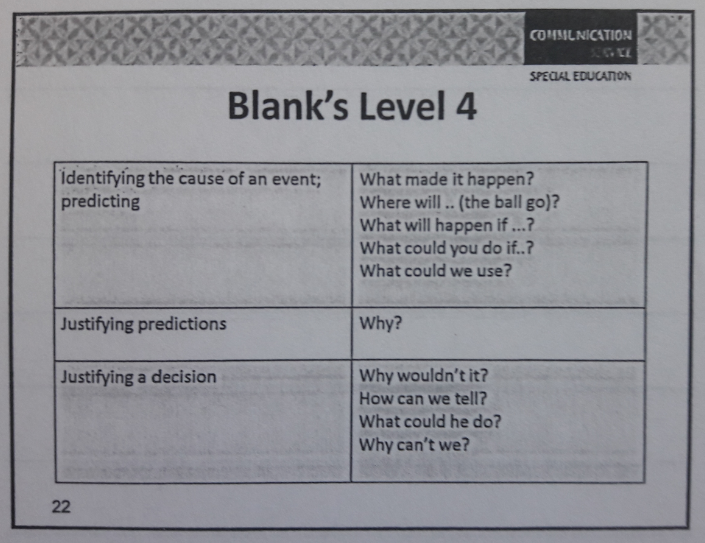
Blank’s Levels of questioning
Blank’s Level 1 is about immediate
Blank’s Level 2 is about properties, punctuation, comparing
Blank’s Level 3 is about what they know, relating
Blank’s Level 4 is about reasoning and why something has happened, justify
Reflection: When the goal is successful communication, match the question complexity to the child's language level.
~ "Language is the blood of the soul into which thoughts run and out of which they grow." - Olivier Wendell Holmes ~
I have been part of organising yet another EducampRotovegas. This year we were a small but select group and the conversations were rich and meaningful.
At times we followed the slides, however it was great to have had the opportunity to have impromptu discussions not even added to the slides.
~ "Never doubt that a small group of thoughtful, committed citizens can change the world. Indeed it's the only thing that ever has."- Margaret Mead ~
I signed up for the Apple Teacher learning program, which was a fun and easy way to build my skills and be rewarded for the work I do every day.
What I liked about the program was that you start your own self-paced journey and when you are ready, you can test yourself by taking interactive quizzes in the Apple Teacher Learning Center. Each time you pass a quiz, you earn a new badge and once you collected all eight badges, you are recognized with an official Apple Teacher logo (see right panel on my blog) to share with the world.
Message received:
Thank you Apple for this opportunity. It is an honour to be recognized as an Apple Teacher!
~ "Never stop learning, because life never stops teaching" - Anonymous ~