Friday, October 12, 2018

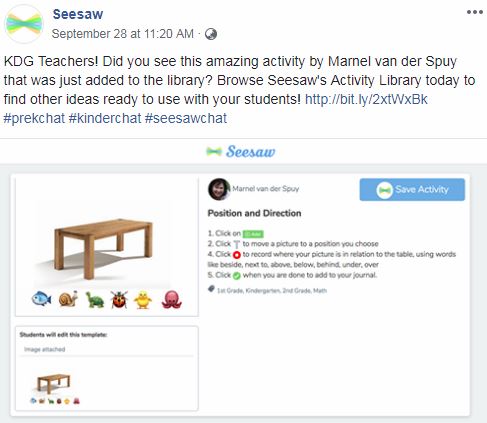
Seesaw Activity recognition


Been notified by someone that they saw this posted on Seesaw's FB. Thank you for the mention !
 

Saturday, September 29, 2018

CoL TOD - Taking our Community on a Journey


Outline of my involvement during the Day...

Moral purpose

1. Recap Appreciative Inquiry & Sharing of Teaching as Inquiry
Adjusting the lens we look through - Making a conscious decision to look for strengths.
Coaching skills to be used - active listening - without interruption and reflective questioning at end. 
Genuine Inquiry - open minded, declarative statement or genuinely open and non judge-mental reflective question
Positive does not ignore deficits but instead focuses on the solution

2. Evaluating Effectiveness
Hard data vs rich data - formative, making sense of the work children are doing, the shifts they are making.
Appreciation - how do we talk about the hard stuff - challenge each other - to ask a probing reflective question does not show lack of appreciation - the way the question is communicated is possibly the key - today and the way we are working together is about digging deeper - in a non judge-mental way.  Holding up the mirror
Sometimes in our work as Principals, DPs, or HODs we work in a mentor role where there may well be an element of judgement and direction in a learning conversation, but this approach is not about mentoring - it is about listening to understand and asking probing questions to deepen understanding and to require the presenter to deepen their reflection.

3. Knowing they impact
Knowing they impact - if we are to be innovative as a profession and if we are to make a difference for kids we need to work through ways of knowing and justifying what works and why. - as a profession.
The way you think about your role as a leader or teacher defines the way you work and the impact you will have.

4. Oral language focus - What has been the effect of the work you have been doing with students?
Ask reflective questions - in line with coaching- levels of reflective questioning.
Have levels of questioning for students.

5. Disrupting the status quo
How can we create a learning system where all young people leave as successful learners.
Not about cruising through the system or dumbing down learning.

What are the rich skills we want to assess? (that would enable this goal)
What do young people need to know/do? 


6. Bus stop activities


7. Evaluate well-being 
Discussion:  Looking at ways the current system might impede well-being and success.

Evaluate personal identity, language and culture (Do I know the language of mine) 
We become our stories – so... What are the stories we want to tell about Reporoa? What does it mean (look like, sound like, feel like) to be an actively involved, confident, connected member of our community?
What is already working well in our community? Who are our success stories? What worked well for them?
What part do you play in this? What is your responsibility in this story?
What do we expect from each other and from ourselves?


~ "The manager accepts the status quo; the leader challenges it." - Warren Bennis

Friday, August 24, 2018

Seesaw Contributing Author

I am sharing activities I create on Seesaw (for my students) with other teachers (over the world) to use too.
Received this email in recognition from the Seesaw team in the USA. How uplifting! 

Thanks Seesaw!


Friday, August 3, 2018

Further assessing children identified as 'at risk'

As part of my online SENCo training, I had an opportunity to work with and learn from Jenny from Raising Achievement on assessing students identified as 'at risk' to further identify their specific learning difficulties using a Screening Assessment kit. This will be very helpful in my role as SENCo and will enable me to create a specific plan to help cater for the needs of these students.
The purpose of the Screening Assessment is to find underpinning cognitive weaknesses. These are the underlying reasons why students are being held back and not able to achieve in academic subjects. Underpinning Cognitive Weaknesses are Auditory and Visual Processing problems. Other Underpinning Cognitive Weaknesses are things like processing speed, short term and working memory and gross and fine motor skills.

I learned about the different Screening tools and what to use for students under the age of 7. Yes, it can be done under 7... and [in my opinion] early identification is vital.

Reflection:
I am absolutely loving my role (on top of everything else) as SENCo. It is rewarding to see how students progress when given extra support and to see their confidence grow!

I am looking forward to implement my new learning into my role to support students, teachers and teachers' aides.


~ "A child with 'special needs' will inspire you to be a special kind of person. - Anonymous ~

Wednesday, July 25, 2018

Oral Language across the curriculum

This workshop presented by Sheena Cameron and Louise Dempsey aimed "to support teachers to include more quality 'learning talk' in the classroom and to embed purposeful oral language opportunities across the curriculum." This was timely PD for my Teaching as Inquiry with my focus on developing Oral Language.

We started the session with the Talking strip - Introductions' by turning to a partner and by follow the steps on the strip.

We can use oral language strips to get children talking and using full sentences. Explicit teaching can include using pictures - lips closed, eyes open, ears listening etc.

The types of talk:
1. Exploratory talk (to help us understand and develop ideas)
2. Presentational talk (to share ideas and information and to entertain others)
3. Conversational talk (to build relationships)

Types of listening:
1. Informational listening (to obtain information and understand ideas)
2. Critical listening (to evaluate ideas and form opinions)
3. Appreciative listening (listen for enjoyment)
4. Responsive listening (listen to build relationships)

Establishing a 'think, pair, share' culture. Move away from the 'hands-up' approach as it is controlled by the teacher and severely limits student talk. This often results in a small group dominating the talk in a competitive manner.

Listening activity ideas:
1. Partner activity: call a friend - pretend to talk on the phone to a friend about something. Sit back to back and share.
2. Barrier games - making shapes, use a barrier to hide. Two students have the same bag of sticks. One student makes a shape, the other has to make the same shape through listening to the other's description. Another one is the Pizza barrier game where one has to explain to the other how to add pieces on the pizza.

Asking more open questions using:
1. Question strip
2. I wonder...?

Students should be talking in full sentences and elaborating on ideas...

Some elaboration questions / Prompts:
- Tell us more about...
- Why do you think that?
- Can you give us an example?
- What is your evidence?
- Can you justify your opinion?
- I have another example...
- I have a different idea...

Some alternatives to questions:
1. Students sit in a circle. Introduce a talk topic. Students use a microphone for taking turns to talk and to generate questions.
2. Shared Reading - predictions from cover. Do think-pair-share. Move away from hands up.
3. Make a suggestion - "My idea is ..." can help with getting students into a discussion

Talking groups:
Use different groupings to increase opportunities for student talk
1. Think, pair, share (partners)
Pausing in a lesson engage students in 'think,pair, share' and benefit both students and teacher as students shift from passive to active learning.
- Think:  allow students five seconds to think of what they will say
- Pair: students talk for a short time with a partner. Teacher can end talking time with simple countdown from five
- Share: a range of students can share back responses when appropriate and not necessary every time students talked to a partner.

2. Think, pair, square
Instead of sharing back as a class, partners can turn and face another pair and then share as four. Students can listen to ideas from one pair and summarise/add and new idea/ask a question.

3. Doughnut circle
Students sit or stand in two circles, outside one faces inward and inside one outward, so that all is facing a partner. Each student have a turn to speak. When it is time to change partners the teacher could call 'switch'. The inside circle then moves one partner to the left.

4. Jigsaw
Effective when planning an in-depth collaborative task. Each student in the group is given a number e.g. 1, 2, 3 or 4. Students with same number move to form a group. students then work together to learn about a topic and afterwards return to their home group and each team member shares his or her information.

5. Listening triads
Students work in groups of three taking on roles e.g. speaker, questioner, recorder [and/or] speaker, listener, questioner. The speaker talks about something specific and afterwards the other two students follow their roles by either asking questions (Questioner) and taking notes (Recorder) in order to feed back to the speaker, another group or whole class. Roles can be rotated.

6. Circle
This is a common grouping in the classroom. The idea is that everyone in the circle have a turn to say something. Students talk and listen to other's ideas and points of view. It is also good practice for speaking in full sentences.

7. Line up
Similar to the doughnut circle except students face their partner in two lines.

8. Horse shoe
Similar to the circle, but students are able to view the teaching area as well as each other.


~ "Children need writing to help them learn about reading, they need reading to help them learn about writing; and they need oral language to help them learn about both." - Anonymous ~

Tuesday, July 10, 2018

Local stories - some of the history...

I spent a lovely day at Ohaaki Marae (with some colleagues), learning about the local stories of Ngāti Tahu-Ngāti Whaoa...

The Māori of the valley decended from the Arawa tribe. The Ngāti Whaoa moved inland from Maketu to Wai-O-Tapu (Māori for "sacred waters") and the Paeroa Hills.

Ngāti Tahu maintain a separate identity, but they have also been described as subtribe of Ngāti Tuwharetoa (who originally lived in the Kawerau area). His people are descended rom both Te Arawa and Mataatua (particularly Ngāti Awa ancestors). 

From the earliest times the Waikato valley near Orakei Korako was occupied by Maori of the Ngāti Tahu.

The names of the meeting houses of Ngāti Tahu Marae reflect their tribal history. Te Ohaaki is the parent marae and the meeting house is called Tahumatua, after their eponymous ancestor. Ohaaki has many claims to fame. It has unlimited supplies of hot water and steam and had one of the biggest and most beautiful thermal hot pools in the Rotorua-Taupo region. Unfortunately, the natural features at Ohaaki have been irreparably damaged by development for power generation.

The Paeroa ranges had once been occupied by the Tribe of Whaoa and at Waitawhero a meeting house was built which was named Whaoa. The south of Mangakara was once occupied by the Ngāti Tahi Tribe and north it was occupied by the Whaoa Tribe. 

Learning a Waiata...

E ngā iwi
E ngā mātā waka
E ngā hau e wha
Anei rā
Ko tāhū whaoa
E tū atu nei
Kia whakatau i a koutou
I te nei ra
Tū mai rā Paeroa
Hei whakaruru hou
Mo te
Hui aroha


Glossary of word meanings:
iwi - people / tribe
mātā waka - every 'waka'
hau - wind
anei ra - here we are
whakatau - informal greeting
I te nei ra - on this day
Paeroa - long ridge
hei - as
whakaruru hou - shelter
mo - for
te - the
hui - gathering

This day contributed in developing a deeper understanding of culturally responsive and relational pedagogy


~ He aha te mea nui o te ao, he tangata he tangata he tangata (What is the most important thing in the world, it is the people, the people, the people.) - Māori proverb ~

Monday, June 18, 2018

Anxiety, Learning and Behaviour

This was an interesting workshop that challenged thinking and perceptions.

Notes:
Each person comes to school with their own Thoughts, Emotions, Perspective from home. This is the case for both teachers and students...

Anxiety can start when having to deal with above

Anxiety – look at yourself first and how you cope with this, keep energy up. What can I do to fill my bucket at the end of the day. Know about mindfulness. If a teacher’s anxiety is going up, it will escalate the anxiety of the student. Look at the development of the brain – look at impact of trauma, neglect… they influenced development.

Brain development starts with:
Brainstem    -     Safety
Midbrain     -      Movement
Limbic         -     Emotions
Cortex          -     Learning

When students do not feel safe, they might make noise and be disruptive so they can be send out. They then they might feel safe as they are not subjected to the learning (which they might be scared of).

If a student is constantly anxious – it can be something specific...

Your anxiety can cause the student’s anxiety. Stay calm and talk in a calm voice.  When a student does not react, it might be their brain telling them "I am in danger" and that is why they might not react / respond. Unfortunately, a teacher / adult might perceive it as being defiant.

Acknowledge the feeling, but know how to cope with it. What strategy can be used to cope with feelings?
- Anti-anxiety activities: breathing exercises
- Get students to know to just breathe, will make them feel better
- Also, think how well you know this specific student.

Try and capture the right moment to help the student cope with strategies about what we do when not feeling well. Use the right vocabulary – don’t confuse angry with not happy.

Maybe do whole class teaching for coping strategies, step-by-step. Mentally visualizing working through the anxiety. Talk about what it might look like / feel like.

Know what emotions look like. Get students to act out – look up on internet.

Often an anxious student just needs time… but let them know you will be coming back to them. Difficult for anxious child to be put on the spot, speak up in class in front of everyone or even give an answer.

Often when a child is anxious, a parent will have it to. A dad might be aggressive because they are anxious. Women can cry. Get the parent to practice handling feeling and emotions with their child at home. Exercise help for unsureness- suggest they take a walk together each day. There will be more success when including the parent.

Diagnoses just gives us a bit more knowledge about the child, it is not the end of all.

Teach the ‘Worry Tree’ Problem solving technique...

The Helicopter view – teach kids to look at something with a 'bird’s eye view' and not ‘close up’. Look at something differently. What am I reacting to? What does this situation mean to, or say about, me? What's the worst thing about thinking that, or about the situation?


Resource:
Lots of ideas and metaphors on www.getselfhelp.co.uk


~ "Affirmations for Anxiety: This is only temporary; I am in control; I can take things one step at a time; Anxiety does not define me" - Anonymous ~