Friday, March 23, 2018

Difference, Difficulty or Preference... The Power to Decide (SENCo Workshop)

As part of my SENCo role, I felt it is important for me to learn more about working with students with specific learning differences and how to be able to identify these students more accurately. 

Raising Achievement in at risk students and setting them up for success:

Although there are many success stories, 'good outcomes' does not always happen for kids with 'problems'. Unfortunately, teachers are not trained to look for learning difficulties. Traditional teaching is auditory which does not help, these kids need kinesthetic learning.

Assessment [for at risk students] shows the following:
- Adequate intelligence
- Literacy underachievement
- A range of undiagnosed learning difficulties / disabilities
- Unaddressed barriers to learning
- Learning styles are not readily catered for in our mainstream education system

In any given classroom there are different groups of learners...

1st Wave Learners: These are the students that learn easily and who hardly need a teacher. Our job is to put opportunities and resources in front of them and they are off.

2nd Wave Learners: The majority of our students lays here. The may be a bit above average, intelligent or they may be achieving even 6 - 18 months below their chronological age. Given all the good things we do in education, they will achieve quite nicely with the programmes, resources and teacher capability we have and they will reach their chronological age quite easily.

3rd Wave Learners: Students with things like dyslexia, dyspraxia, children who are on the autistic spectrum (Asperger's are part of the autistic spectrum) and ADHD. Not that ADHD is regarded as a learning disability, but often children with ADHD also have a learning difficulty and remediation for ADHD is similar to the other groups. The other ones to consider here are the auditory and visual processing disorders.
Underpinning Cognitive weaknesses (how brain process things - visual processing issues), Auditory (hearing fine, but how brain process) - hear things in the wrong order and write in the wrong order. Say words wrong. Phonological is the part what these kids struggle with.
Working memory important (kids who did not have this will have trouble in literacy and numeracy) - cognitive testing - processing in the head takes much longer.

4th Wave Learners: These are students with perhaps major auditory / visual type problems, major physical difficulties, intellectual difficulties and we also have our behavioural initiative in here. They are looked after Special Education teams, MOE and Special Education.  

Looking at the role of a SENCo:

Dyslexia:
Reading is a very difficult task for these students. We participated in a 'simulated' reading task... (note: put the two lines together and try to read it... you have to think if letters are p, b, d, etc). This is how a dyslexic student might see reading...

Currently the best means for identification of dyslexia type difficulties are tests of Phonological Processing. (Tunmer & Chapman 2005)

Something to think about:
50% of people with ADHD (Attention Deficit Hyperactivity Disorder) might also have dyslexia. There are 3 types of ADHD 
- inattentive type: getting distracted, having poor concentration and organizational skills
- hyperactive-impulsive type: never seeming to slow down, talking and fidgeting, difficulties staying on task; interrupting, taking risks
 - combination type (when student behave one day and another not - chemical imbalance)

Tips: 
- Print on pastel colours when making copies for dyslexic students - white page is not desirable. 
- See the ability, not the need... (show students photos of famous people with dyslexia)
                   
Dyslexia... Disability? Difficulty? Difference? or Preference? "STOP" before we label! Understand dyslexia as a learning preference.

Strengths of Dyslexic learners:
- Often imaginative, creative, lateral thinkers who develop original solutions to problems.
- Have an ability to think in pictures, sometimes with strong artistic talent and often with a strong visual preference for information acquisition and processing.
- Many are socially and verbally able and may enjoy drama and sport

Limitations / Difficulties of Dyslexic learners:
- Unexpected problems - literacy / numeracy (e.g. can't transfer skill from adding to subtraction)
- Require special ways of teaching to minimise problems and maximise potential
- Vulnerable as learners when reading and spelling is allowed to detract from information processing, core thinking skills and knowledge acquisition.
- Thinking ability is good or better than peers.
- Writing is the ptoblem

No dyslexic case is the same and there is no cure for it. Dyslexia can be improved by teaching students skills and strategies to use, when putting accommodations in place. Make students aware of what they get distracted with.
Accommodations can include:
- Create and model a supportive classroom environment that recognises and accepts difficulties
- Invite students to read, but allow them to pass in a group or class situation
- Set up paired reading activities (Buddy Reading / Tuakana-Teina)
- Use I.T.
- Give information auditorally as well and not just on paper

Developing Best Policy and Practise:
Recognising Dyslexia Type:
- Family history
- Early to walk, may not crawl
- Dressing skills
- Performance inconsistency
- Quick thinker, but not necessarily when given instructions
- Possible enhanced creativity
- Aptitude for construction / technical toys
- Appears bright, but is an enigma

Multisensory is important and we need to look at it from all perspectives: Kinesthetic (37%), Auditory (34%), Visual (29%). These have to be in place for 3rd Wave Learners. We know now that it is not true when people say "I learn better visually", as learning is not just 'in a box'.

Dyslexic students' - not brain compatible and some times need up to 49x repetition -> look at different learning styles. Should train T/A's to do the repetition, use computer programmes to back up what's been taught, using peers. Based on diagnostic evidence - important to know what the gaps are.


Reading Strategies:
- 1-1 tutor reading programmes
- Provide parent training and reading support at home
-  Give 1-1 reading opportunities as often as possible

Spelling and Writing Accommodations:
- Organise a scribe
- Set up shared writing
- Encourage mind maps, story boards, flow charts
- Mark for content and ideas

Metacognitive Strategies Writing:
- Scaffolding
- Moving from dependence to independence

Minimise fears of how to start:
- Give paragraph starters
- Offer to act as a scribe
- Give sentence starters and key words
- Accept work in different form

My Next Steps:
- Learn more / Upskill myself
- Give more opportunities to work with strengths. Set them up for success and focus on what they are doing right.
- Get T/A's trained to help raise achievement
- Look at integrated reading, writing and spelling programme 'Alpha to Omega' (can be used up to age 15 years). This a a programme that can be used in a class with all children. It fits all the criteria for 3rd Wave programmes. At the beginning of the book is an assessment where you can assess where children are with spelling and phonemic awareness and identifying any learning gaps there might be, which will give you a starting place to work from. This is a fantastic resource to use as it teaches you step by step as many teachers have not been trained in specifically development stages of learning or even knowing which areas comes first.
- Setting students up for success - look in to HPP programme and JOST

Remember:
- It is important to keep in mind that it is not just 'mainstream' students we are working with... some students have underpinning cognitive weaknesses that need addressing before academic learning can take place.
4D New Zealand model: "Get it right for dyslexia and we get it right for all"


~ "Learning is NOT the product of teaching. Learning is the product of the activity of learners." - John Holt ~

Friday, March 9, 2018

A first opportunity to meet as a CoL

This was our first opportunity to meet as a group of Principals, Teachers and Support Staff as a community of learners to strengthen connections, share positive practices and to deepen our understanding of the 'Teaching as Inquiry' process.


Part 1 - Analyse current TAI: (school group)
My thinking:
- Interesting read: Deepen Teacher Inquiry

Part 2 - Envision creative possibilities for students to expand their Oral Language/Writing: (mixed group)


My thinking:
1. Greetings – Encourage students to greet each other by name, shake hands, sing, clap, and
learn greetings in different languages. 
2. Sharing – Similar to “show and tell,” allow students to share activities and respond to classmates’ questions
3. Daily Oral Language ...Everyone participates in singing, chanting, games, and so forth
4. Word Wall. ...
5. Nursery Rhymes / Poems / Speeches and “Take A Stand” activities. ...
6. Listening Activities. ...
7. Storytelling is a creative way to build oral language skills. Provide students with a sentence that is the beginning of a story; for example, "The boy who lived next door had a very strange pet." Have students complete the story, and then retell in their own words. Focus on the sequence of events and sentence structure. Remember to wait patiently while students put thoughts together, and praise students’ efforts to use new words and sentence patterns 
8. Sorting. - Students work together to group, or sort, words based on commonalities such as word beginnings or endings, vowel sounds, parts of speech, rhymes, meanings, or some other common feature. Students may compare, contrast, or identify similarities while building automatic recognition of words, thus promoting fluent reading and writing. 
9. Sentence starters - “Describe a time when you (blank—ex, urged) someone to (blank).” What happened?
10. Sequencing - Students frequently have difficulty following the sequence of events in a story/passage. The following activity can help pupils become familiar with the concept of sequence:
• Retell several familiar stories such as "The Three Little Pigs", "Snow White", etc.
• Purposely misread, mix up, or omit items and events. Give students the opportunity to correct you.
11. Tongue Twisters are great for practicing articulation, and fun, too.  eg. Super thick sticky tape; She  sells seashells by the sea shore; Sly Sam sips Sally’s soup.

Remember:
Good oral language communication activities should be two-way, ongoing, comprehensible, instructional, and enjoyable.

- My PD in 2017: Language and Learning

Part 3 - Refining and Forming direction for TAI: (school group)

Next Steps:
- Check out Oral progression matrix on TKI
- Check out talk moves (for maths) use it in circle time (DCIM FB page). If kid did not know what was said, they should say I don’t know and ask someone to explain it again
- Engage in discussion and kids and ask them what they are doing and what it is about
- Get kids to clap a poem. (Note: if they are unable to clap in time… that is indication / evidence that they [might] have oral language problems)
- Check out learning maps for kids to talk about their learning


~ "Our job is not to prepare students for something. Our job is to help students prepare themselves for anything." - A.J. Juliani ~

Wednesday, February 28, 2018

STEAM / Minecraft Learning for a classroom

James (a colleague) and I had the privilege of attending a STEAM / Minecraft day organised by 'Using Technology Better'.   

Interesting Fact: "75% of fastest growing occupations in Australia require skills relating to STEM."


Pedagogy of a STEAM approach
- Start with the why (why do we use it in our classroom?, why using STEAM? Make kids think, using 21st C skills…)
- Important to find solutions for problems in everyday life and to think what we are doing

How the world is changing...


What is Active Learning?
"Students that are engaged in more activities than just listening. They are involved in dialog, debate, writing and problem solving as well as higher order thinking, e.g. analysis, synthesis, evaluation and creating" - Bonwell and Eison, 1991


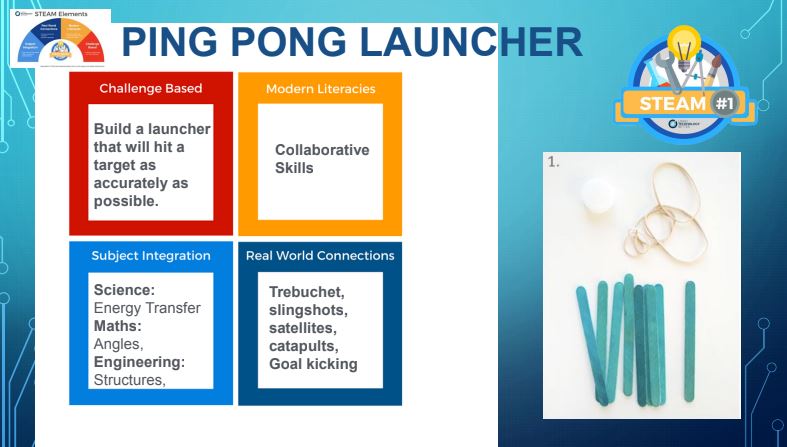
Our challenge... 'Make a Ping Pong launcher'

My launcher...

James, busy constructing his...

Check out MakeCode...

We also looked at MaKey MaKey and how to introduce kids to circuits... tip: tin foil is a good conductor.

Minecraft Education:
- Minecraft is not ‘low floor’
- Why sticking with minecraft?
Case Study: Kid who struggled, not engaging, hard to communicate with. Work around an inquiry. Present this any way you want. Kid choose to present it in Minecraft. Engagement changed, started talking and explaining learning. Kid started caming to school beaming, and with the opportunity to using all the learning criteria that is available in/through Minecraft.

How to persuade the Principal?
Write persuasive letters… not calling it a game (as it isn't!)… kids have to come up with another word.


Minecraft = Engagement, Collaboration, Creative Exploration, Learner-Centered outcomes!

Student Engagement:
By using Minecraft as a platform for learning, educators can motivate and inspire every student to achieve more and ignite a passion for learning.
"Motivation is such a huge part in what ends up differentiating student outcomes. Everyone has the ability to do fantastic word at a high level. It's just, without the right teacher and the right motivation, you don't always get there." - Bill Gates

Collaboration:
Minecraft: Education Edition is designed for students to play together - whether that's working in teams to solve a problem, or collaborating as an entire class completing learning activities.
"To function effectively in increasingly complex business structures and organizations, employees must become more comfortable with ambiguity, take initiative, and be able to work in a team-based environment." - IDC Skills Requirements for Tomorrow's Best Jobs (2013)

Creative Exploration:
There are no step-by-step instructions in Minecraft - students must try, fail, and try again to achieve the result they want. This open canvas encourages independence and self direction, where students are able to express themselves and their ideas in unique ways.
"Imagination is the source of every form of human achievement. Creativity is as important now in education as literacy and we should treat it with the same status." - Ken Robinson

Learner-Centered Outcomes:
Learning-by-doing in Minecraft teaches students independence and perseverance, giving them a great satisfaction and sense of accomplishment when they can demonstrate their knowledge.
"Education is a natural process carried out by the child and is not acquired by listening to words, but by experiences in the environment. And Education should no longer be mostly imparting knowledge, but must take a new path - to seek the release of human potential." - Maria Montessori

Examples of how Minecraft have been used...


~ "Learning is more effective when it is an active rather than a passive process." - Kurt Lewin ~

Wednesday, January 31, 2018

Manaakitanga

I've always believe in creating a positive learning environment for my students and where they feel that they are excepted. It is also important to establish a strong learning environment where students can experience success.

Dalton and Smith (1986) believe it is important to 'organise materials systematically so that the students have easy access to them.' It also states that for students to 'function independently they need to know what resources are available, where they are housed and how to collect, use and return.'
Therefore, Room 4 got a complete overhaul, with a variety of learning opportunities, lots of little corners for students to work at and to use resources (easily displayed) when necessary and if they so choose.

Dalton and Smith (1986) believe it is important to 'encourage children to learn with different people, for example by themselves, with a partner, in a small group, with older and younger children or with adults.' We will [again] have learning buddies (not set) in our learning environment and engage with the older students in the school via buddy reading.

Cultural awareness is important as students come from a variety of different backgrounds and cultures. I believe my learning environment should embrace the diversity and uniqueness of all learners to enable them to be confident in their identity, language, culture and abilities. I will use and develop the use of te reo and tikanga Māori in our learning environment and will be responsive to Māori celebrations (Matariki / Māori Language Week). Karakia plays an important part in my daily programme, as is the participation in a weekly Kapa Haka session.


McGee and Fraser (2008) said that 'caring and a sense of community are related to feelings of belonging in the classroom, and students' motivation, achievement and efficacy beliefs are enhanced when the feel they belong'.

Having a positive classroom community also creates a sense of self worth and belonging which will help to develop a 'team work attitude'. Students were learning to use the Virtues of 'Respect' and 'Co-operation' on the first day...!


References:
Dalton, J., & Smith, D. (1986). Extending Children's Special Abilities - Strategies for primary classrooms. Victoria, Australia: Ministry of Education Victoria.

McGee, C., & Fraser, D. (2008). The Professional Practice of Teaching. South Melbourne: Cengage Learning Australia Pty Limited.


~ "Learning is a treasure that will follow its owner everywhere" - Chinese Proverb ~

Tuesday, January 30, 2018

School Virtues and the Key Competencies

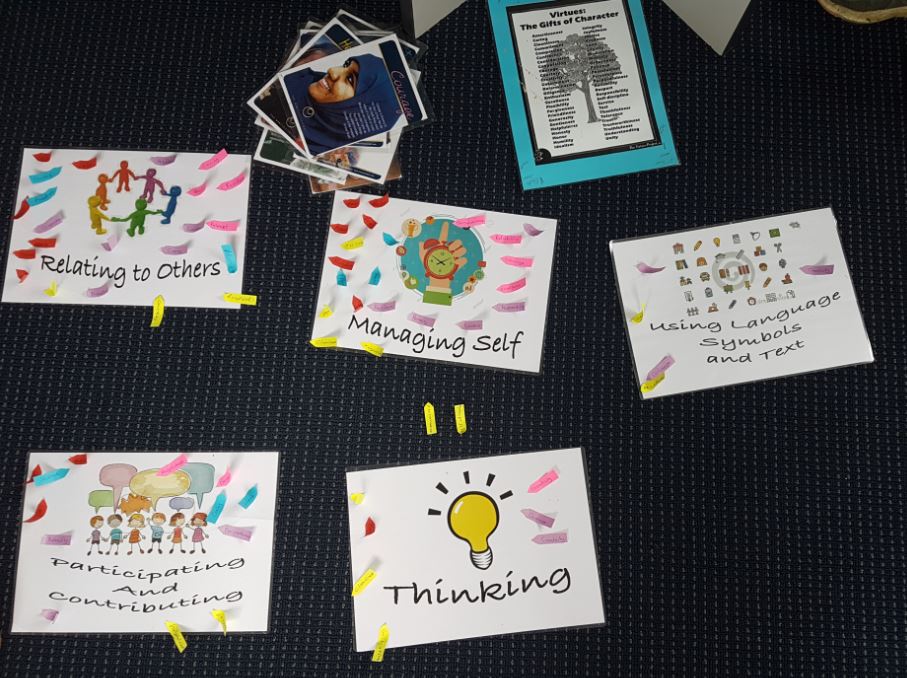
As a staff we looked into prioritising the daily use of our 20 school Virtues in a natural and meaningful / contextual way. Therefore we decided to 'unpack' the Key Competencies and linking them with our school Virtues.

In past years we have been weaving the Key Competencies and Virtues into the planning of learning experiences, but now we are reflecting on how we could / would make this work better for our students and how this could help them with their reflections on learning outcomes.

As stated "The key competencies element of The New Zealand Curriculum brings with it exciting possibilities for making students’ experience of learning more relevant, engaging, meaningful, and useful. Key competencies-rich programmes will enable students to be confident, connected, actively involved learners in the present and in the future. They will encourage lifelong learners who are equipped to participate in rapidly changing local, national, and global communities." (NZ Curriculum Online, 2014)


Why do key competencies matter?
Constant change in the nature of work and technologies means that learning is a life long pursuit and students should be taught to think, to work collaboratively, to be creative and to discover. The key competencies support this and brings with them a future-focused outlook to teaching and learning, where students are at the centre.

Some things to ponder...
- Skills required 'today' is not being taught in today's schools
- Think about how many students might finish school without knowing their potential...


References:
NZ Curriculum Online (2014). TKI - Culture / Leadership and the key competencies


~ 'Thinking': "We can't solve problems by using the same kind of thingking we used when we created them" - Albert Einstein ~
~ 'Participating and Contributing': "Alone we can do so little, together we can do so much." - Helen Keller ~
~ 'Relating to Others': "Always put yourself in the other's shoes. If you feel it hurts you, it probably hurts the person too." - Rachel Grady ~
~ 'Understanding Language, Symbols and Texts': "The more you read, the more things you know. The more that you learn the more places you'll go." - Dr Seuss ~
~ 'Managing Self': "The moment you take responsibility for everything in your life is the moment you can change anything in your life." - Hal Elrod ~

Monday, January 29, 2018

'Teaching in the Rain"

"Learn and grow from the drizzle, surround yourself with a support system to help you through the downpour, and remember that there is beauty to be found once the rain has passed." -  Chuck Poole


Listen to the Podcast: Teaching in the Rain

Monday, January 22, 2018

Walking on a tightrope


DO...
  1. Get-up-and-Go (be determined and full of energy) 
  2. Stop and celebrate [even little] Successes 
  3. Look after myself (no school work after 6.00 pm)
  4. Continue DOing [something] despite difficulties (stick-to-it-iveness) 
  5. Do what I believe to be best for ALL my students as they are my number one priority 
  6. In my role as Assistant Principal and ICT Lead, I will take the 'bad days' in stride and remember that I get to start fresh tomorrow 
  7. Blog more regularly
I will DO more of what I like to regain my energy and to be successful.

For me, 2018 would be like walking on a tightrope... balancing and keeping my eyes to a fixed and un-moving point at the far end of the wire, not to say that I won't take my eyes of that point... but if I do loose my 'balance/focus' for any reason whatsoever, I will return my vision to 'that point/my goal' to regain my balance. And if I get tired walking on the rope, I will stop and take a minute to catch my breath again. If I fall, I will pick myself up and although falling hurts, I will remember that 'the show must go on' and the only thing that I can do to get myself back on the tightrope is to get focused on that point and continue on.

The un-moving point will be my DO 'one word' and if I persevere, not give up and hang in there, I will accomplish the almost impossible this year...


~ "Critics risk nothing. It's the creators who must face the vulnerability of failure with the possibility of success." - Justin Dillon ~